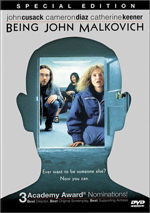
Being John Malkovich appears in an aspect ratio of approximately 1.85:1 on this single-sided, double-layered DVD; the image has been enhanced for 16X9 televisions. This wasn’t an atrocious presentation, but it had a bunch of problems.
Sharpness was decent at best. Close-ups looked fairly accurate, but anything wider tended to be tentative and mediocre. Prominent edge haloes exacerbated this issue, though I saw no issues with jaggies or shimmering. The image didn’t suffer from tons of source flaws, but I noticed occasional specks.
Colors tended top be flat. Some of this appeared to reflect the film’s production design, but I still felt the hues looked duller and less vibrant than they should’ve. Blacks were drab and inky, while shadows tended to seem too thick and opaque. This ended up as a disappointing presentation.
I felt more satisfied with the film's Dolby Digital 5.1 soundtrack. It provided a fairly broad and rich audio environment that presented effective information from all sides. This didn't seem to be the kind of project that would lend itself to a wide surround presentation, but the sound designers made the environment realistic and effective. The audio seemed well-placed and nicely localized, and it remained natural at all times; the gimmicks used are appropriate but not overdone.
The quality also seemed fine. Dialogue appeared natural and warm and was consistently intelligible. The music was pretty smooth and deep and displayed good dynamic range, while effects were clear and realistic. All in all, the audio complimented the film.
Being tosses in a few interesting supplemental features. Like the film itself, there are some rather unusual choices available. Included are some of the materials partially displayed in the film itself. We find 7 ˝ Floor Orientation at about two minutes and 10 seconds and American Arts & Culture Presents: John Horatio Malkovich, Dance of Despair and Disillusionment which runs for four minutes and 15 seconds. As with the film itself, the less said about these, the better; to simply discuss them would be to reveal too much of the story. In any case, they're somewhat superfluous - we see virtually all they have to offer during the film itself - but make for nice additions nonetheless.
As I watched some of the other supplements, I got the distinct impression that folks such as myself - those of us who get off on the behind the scenes minutiae found in DVD extras - were being mocked. The kinds of contents and their presentation tend to be overly-somber and portentous.
Well, at least we're not the only ones at whom they're laughing. An Intimate Portrait of the Art of Puppeteering provides a look at Phil Huber, the guy who manipulated all of the puppets in Being. This segment runs for about seven minutes and walks a very fine line between sincere tribute and barely-concealed lampooning. It's cool to learn a little more detail about the techniques; I could have lived without the somewhat smarmy tone, though the latter isn't as nasty as it could have been.
A more clear-cut case of mockery occurs during An Intimate Portrait of the Art of Background Driving, a piece that goes for six minutes and 20 seconds. It focuses on that most obscure facet of extra acting, the background drivers, those people who have to motor by in the background of street scenes. We sit in the car of an unnamed driver who rambles about God knows what in a rather "Valley girl" manner. It's an odd piece, but strangely entertaining.
This year's truth in advertising award goes to Don't Enter Here - There Is Nothing Here, a feature aimed at teasing the Easter egg hunting geek in all of us. No prizes to anyone who guesses what they find when they click this link.
Also typically bizarre is An Interview with Director Spike Jonze. This provides two and a half minutes of essentially nothing - an interviewer asks Spike questions as they drive around but Jonze essentially only stammers in response and eventually he pukes. I admit I found this strangely amusing, but I can't imagine it's something I'll want to watch again.
A few other supplements round out the collection. Spike's Photo Album provides 30 images of the cast and crew; they're pretty decent and deserve a look. We also find the theatrical trailer and some excellent TV spots; best of the bunch is the one that treats the promo as if it were an ad for a cheesy service.
Finally, Cast and Filmmakers provides fairly good biographies for Jonze, actors John Cusack, Cameron Diaz, Catherine Keener, John Malkovich, Orson Bean and Mary Kay Place, and screenwriter/executive producer Charlie Kaufman appear. It's certainly not a great collection of extras, but it's different.
As is the movie they serve. Being John Malkovich isn't the best movie I've ever seen, but it's one of the most unusual, and it's also awfully compelling. The DVD comes with decent supplements and good audio but suffers from problematic visuals. I like the flick but find the DVD to be a disappointment due to the weak picture quality.
To rate this film, visit the Blu-Ray review of BEING JOHN MALKOVICH