Reviewed by Colin Jacobson (November 6, 2025)
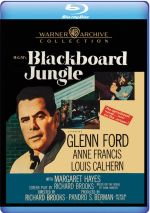
In 1955, Rebel Without a Cause delivered a classic tale of troubled teens. Though not quite as famous, the same year’s Blackboard Jungle took on the same topic.
Military veteran Rick Dadier (Glenn Ford) embarks on a new career as an educator. He lands a gig as an English teacher at inner city North Manual High School.
Rick finds a major lack of discipline at North Manual, as the students intimidate the professionals. Rick tries to alter this atmosphere, efforts that come with various ramifications.
More than 70 years after its release, Jungle remains remembered mostly for its cultural impact at the time. The film used “Rock Around the Clock” from Bill Haley and His Comets as its theme, a choice that did a lot to make rock ‘n’ roll mainstream.
Viewed as controversial at the time, Jungle also inspired riots at some theaters. The film even got banned in some places as a “bad influence”.
In addition, Jungle boasts a number of soon-to-be-famous actors in early roles. We find Sidney Poitier, Richard Kiley, Vic Morrow and Jamie Farr as well as Paul Mazursky, a castmember who’d later enjoy success as a director.
All of this makes Jungle noteworthy as a historical artifact. Does it work as a movie in 2026, though?
To some degree, and better than I expected, honestly. Usually the depiction of “bad kids” from the 1950s depicts them in a way that looks quaint from the perspective of 2026.
The “hoodlums” of that era tend to seem mildly sassy at most. That doesn’t become the case with the students of Jungle.
Instead, these teens offer a genuine threat to society. For instance, they drive through the streets in ways that endanger lives, one attempts to rape teacher Lois Hammond (Margaret Hayes), and delinquents beat the crap out of Rick and fellow instructor Joshua Edwards (Richard Kiley).
That said, the film doesn’t depict the kids as unteachable/intolerable on a constant basis. It throws out some genuinely disturbing behaviors at times but shows them in a more moderate light much of the time.
Still, given my suspicion that the students’ “incorrigible nature” would seem decidedly tame these days, I felt pleased that they showed some threat. This allows Jungle to become more relatable in 2026 than I anticipated.
Well, relatable to a degree. While Jungle provides more violence and menace than I anticipated, it leans too melodramatic to feel like a film that depicts something akin to “real life”.
More than a little of that comes from a subplot that involves Rick’s wife Anne (Anne Francis). To sabotage Rick, troublemaking Artie West (Morrow) sends her anonymous messages that claim Rick cheats with Lois.
This makes Anne jealous and potentially sabotages her pregnancy. These elements feel superfluous and I wonder if they exist more to give second-billed Francis more screen time, as her character doesn’t show up much otherwise.
Jungle also takes an unusual approach to the “inspirational teacher” genre in that Rick doesn’t really seem all that good at his job. Yeah, he finds a way to connect with most of his students, but he doesn’t deliver in the way we usually see.
Instead, Rick wears down the kids because he literally takes a punch and won’t quit. Normally the instructor discovers unconventional ways to bond but here Rick succeeds mainly due to perseverance.
Which seems fine, I guess, though “get the stuffing knocked out of you long enough and you’ll succeed” doesn’t feel like a good model for most teachers. Still, it works fine in the end.
The good cast does well enough in their roles. Morrow grants Artie a sense of real menace, and Poitier brings his usual intelligence and just enough insouciance to make Gregory fit the film.
At 27 and 29, Morrow and Poitier were both far too old for their parts. Still, I could suspend disbelief because they offered such good performances.
Ford seems a bit dodgier as Rick, mainly because he leans into overacting on occasion. Still, he delivers a perfectly acceptable turn, and the remaining actors hold up nicely as well.
Jungle does show its age in a mix of ways, but it nonetheless proves mostly compelling. Though it never threatens to bring us a great film, it offers lively melodrama.
Footnote: it seems amusing to realize that Poitier would play his own put-upon educator barely a decade a later via 1967’s To Sir, with Love. Though 12 years “newer” than Jungle, that film actually seems more quaint and dated, mainly because its “rebellious youths” come across as much more tame than the delinquents of Jungle.