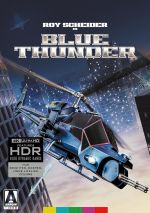
Blue Thunder appears in an aspect ratio of approximately 2.40:1 on this 4K UHD Disc. The Dolby Vision transfer seemed very good.
Sharpness looked solid. A few low-light scenes came with mild softness, but these remained modest, so the film usually boasted appealing delineation.
The movie displayed no concerns related to moiré effects or jagged edges, and I saw no edge haloes. Grain felt appropriate and I saw no print flaws.
Colors seemed strong, as the movie featured a fairly natural palette that demonstrated quite a few attractive tones. The hues consistently appeared concise and vivid, with a boost from HDR.
Blacks felt deep and tight, while low-light shots appeared fairly smooth and clear. This wound up as a satisfying rendition of the film.
Similar positives greeted the DTS-HD MA 5.1 soundtrack of Blue Thunder. My criticisms connected to the quality of the audio.
Most of the time the mix sounded very good, but a few concerns interfered. Speech showed a little edginess, though the lines consistently remained intelligible and usually demonstrated good clarity.
Effects were reasonably robust, though distortion came with some of the louder elements like explosions and gunfire. Music seemed fine, as the score presented nice definition. Bass response varied but we occasionally got strong low-end, especially when we heard the helicopters.
The soundfield seemed very good for a movie from 1983. The action sequences fared the best, especially since they used the choppers well.
Helicopters flew about the room with smoothness and precision, and other combat elements opened up matters well. The score showed nice stereo imaging, and the whole thing used the surrounds to good effect.
The back speakers kicked into action frequently and formed an active partnership with the front. The track seemed a little too distorted for an “A”-level mark, but I remained impressed with it.
How did the 4K UHD compare to the Blu-ray from 2009? Though it went with DTS-HD MA 5.1 instead of the BD’s Dolby TrueHD 5.1, I felt the two soundtracks seemed virtually identical.
The UHD’s Dolby Vision image came with the expected improvements in terms of colors, blacks and delineation, though the superior resolution revealed some slightly soft shots less apparent on the BD. Nonetheless, the UHD turned into an appealing upgrade.
The Arrow 4K UHD includes old and new extras, and we begin with an audio commentary from director John Badham, editor Frank Morriss, and motion control supervisor Hoyt Yeatman. Badham and Morriss sit together for a running, screen-specific discussion whereas Yeatman joins them at about the 58-minute mark.
The commentary covers the requisite topics. Badham dominates as we learn about the cast, the story and its development, stunts and action sequences, sets and locations, photographic choices and challenges, and filming the helicopter shots.
We get many technical notes related to the chopper scenes, and these prove pretty informative. We also find a few nice anecdotes such as when we find out that Malcolm McDowell was terrified of flying.
At its best, the commentary gives us decent rudiments related to the production. Unfortunately, there’s not a lot of depth on display, and the track suffers from an awful lot of gaps.
The dead air often dominates the piece. Though it improves in its final act, this remains a moderately useful program that loses points due to frustrating elements.
Next comes a featurette entitled ”The Special”: Building Blue Thunder. This eight-minute, 13-second program presents info from Badham, visual consultant Philip Harrison, and art director Sydney Z. Litwack,
They discuss the design and assembly of the flick’s star helicopter. Subjects include research and various component choices. The show offers a solid overview of the topics and proves nicely illuminating.
After this we locate a three-part documentary called Ride With the Angels: Making Blue Thunder. Taken together, the three segments fill a total of 44 minutes, 45 seconds.
They include notes from Badham, Harrison, Morriss, Yeatman, Litwack, writer Dan O’Bannon, and actor Roy Scheider, “Angels” starts with “Pre-Production” and looks at the project’s genesis and development, differences between the original script/characters and the final result, cooperation with the LA Helicopter Division, casting, and storyboarding.
“Production” examines shooting the aerial and action sequences, photographic choices, and visual effects. Finally, “Post-Production” examines editing and deleted scenes, reactions to the flick and studio pressures, and final thoughts.
The only real negative connected to this documentary stems from the small roster of participants. I’d like to hear from more people, especially since only Scheider represents the actors.
Nonetheless, it offers quite a few useful notes. Some of these inevitably repeat from the commentary, but we get plenty of fresh material. The program gives us a tight little piece that covers the flick well.
A 1983 Promotional Featurette lasts eight minutes, 26 seconds. It features Badham, and Scheider shot on the film’s sets.
The piece looks at story and character basics as well as some aerial elements. We get a couple other notes like Scheider’s research and Badham’s interest in the movie.
We also find decent footage from the set. This remains a long advertisement, though, so don’t expect much from it.
The Arrow release comes with three new video programs. The first of these, Flight Risk runs 13 minutes, 45 seconds and provides a 2025 interview with Badham.
The filmmaker tells us about what brought him to the film, shooting in LA, casting, music, influences, and technology since 1983. Some repetition from the commentary appears but Badham delivers a generally interesting overview.
A Rollercoaster Ride lasts 12 minutes, 41 seconds. Also from 2025, it involves actor Candy Clark.
She discusses how she became part of the cast, her character and performance, working with Badham compared to other directors, and experiences during the shoot. Clark offers a good collection of insights.
Finally, Catching Up fills 13 minutes, 32 seconds. Another 2025 reel, it brings comments from actor Malcolm McDowell.
He covers what drew him to the project as well as his character and performance, his co-stars, memories of the shoot and how the movie holds up in current day. Like Clark, McDowell brings us plenty of solid notes.
An Extended Scene occupies one minute, 29 seconds and expands a car chase sequence. In some non-US locations, this segment came as part of the released film.
With such a brief running time, we don’t get much in terms of extensions. The clip also goes with a cropped 1.33:1 ratio and seems sourced from a videotape.
In addition to the trailer for Blue Thunder, we get an Image Gallery with a mere 14 shots from the film. It brings little of interest.
Blue Thunder disappointed me when I was 16, and I don’t think more highly of it at 58. The movie boasts a lot of potential but lacks coherence and excitement too much of the time. The 4K UHD offers positive picture and audio along with a mix of supplements. Although I don’t think a lot of the film, I can’t complain about this solid 4K UHD release.