|
COLUMBIA TRISTAR
|
| |
|
MOVIE INFO
|
|
Director:
Stephen T. Kay
Cast:
Barry Watson, Emily Deschanel, Skye McCole Bartusiak, Lucy Lawless, Tory Mussett, Robyn Malcolm, Charles Mesure, Aaron Murphy, Louise Wallace, Michael Saccente
Writing Credits:
Eric Kripke, Juliet Snowden, Stiles White
Tagline:
You thought it was a just a story ... but it's real.
Synopsis:
Every culture has one - the horrible monster fueling young children's nightmares. But for Tim, the Boogeyman still lives in his memories as a creature that devoured his father 16 years earlier. Is the Boogeyman real? Or did Tim make him up to explain why his father abandoned his family? The answer lies hidden behind every dark corner and half-opened closet of his childhood home - a place he must return to and face the chilling unanswered question does the Boogeyman really exist?
Box Office:
Budget
$20 million.
Opening Weekend
$19.020 million on 3052 screens.
Domestic Gross
$46.363 million.
MPAA:
Rated PG-13
| |
|
DVD DETAILS
|
Presentation:
Widescreen 1.85:1/16x9
Audio:
English Dolby Digital 5.1
French Dolby Digital 5.1
Subtitles:
English
French
Chinese
Closed-captioned
Runtime: 89 min.
Price: $28.95
Release Date: 5/31/2005
Bonus:
• “The Making of Boogeyman” Documentary
• Deleted Scenes and Alternate Ending
• Animatics
• Visual Effects Progressions
• Previews
| |
|
PURCHASE @ AMAZON.COM
|

| |
|
EQUIPMENT
|
Sony 36" WEGA KV-36FS12 Monitor; Sony DA333ES Processor/Receiver; Panasonic CV-50 DVD Player using component outputs; Michael Green Revolution Cinema 6i Speakers (all five); Sony SA-WM40 Subwoofer.
| |
[an error occurred while processing this directive]
|
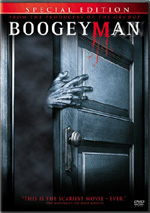
Boogeyman: Special Edition (2005)
|
|
Reviewed by Colin Jacobson (May 31, 2005)
In an attempt to generate higher box office revenues, many modern horror films shy away from the usual “R” ratings and instead seek the tamer “PG-13”. It still surprises me to find that flicks like The Grudge and The Ring come with the less restrictive rating, but I guess it shouldn’t.
Still, I just think there’s something wrong with “PG-13” horror flicks. So far audiences don’t seem to mind, as efforts like Grudge and Ring have done awfully well, but I think eventually the lowered level of freedom will harm the genre.
Add Boogeyman to the list of “PG-13” horror flicks, though it’s not one that threatened the success of The Grudge and The Ring. Still, a $46 million gross for a cheap flick like this ain’t bad, and it seems likely to spawn a sequel or 12.
Many kids fear that the boogeyman lives in their closets. As it happens, eight-year-old Tim (Aaron Murphy) apparently is right, and the monster captures his dad (Charles Mesure). The film then leaps ahead 15 years to find Tim (Barry Watson) as a young magazine associate editor who dates Jessica (Tory Mussett) from the art department. They’re about to head to her home for Thanksgiving and Tim’s first meeting with her parents.
His childhood experiences leave Tim scarred. He maintains a fear of closets and also freaks when unknown figures emerge from the dark, even when very rational explanations exist. We also learn that he doesn’t have much contact with his family even though his mother’s (Lucy Lawless) not doing well.
Over the Thanksgiving break, Tim has a horrific dream about his mom and then immediately learns of her demise. He decides to face his demons and spend some time in the old family home where he last saw his dad. While there, he flashes back to childhood experiences and remembers the rough times when his parents bickered as well as his dad’s attempts to force the boy to conquer his fears. Tim also re-encounters Katie (Emily Deschanel), a childhood friend.
Tim also meets a young girl named Franny (Skye McCole Bartusiak) who wants to find out about his childhood experiences. She wants to know about his alleged boogeyman encounter for reasons we later learn. The rest of the movie follows Tim’s attempts to deal with his past and issues that persist in the present. Of course, the latter deals with whether or not he really met the boogeyman.
As I sat down to watch Boogeyman, I didn’t look forward to it. I’m not a big horror fan, and I’d heard few positive comments about it. Frankly, I’m not sure why I decided to give it a look in the first place.
While I can’t say I’m overwhelmingly pleased that I did screen Boogeyman, I can definitely relate that the flick worked better than I anticipated. A whole lot better, as a matter of fact, as it usually stayed away from many of the traps I thought I’d encounter.
I guess I figured Boogeyman would be an obnoxious supernatural chop-‘em-up in the vein of Candyman or similar efforts. Aren’t most of those films interchangeable? You get your unstoppable killing machine and his prey with little to differentiate them other than their backstories.
To my surprise, Boogeyman avoided that trend. Really, the vast majority of it falls under the heading of psychological thriller. Though the opening sequence leads us to accept the existence of a real boogeyman - as does our expectations for a film of that title - much of the remaining movie does its best to play with our heads. As it progresses, we continually question how many of Tim’s fears are real and how many relate to his own issues. Did the boogeyman take his dad or did his old man simply abandon the family?
Again, given the way this genre works, the answer probably won’t surprise you, but the manner in which the flick keeps us guessing will. Yes, the movie eventually reveals whether or not the boogeyman was involved, but this doesn’t occur well into the film’s third act. Up to that point, the story consistently toys with us and subverts our expectations.
Oh, that third act. It’s the only real disappointment about Boogeyman, as the story finally embraces predictability and inanity. The film degenerates into a loud fright-fest and suffers from some of the worst CG I’ve seen in years. The climax falters so badly that it almost ruins the effectiveness of the prior 75 minutes.
Almost, but not quite. When Boogeyman succeeds, it does so in a truly effective manner. A lot of the credit goes to Barry Watson’s startlingly strong lead performance as Tim. Watson really digs into the character’s head and gives a full-blooded piece of work. He conveys Tim’s psychological issues and dilemmas but avoids the usual tics and gimmicks. Tim’s clearly got some problems, but he’s not a simple nut either. He appears in almost every scene, and Watson ensures that the film delves more deeply into its themes than anticipated.
Sure, Boogeyman resorts to too many cheesy scares, and we see almost all of these in advance. Sure, the climax degenerates into cheesiness. Nonetheless, it manages to paint a strong psychological portrait of its lead character and keeps us in suspense much longer than usual. Despite a mix of flaws, Boogeyman stands out as better than average for its genre.
Footnote: stick around through the conclusion of the end credits for a little extra creepiness - and a potential lead-in for a sequel.
|
The DVD Grades: Picture B/ Audio A-/ Bonus C+
|
|
Boogeyman appears in an aspect ratio of approximately 1.85:1 on this single-sided, double-layered DVD; the image has been enhanced for 16X9 televisions. Not a great transfer but not a poor one, Boogeyman came across as perfectly acceptable.
Sharpness was generally fine. Some slight examples of softness occasionally interfered with wider shots, but those instances stayed minor. The majority of the movie came across as distinctive and concise. I saw no jagged edges or moiré effects, but some mild edge enhancement created a few haloes. Print flaws didn’t manifest themselves, though the movie’s darkness led to more grain than normal.
Supernatural horror flicks don’t lend themselves to bright palettes, and Boogeyman followed the kind of drab look one would expect. A cold tone affected the vast majority of the film, as almost no even mildly bright colors emerged. Overall, we got a chilly, unsaturated look that the DVD replicated well.
Blacks were sufficiently deep and dense, but shadows tended to be slightly heavy. This became something of a problem since so many low-light shots appeared. I expect that some of this stemmed from visual design choices, but I still found the denseness of these shots to became a minor distraction. Ultimately, Boogeyman presented a good but unexceptional transfer.
As one might expect from this sort of spooky flick, the Dolby Digital 5.1 soundtrack of Boogeyman mostly concentrated on general ambience. However, its supernatural bent meant that those aspects of the mix were decidedly more active than usual, and they resulted in a surprisingly effective track. The audio conveyed the desired creepiness quite well. Houses creaked and voices whispered all around us, and these pieces made things involving. The action sequences cranked matters up a notch and created real life. The whole film used all five channels to put us in the eerie action and I felt impressed with the way it worked.
Audio quality was positive. Speech consistently sounded natural and crisp, with no problems connected to intelligibility or edginess. Music was smooth and vibrant, as the score presented well-rendered tones. Effects clear and accurate. Bass response added a lot of pop throughout the flick, as low-end was nicely deep and firm. All this added up to a very strong mix that made the movie more impressive than I anticipated.
A mix of extras rounds out the DVD. The main attraction comes from the two-part documentary The Making of Boogeyman. Taken together, the two segments fill 34 minutes and 40 seconds. They include movie snippets, production elements, and comments from producer Rob Tapert, director Stephen Kay, and actors Barry Watson, Lucy Lawless, Skye McCole Bartusiak, Tory Mussett, and Emily Deschanel. The program follows the production’s genesis and route to the screen, how Kay came onto the project, the story and its themes, the participants’ childhood fears and the movie’s villain, the filmmakers’ approach to the subject and the influence of Japanese horror, the movie’s visuals and cinematography, set design, and casting and working on the set.
“Making” suffers from a bland presentation and an erratic path through the production. It depicts its information in a basic manner without any flair and fails to move things along in a brisk manner. That makes it plodding at times, though it contains a reasonable amount of good material. We get a decent overview of the production and related topics, so although the slow pace almost made me nod off, it featured enough useful data to merit a look. Note that the first half works significantly better, as the second segment often degenerates into praise for the actors and generic character notes.
Six Deleted Scenes last a total of 12 minutes and 44 seconds. Most consist of minor bits and don’t really go anywhere, but a couple good ones appear. For example, we get a flashback that shows how Tim’s mom disintegrated emotionally after her husband’s disappearance. We also get a five-minute and 57-second Alternate Ending. It doesn’t seem worse than the actual conclusion, but it doesn’t work better either.
Animatics lets us look at planning pieces for three scenes. We can check out “Opening Sequence” (three minutes, 51 seconds), “Missing Children” (1:09), and “Climax” (4:21). These consist of filmed storyboards accompanied by some audio elements. They give us a good look at the evolution of the shots and are interesting to see.
More behind the scenes bits show up in the Visual Effects Progressions. These cover four sequences: “Bathtub” (48 seconds). “Plastic Wrap” (0:44), “’What Are You Doing?’” (0:53) and “Climax” (2:02). These show the various elements used to make up the effects shots and provide a cool view of the different parts, most of which relate to the integration of the Boogeyman himself.
Lastly, the DVD includes some Previews. This area presents ads for Guess Who, DEBS, Man of the House, The Grudge, The Forgotten, Anacondas: The Hunt for the Blood Orchid, The Cave, Lords of Dogtown and Stealth. Oddly, the trailer for Boogeyman fails to appear.
While I didn’t expect much from Boogeyman, I found the movie to offer a pleasant surprise. It suffers from a mix of problems, most of which surface during its lame climax. Nonetheless, the majority of the flick provides a relatively deep piece of psychological terror. The DVD offers decent picture with excellent sound and a few decent extras highlighted by a collection of deleted footage. I don’t think Boogeyman is good enough as either a movie or a DVD to push for a purchase, but it works well enough to earn a rental.
|
|
[an error occurred while processing this directive]
|
|