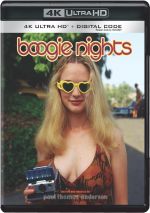
Boogie Nights appears in an aspect ratio of approximately 2.40:1 on this 4K UHD Disc. Across the board, this was a satisfying presentation.
Overall sharpness was solid. A smidgen of softness appeared occasionally due to the photographic choices, but that was negligible and the movie usually offered positive delineation and accuracy.
No issues with jaggies or shimmering materialized, and edge haloes remained absent. We got a nice layer of grain and print flaws failed to manifest.
Colors proved to be a highlight of Nights. With its 1970s setting, the flick opted for loud, borderline garish tones, and the disc reproduced them with fine fidelity.
The 1980s scenes – which take up about half of the story – seemed colder, but they’re still presented in an appropriate manner. HDR added punch to the tones.
Blacks appeared dark and deep, while low-light shots seemed smooth and well-defined. Whites and contrast got a boost from HDR. All in all, I felt pleased with the image and thought it accurately replicated the source.
Though not as good, the film’s DTS-HD MA 5.1 soundtrack worked fine. The movie featured a soundfield oriented heavily toward the forward channels, where I heard excellent stereo separation for music, but general ambiance seemed less exciting.
The mix used the rear speakers mainly for some minor reinforcement of the front channels such as light applause during the award banquets. That was about it, however.
That said, I won’t complain about the mix because it fit the film. The soundscape probably could have benefited from a little extra breadth, but this wasn't a movie that required an explosive surround track.
Audio quality appeared strong, with dialogue that always came across as crisp and well-defined, with no edginess or concerns related to intelligibility. Effects appeared clear and realistic, and I noted no signs of distortion.
Although speech offered a major aspect of the film, I think music may actually be most important, as the mix of pop tunes and Michael Penn's score added a lot to the mood and pacing of the movie. Happily, the track reproduced the music with clear highs and some solid bass. The track as a whole worked well for the movie.
How did the 4K UHD compare to the Blu-ray from 2010? Audio switched from the BD's Dolby TrueHD to the UHD's DTS-HD MA but that meant tracks that sounded virtually identical.
The 4K's visuals came with the usual format-related improvements in terms of sharpness, colors and blacks, though the superior resolution actually made some of the image's softer spots more obvious. Nonetheless, the 4K UHD brought us a good upgrade.
We get a mix of old and new extras and we find two separate audio commentaries. The first appeared on the original 1998 DVD, and it comes from director Paul Thomas Anderson as he delivers a running, screen-specific look at the project’s origins and development, inspirations, influences and research, story/characters, cast and performances, music, editing, studio/ratings issues, and a mix of other domains.
When I first heard this commentary in the 1990s, I loved it. Years later, it seems less winning, but it still becomes a good chat.
The main problem stems from its looseness, as Anderson can be more than a little “stream of consciousness”. However, I enjoy his frankness and his willingness to avoid the usual commentary BS.
We learn quite a lot about the film, so this becomes a very good discussion. It’s just not as amazing as I used to believe.
Created for Criterion’s 1998 laserdisc, the second commentary features Anderson and actors Mark Wahlberg, Julianne Moore, Don Cheadle, Melora Walters, John C. Reilly, Luis Guzman, William H. Macy, and Heather Graham. That crew doesn’t sit together and watch the film, though, as the actors come and go along the way.
All include Anderson, and most sit alone with him. Macy and Graham come as a package, as do Cheadle and Reilly.
As with many Criterion commentaries, this one culls a big group of remarks and edits them into one coherent piece. Or semi-coherent, in this case, but it's amusingly sloppy.
This is one of the least straightforward commentaries I’ve heard, but it’s oddly entertaining. Anderson acts as a provocative moderator, as he pushes his cast to touch on semi-taboo subjects.
Did Graham get turned on by her nude scene? Did Wahlberg pop a boner during his sex sequences? Was Guzman sober during the shoot? And what about that fight between Wahlberg and Reilly?
No one will call this the most informative commentary ever, at least not in terms of the usual filmmaking facts. It also can veer into semi-incoherence at times, as its looseness becomes a minor distraction.
Nonetheless, it’s such a weird and unconventional look at the film that I like it. Amid the anecdotes and unusual insights, we learn more than enough about the movie to justify the commentary. This ends up as a fun piece.
10 Deleted Scenes occupy a total of 29 minutes, 32 seconds, and the vast majority of these offer extended versions of existing segments. For example, we see more of the van ride early in the movie, and there's also more "coke talk" among Reed, Dirk and Todd.
All of these snippets can be screened with their original audio or with commentary from Anderson, and they're fun either way. Anderson gives us notes about the scenes and also lets us know why he cut them. Anderson delivers useful material.
More cut scenes appear in The John C. Reilly Files, which offers 14 minutes, 45 seconds of outtakes. Not surprisingly, all of these bits feature Reilly.
“Swim Trunks” (3:11) expands upon the first meeting of Reed and Eddie. “Waiting for Todd” (2:42) shows more coked-out rambling from Reed.
“Mixing With Nick” (8:52) gives us additional shots of Reed interacting with Nick the sound engineer during Dirk's recording sessions. None of these are vital, but all are fun and worth a look.
We finish pre-existing extras with Michael Penn's Anderson-directed music video for "Try". It’s a solid piece and some cameos from Nights cast members add to the fun. Anderson also discusses the video during an optional commentary track.
New to the 4K UHD, we get two separate American Cinematheque panels. Night One (24:47) involves Anderson and Reilly, while Night Two (25:40) includes Anderson solo.
Well, "solo" including moderator Grant Moninger. The presentations discuss aspects of the Nights production with an emphasis on anecdotes for Night One and more nuts and bolts Night Two.
Both work well. Given all the prior discussions, we get some repetition here, but the two panels offer useful material.
Only one omission occurs: we lose the movie's trailer. Don't ask me why.
Boogie Nights remains a flawed masterpiece, but it's a gem nonetheless. I like this movie more every time I see it, although its problems seem impossible to ignore. The 4K UHD brings us positive picture and audio along with a solid collection of supplements. Even with its inconsistencies, Boogie Nights remains a classic.