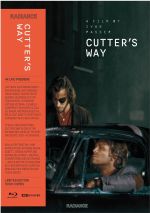
Cutter’s Way appears in an aspect ratio of 1.85:1 on this Blu-ray Disc. Way came with a largely appealing presentation.
For the most part, sharpness worked fine. A little softness impacted the occasional interior, but these instances remained modest and non-intrusive.
No signs of jagged edges or moiré effect appeared, and I saw no edge haloes. With a natural layer of grain, the image didn’t seem to suffer from egregious noise reduction techniques, and print flaws became a non-factor.
Colors opted for a lean toward the brown/amber side of things. When given the chance, the hues felt reasonably vivid and they always worked fine given the movie’s choices.
Blacks appeared pretty deep and dense, while shadows offered appropriate clarity. This was a nice rendition of the film.
One shouldn’t expect much from the DTS-HD MA monaural soundtrack of Way. The flick offered a fairly chatty experience, and dialogue dominated the film.
Music became a moderate factor and effects usually played an environmental factor. A few scenes became louder, but the majority of the movie stuck with ambience.
Audio quality appeared acceptable given its age. Speech felt a little stiff but the lines remained intelligible and usually seemed fairly natural, with only a smidgen of edginess at times.
The score appeared reasonably full, while effects replicated the source well enough. The soundtrack worked fine given the movie’s age and ambitions.
This set comes with a bunch of extras, and we find three separate audio commentaries. The first comes from novelist Matthew Specktor, as he offers a running, screen-specific look at the source novel and its adaptation, cast and performances, sets and locations, story/characters, and related elements.
At times Specktor provides some useful material, but too much of the track turns into a basic appreciation for the movie or just narration of on-screen events. Add to that the fact Specktor goes MIA a little too often and this becomes a spotty piece.
Next we get a commentary from Assistant Director Larry Franco and Unit Production Manager Barrie Osborne. Along with moderator Gillian Horvath, they sit together for a running, screen-specific look at cast and crew, production details and memories of the shoot.
With Horvath there to fill in basic film historian-style notes, this becomes a pretty solid experience. We get a good mix of movie facts and interesting anecdotes.
Finally, we locate a commentary from film historians Julie Kirgo and Nick Redman. They provide their own running, screen-specific view of story and characters, themes and interpretation, cast and crew, genre domains and their thoughts about the film.
Like Specktor, Redman and Kirgo occasionally make this track fall into “appreciation” territory. However, they do so in a more introspective manner and rely less on basic praise.
Inevitably, some of the production and cast/crew notes also appear elsewhere. Still, Kirgo and Redman give us a pretty good mix of critical POV and filmmaking notes.
In addition to these commentaries, the disc includes an Isolated Score Track. It presents Jack Nitzsche‘s music in stereo and sounds surprisingly good.
We can watch the movie with or without a circa 2022 Jeff Bridges Introduction (5:42). He offers some memories of the production in this moderately enjoyable piece. Note that the intro also appears under “Jeff Bridges” in the disc’s “Special Features” area.
The film also comes with an option to view it with its original title sequence that called the project Cutter and Bone. This turns into a minor variation.
A bunch of video programs ensue, and Piety, Patriotism and Violence goes for 41 minutes, 43 seconds. It involves writers Megan Abbott, Jordan Harper and George Pelecanos.
“Piety” looks at the source novel and its adaptation, genre domains, novelist Newton Thornburg, and their thoughts about the film. I don't know if they give us enough useful content to fill nearly 42 minutes, but we do find some insights along the way.
A mix of interviews follow, and the first comes from director Ivan Passer. Shot in 2020, it lasts 37 minutes, 43 seconds.
Passer examines how he came to the project, casting, story/characters, crew, sets and locations, cinematography, the movie's release/legacy and aspects of his life/career. While we get more than a few notes heard previously, Passer fleshes these out with some new elements as well.
A chat with actor Lisa Eichhorn follows. Recorded in 2022, it spans 38 minutes, 53 seconds.
Eichhorn tells us about her life and career prior to Cutter's Way before she digs into that film in detail. Eichhorn brings lots of info not found elsewhere and makes this a very good chat.
Next we hear from producer Paul Gurian. Also taped in 2022, this reel runs 26 minutes, 21 seconds.
During our time with Gurian, he discusses the novel's journey to the screen along with other production elements. Some of this repeats from other extras but Gurian delivers a largely fresh take on the behind the scenes wheedling needed to get the project into motion.
The next interview comes from former United Artists executive Ira Deutchman. Another circa 2022 piece, it occupies 11 minutes, 17 seconds.
Deutchman relays a look at the production of Way from the studio's POV and other notes about UA in the era He gives us an informative take on this side of the shoot.
Inside the Score fills 11 minutes, 55 seconds. It brings us remarks from music editor Curt Sobel.
We learn about the movie's composer and the score. Expect a good look at this topic.
For the final featurette, we get an appreciation from filmmaker Bernard Tavernier. This reel runs 26 minutes, 27 seconds.
Tavernier discusses his thoughts about Way. I don't think we needed another appreciation because two of the three commentaries but at least Tavernier gives us this view from the perspective of an accomplished director.
In addition to the film’s trailer, we locate a gallery with 24 frames that mix ads and shots from the movie. It becomes a mediocre compilation.
This limited edition set concludes with a Collector’s Book that includes credits, photos, three essays and a 1989 interview with Passer. This gives us a fine complement to the disc.
An unusual riff on film noir, Cutter’s Way becomes a complex character piece. Less a ‘whodunnit’ and more a tale of obsession, it becomes a deep and involving project. The Blu-ray boasts very good visuals, acceptable audio and a long collection of supplements. This becomes a quality release for a strong movie.
Note that this Blu-ray edition of Cutter’s Way can be purchased only as part of a two-disc set with a 4K UHD version of the film. Way received prior BD releases but this appears to provide a new scan of the movie.