Reviewed by Colin Jacobson (April 22, 2026)
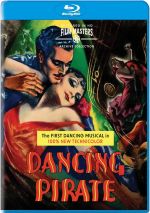
Supposedly 1936’s The Dancing Pirate offered the first movie musical to shoot completely in three-strip Technicolor. Does the film boast any appeal beyond this historical value? Read on and see.
Boston resident Jonathan Pride (Charles Collins) finds himself tricked into membership on a pirate ship. This eventually leads Jonathan to California, where he winds up sentenced to death.
However, before Mayor Don Emilio Perena (Frank Morgan) lets Jonathan hang, his daughter Serafina (Steffi Duna) intervenes and insists Jonathan’s execution wait until he teaches her to waltz. This leads Jonathan on a mix of adventures as he attempts to remain alive.
If you never heard of Charles Collins, join the club. Though he worked sporadically from 1932 to 1984, he never made a major mark in front of the camera. Indeed, Collins eventually shifted gears and worked as an agent instead.
I admit that I feel a bit surprised Hollywood didn’t push Collins toward stardom a bit harder, as he showed some talent. However, perhaps the studios thought he didn’t seem magnetic enough to merit much attention.
Given Pirate as evidence, I can’t claim Hollywood made a mistake. With a face that resembled a less handsome Errol Flynn and dancing talents that felt like a less skilled Fred Astaire, Collins comes across like a man who possessed talent but who lacked the “It Factor” to turn into a star.
That said, I find it tough to imagine Flynn and/or Astaire could’ve done much with the meager meal we find from Pirate. The movie throws a lot at the screen but little of it sticks.
Pirate offers a mix of genres, as it blends light adventure, comedy, music and dance into one package. Unfortunately, it never does much to succeed in any of these domains, as all feel vaguely competent but largely forgettable.
The story rarely makes a lick of sense, and neither the action scenes nor the production numbers allow us to ignore the silly “plot”. Pirate really does try to showcase Collins as an Astaire-in-Training, but he lacks the charm to accomplish this goal.
For instance, early in the film, we see Collins do a tap dance number as he extinguishes candles in a room. While Astaire probably would’ve brought charm and verve to the scene, Collins just feels pedestrian.
Again, I don’t want to place too much blame for the mediocrity of Pirate on Collins, as everything about the film comes across as forgettable. Even at a mere 79 minutes, the “story” gets stretched too thin, and I think the tale would’ve worked better as a 20-minute short.
Pirate never becomes a truly poor movie, but it also fails to find much to make it succeed. This becomes a wholly forgettable cinematic experience.