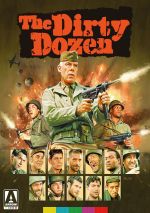
The Dirty Dozen appears in an aspect ratio of approximately 1.85:1 on this Blu-ray Dsic. The nature of the source left the image as a mixed bag but the BD represented it well.
Various process shots created problems, though sometimes the movie could seem somewhat soft for no logical reason. This meant the delineation lacked consistency, though most of the movie came with largely appealing definition.
No issues with jagged edges or shimmering occurred and I saw no edge haloes. Grain seemed heavy but appropriate and I detected no print flaws.
I expected a low-key palette from Dozen and got one, as the movie opted for a fairly earthy set of colors. These didn’t shine – partly due to all that grain – but they seemed generally positive.
Blacks felt acceptably dense and dark, and shadows seemed decent to good. Low-light shots suffered from only a little thickness and usually appeared acceptable. No one will use this presentation to show off their TVs but the end results gave us the film as shot.
Also erratic, the DTS-HD MA 5.1 soundtrack of The Dirty Dozen fared fine, and the score easily worked the best. The music showed good stereo imaging and sounded just great. The score was always bright and dynamic.
Other parts of the mix were less successful. Effects tended to lack clarity and the louder elements seemed a bit distorted.
Bass response was too strong for those aspects of the track. Low-end overwhelmed everything else during explosions, and bass was awfully boomy.
At least the effects boasted a decent soundstage. They cropped up on the sides in a reasonably involving way, and the surrounds contributed minor but useful reinforcement of the battle sequences.
Speech tended to be flat and dull. I always thought the lines remained intelligible and without edginess, but they came across as a bit limp. Overall, the audio was good when compared to other efforts of the film’s era, but the mix of flaws left it with a “B”.
The disc also included a DTS-HD MA 6.0 soundtrack that attempted to replicate the audio from the movie’s 70mm release. This came with sound quality similar to what I heard from the 5.1 mix.
However, the 6.0 version’s soundscape became much more aggressive and accentuated the back speakers much more heavily than anticipated. Indeed, I sometimes wondered if the front and back channels got swapped, as the rear domain seemed awfully prominent.
This made the 6.0 track more intense but less balanced. I preferred the more natural feel of the 5.1’s soundfield.
How did this 2026 Arrow Blu-ray compare with the original 2007 BD? The 2007 disc only came with lossy Dolby 5.1, so the 2026 platter’s lossless DTS-HD MA 5.1 became warmer and more dynamic, albeit with a similar soundfield. The 2007 disc lacked the DTS-HD MA 6.0 mix found here, though.
In terms of visuals, the Arrow release brought a cleaner presentation with stronger delineation and colors. The nature of the source meant the Arrow still came with inconsistencies but it reproduced the film better than its 2007 counterpart did.
On the movie disc, we open with an Introduction by Ernest Borgnine. In this three-minute, 30-second piece, the actor offers a few notes about the flick, its participants, its setting and sets, its reception and its legacy.
It includes some minor spoilers, which seems odd for an introduction. Borgnine provides a general overview of things in this fairly superfluous piece.
We get two audio commentaries, the first of which comes from actors Jim Brown, Trini Lopez, Stuart Cooper and Colin Maitland, producer Kenneth Hyman, original novelist EM Nathanson, film historian David J. Schow, and veteran military advisor Captain Dale Dye. It should come as no surprise to learn that all of them sat separately for this edited piece.
Dye starts the show with notes about his work in Hollywood as well as the military credentials enjoyed by Lee Marvin and Ernest Borgnine and how their backgrounds help their performances. Dye also pops up later in the piece to discuss the reality of how the movie uses prisoners and depicts the military, connections to the “Filthy Thirteen”, and general thoughts about the movie’s details.
After Dye, we hear from Schow as he provides historical notes. For the first parts, he reads from memos written by director Robert Aldrich. Among other subjects, these discuss efforts to update the story and make it fit with the attitudes of the mid-1960s.
The memos also cover topics like rough-cuts and shooting challenges. Later Schow chats with Nathanson as the pair discuss research and writing as well as his military experiences, the adaptation of the story and changes from the novel, and other related work by Nathanson.
Schow also acts as moderator to introduce comments from the four actors and Hyman. These get into things such as experiences on the set and interactions with the other actors. They offer a general view of the shoot from the various perspectives.
Because of all the different sources, the commentary can get choppy at times. However, it provides a nice mix of information and digs into the subjects well. At times it can feel a little promotional, as Nathanson advertises his books and Dye touts his consulting services. Nonetheless, we receive a strong feel for the production and its related concerns through this well-constructed piece.
Recorded for the Arrow release, a 2026 commentary comes from film historians Alain Silver and James Ursini. Both sit together for a running, screen-specific look at the source and its adaptation, director Robert Aldrich and other cast/crew, various production elements, the movie’s legacy and their thoughts about it.
Though sporadically screen-specific, Ursini and Silver mostly avoid topics directly related to what we see. This can lead them down some tangents.
Still, they give us a fair amount of good information, especially related to Aldrich. While an inconsistent – and occasionally frustrating – track, the commentary does enough to merit a listen.
In addition to the film’s trailer, the movie platter concludes with an image gallery that contains 233 stills. These mix shots from the set, publicity elements and some ads to become a pretty good compilation.
On a separate Blu-ray, we get more extras, and one big attraction comes from a bonus movie. 1985’s The Dirty Dozen: The Next Mission runs one hour, 35 minutes, 33 seconds and features Borgnine, Marvin, and Richard Jaeckel in the same roles they played in the original.
Next presents a new “Dirty Dozen” on a mission to kill a German general (Wolf Kahler). Why?
He may attempt to assassinate Hitler, and the Allies think this will actually elongate the war. Reisman trains his new group and leads them on their mission.
Through the film’s first half, it borders on remake territory. Those scenes greatly resemble ones found in the first flick; indeed, Next Mission includes much of the same dialogue and even lifts some shots from its predecessor! The second half manages to deviate from the formula, though not wildly so.
Although Next Mission isn’t painful to watch, it also fails to become a good film or a worthy follow-up to the original. The casting of Marvin, Borgnine and Jaeckel seems asinine.
I understand the desire to have actors continue in their roles, but Next Mission takes place three months after Dirty Dozen. Doesn’t it seem odd that three actors have aged 18 years in that span?
It sure doesn’t help that Marvin looks very weary here. He manages a little rugged toughness on a couple of occasions, but he doesn’t seem like the same vicious threat of the original movie.
In 1967, Marvin was a force with which to be reckoned. Here he seems more like a tired old man.
The lack of creativity dooms the film, as does the loose sense of history. The characters are cartoony and dull, and the scenarios feel contrived and silly. The movie movies through its 95 minutes without becoming a chore, but it never turns into anything very entertaining.
A “vintage featurette” entitled Operation Dirty Dozen appears. It runs nine minutes, 14 seconds and shows aspects of the production.
“Operation” mostly focuses on actor Lee Marvin as it shows aspects of his “rugged” life. It tells us little about the production, but some of the behind the scenes bits are fun to see. This is clearly a promotional piece, though, so don’t expect much from it.
Armed and Deadly: The Making of The Dirty Dozen lasts 30 minutes, 57 seconds and includes remarks from Borgnine, Brown, Nathanson, Hyman, Maitland, Cooper, Lopez, Great Film Directors author Leo Braudy, Whatever Happened to Robert Aldrich? co-authors James Ursini and Alain Silver, Guts & Glory: Great American War Movies author Lawrence Suid, dialogue director Peter Katz, script supervisor Angela Allen, set designer Ty Hutchinson, and actors George Kennedy, Donald Sutherland, Clint Walker, and Al Mancini.
The show covers the status of war films in the mid-Sixties, the development of the Dirty Dozen novel and its path to the screen, and reflections on director Aldrich. From there we hear about changes made to the script, casting and the actors, rehearsals, training and work on the set and various problems during the shoot.
We then zip through Aldrich’s filming style and related delays, the chateau set and connected issues, the film’s reception, and a mix of valedictory thoughts about the flick and its director.
Not much fat appears in this tight show. Even when movie clips pop up, they fly by quickly and don’t waste our time. “Armed” cranks through a mix of good material in a quick way but develops the subjects in a satisfactory manner. This turns out to be a solid documentary packed with many fine anecdotes from the shoot.
In the 47-minute, 14-second The Filthy Thirteen: Real Stories from Behind the Lines, we learn about true war tales. This program features Nathanson, Dye, military historians John Keegan and Richard Killblane, US Army Center of Military History’s Dr. David W. Hogan Jr., University of Central Oklahoma Professor of History Herb Ham, and former soldiers Jake McNiece and Jack Agnew.
The piece looks at real-life inspirations for Dozen with a particular emphasis on the members of “The Filthy Thirteen”. We learn McNiece’s story and his parachute regiment. We hear about their training, their attitude, and how they became known as “filthy”. We find out a lot about their activities during World War II, with a particular emphasis on D-Day and subsequent events.
This terrific documentary tells a great tale. We get a fine look at what made McNiece’s group different and what they went through during the War.
It hits on the similarities between the Thirteen and the Dirty Dozen and views the differences as well. McNiece is a fascinating character and this is a consistently riveting piece.
One unusual element pops up with Combat Leadership: The Ultimate Challenge. Apparently created in the mid-Eighties, this 29-minute, 42-second Marine “vintage recruitment documentary” features Lee Marvin as the host. We hear from Sgt. Major Leo Robert, Brigadier General Michael Sullivan, Staff Sergeant Gene Bailey, Lt. Colonel Wesley Fox, Lt. Colonel Ray Smith, Colonel (Retired) William Lee, Major General (Retired) Jonas Platt, 2nd Lt. Daniel Cowdrey, Lt. Colonel John Cummings, and World War II veterans Joe Foss and Dr. EB Sledge.
Although it clearly acts as propaganda, the show isn’t as rah-rah as I assumed. In addition to notes about bonding and loyalty, it reflects on fears during war and what Marines can expect in combat.
Of course, it reassures the recruits that they’ll do just fine and tells them their anxiety is natural, but the tone still surprised me. This program wouldn’t appear here without Marvin’s participation, but it’s an interesting piece of history.
The remaining extras didn’t appear on the prior release. Peter Whitehead Archives brings two archival pieces found within filmmaker Whitehead’s possessions: “On Set” (14:00) and “Lee Marvin Interview” (6:11).
“On Set” provides raw footage from the shoot, while “Marvin” offers a conversation recorded during the production. The actor doesn’t give us a lot of interest but “On Set” brings some worthwhile footage.
With War Is Over, we get a 23-minute, 41-second “appreciation” from film scholar Kim Newman in which he goes over the WWII movie genre and other films as well as his view of Dozen. I admit I find Newman’s personality a little over the top but he gives us a pretty positive view of these domains.
Finally, The War March goes for 37 minutes, 43 seconds and features writer David Huckvale as he dissects the film’s score. Although I think the reel gets too into the weeds, nonetheless digs into the music and its influences well.
Gritty and exciting, The Dirty Dozen provides an enduring action movie. Though the film rambles at times, it mostly sticks with a lively tale that works well after nearly 60 years. The Blu-ray offers largely good picture and audio along with a terrific roster of extras. Arrow creates a strong release for a vivid war flick.