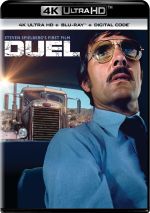
Duel appears in an aspect ratio of 1.85:1 on this 4K UHD Disc. Despite the film’s age and origins, the Dolby Vision image looked great.
Sharpness seemed positive. Only a few minor soft spots emerged in this largely tight flick.
No jagged edges or moiré effects appeared, and I witnessed no edge haloes. Grain seemed light but appropriate, and print flaws also remained absent.
When we considered the arid setting of most of the movie, it didn’t lend itself to a dynamic palette, and rusty tones dominated the tale. These appeared well-rendered and appropriately full, with good kick from HDR.
P>
As for blacks, these seemed deep and firm, while the occasional low-light shots looked clean and smooth. HDR added punch to contrast and whites. This wound up as terrific visual presentation.
As for the film’s Dolby Atmos soundtrack, it reworked the original monaural in a satisfying way, though I’d guess it used some audio not from the original stems. Downconverted to Dolby TrueHD 7.1, I felt that had to be the case for it seemed exceedingly unlikely that they’d be able to rejigger the old material and make it sound so good.
Make no mistake: the quality of the audio here seemed pretty strong. Some of the elements clearly came from the original recordings, as it was obvious we got the dialogue from the production.
The lines occasionally sounded a little tinny, but they usually didn’t belie their age and seemed fairly natural and concise. I noticed no issues with intelligibility.
Music came across well. Given the flick’s minimalist nature, it didn’t use a lot of score, but the parts we heard were pretty dynamic and lively. The music didn’t match up with modern efforts but it seemed strong for its era.
Not surprisingly, the probably-redone effects fared best. These consistently sounded vivid and vibrant, and they offered fine range and clarity. Bass response packed a good wallop when necessary, and with the depth of the truck-related noises, these made the flick all the more effective.
While the soundfield didn’t go nuts, it very nicely broadened the material from its original one-channel origins. The soundscape established its ambitions right off the bat during the opening driving scenes, as they provided a good sense of the road.
The more violent sequences proved involving and active. The various elements zoomed around the spectrum well and made the material come to life. The surrounds offered a great deal of unique information and added measurably to the experience.
The back channels bolstered the action sequences well and turned into dynamic partners in the mix. Overall, this was a solid track that earned a “B+” given that it easily bettered the average circa 1971 mix.
How did the 4K UHD compare to the 2015 Blu-ray? The Atmos soundtrack added a little zing to its 5.1 predecessor but I don’t think it offered notable upgrades to an already very good remix.
As for the Dolby Vision image, it came with superior colors, blacks and sharpness – ie, the usual 4K UHD improvements. These allowed a strong presentation to look even better.
The BD’s extras repeat here, and we start with A Conversation with Steven Spielberg. This program runs 35 minutes, 44 seconds as we hear from the director.
Spielberg chats about how he found the project and landed it, casting both humans and vehicles, studio pressures and his insistence on shooting on location, stunts and driving, planning, various trivia notes, and many tidbits about the shooting of the film like making slow-moving vehicles look faster.
Spielberg discusses his nods to Hitchcock and that director’s influence on the movie, the pressures of the flick’s rapid post-production, sound design, music and reactions to the film.
I still wish that Spielberg would do audio commentaries, but he makes this a very informative and engaging look at Duel. It’s a fine examination of both the movie and Spielberg’s earliest days as a filmmaker.
Next we find Steven Spielberg and the Small Screen, a nine-minute, 27-second featurette. In this piece, Spielberg gets into the various programs he worked on for TV, as he traces his path through that realm and relates his experiences.
We also see clips from many of the programs. I’d love to get a compilation release with all the TV shows that Spielberg directed, but unless that happens someday, this featurette offers a nice take on Spielberg’s “lost” years, material that most of us haven’t seen.
For the last featurette, we turn to Richard Matheson: The Writing of Duel. It fills nine minutes, 24 seconds.
The writer talks about the origins of the tale, its development, changes between the original short story and the script, research, various elements of the text and Spielberg’s take on the work, and his reactions to the final product. It’s another nice program that gives us some good insight into the flick’s creation.
In addition to the film’s trailer, we find a Photograph and Poster Gallery includes 21 images. These mix publicity shots from the movie and international posters from the realms in which Duel ran theatrically.
New to the 4K UHD, we get the film’s TV version. Presented 1.33:1 with Dolby Digital monaural audio, it runs one hour, 13 minutes, 59 seconds.
What did the theatrical cut add? It gave us a longer opening scene as well as additional character beats and more confrontations between Mann and the trucker.
Given that Spielberg went back to do additional shoots for the extra segments, the TV Duel becomes the more pure representation of his original vision. Spielberg didn’t lop material out to make network running time parameters, so theatrical becomes akin to the 1980 “Special Edition” of 1977’s Close Encounters of the Third Kind, an update that brought footage never filmed for the original production.
I can’t claim a preference for one version over the other, though I might feel differently if I’d encountered the TV Duel prior to this release. Given that my previous viewings of the film all involved theatrical Duel, it becomes more difficult to judge TV on its own merits.
Obviously TV Duel brings a leaner experience, and as such, it probably fares a wee bit better. Still, I think both work about the same, as nothing about the longer version harms it.
Presented HD but not 4K, the TV Duel demonstrated significantly weaker quality when compared to the theatrical presentation. Of course, the loss of the Atmos track created a major change.
If we went apples/apples and compared the theatrical’s DTS-HD MA mono with the TV’s Dolby Digital monaural, the latter came short. It seemed flatter and duller than its lossless peer.
Visuals became a major deviation, as the TV cut looked worse than the theatrical version in all possible ways. The TV movie seemed softer and mushier, with waxy skintones that appeared related to grain removal.
The TV Duel also suffered from various forms of noise, print flaws and persistent edge haloes. Colors lacked life and blacks felt dull.
If someone told me the TV presentation here came straight from an old DVD, I’d believe it. I wouldn’t call the TV edition unwatchable but outside of basic curiosity, I can’t imagine anyone would rather view this ugly rendition of the movie instead of the stellar 4K image with the theatrical cut.
A second disc provides a Blu-ray copy of Duel. It includes the same extras as the 4K UHD except for the TV cut of the film.
Steven Spielberg’s earliest film - albeit one created for television - Duel holds up nicely 55 years after its initial release. Simple and taut, the movie presents a clear and gripping tale. The 4K UHD offers very good picture and audio along with a smattering of informational supplements.
Fans who buy this set to experience the original TV cut will find disappointment, unfortunately, as the picture quality seems badly subpar. Nonetheless, the package presents the longer version exceedingly well so Spielberg fans will want to grab this fine 4K UHD.