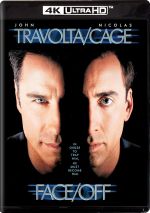
Face/Off appears in an aspect ratio of approximately 2.35:1 on this Blu-ray Disc. This became a pretty solid image.
Overall sharpness worked fine. Occasional shots looked a little soft, but the majority of the flick brought appealing delineation.
I witnessed no issues with jaggies or moiré effects, and edge haloes remained absent. Grain seemed natural and print flaws failed to manifest.
Colors went stylized, with a moderate mix of amber and blue/green. The disc replicated them in an appropriate manner.
Blacks were dense and deep, while shadows appeared smooth. All in all, I felt pleased with this solid presentation.
In terms of audio, Face/Off featured a DTS-HD MA 5.1 mix with a broad soundfield. Music showed good stereo imaging, while effects appeared well placed and involving.
The elements blended well and moved accurately, as the surrounds contributed a lot of unique information, especially during the many action sequences. All the channels received a great workout.
Audio quality worked fine. A couple of edgy lines materialized, but the speech usually was concise and distinctive.
Music showed nice range and delineation, while effects appeared lively and tight. No issues with distortion occurred, and low-end response appeared tight and deep. The movie boasted a simply terrific soundtrack.
How did this 2023 Blu-ray compare to the original BD from 2008? While both showed similar soundscapes, the 2023 disc’s lossless audio gave it an edge.
As for the visuals, the 2023 Blu-ray brought obvious upgrades in terms of accuracy, cleanliness, colors and blacks. I suspect the 2009 disc just recycled an older DVD scan, so this fresh transfer became an obvious upgrade.
This release mixes old and new extras, and we find three separate audio commentaries. For the first, we hear from director John Woo and writers Mike Werb and Michael Colleary as they offer a running, screen-specific track.
They cover what attracted Woo to the project and what he brought to it, working with the actors, script, story and rewrite issues, some stunts, action and effects topics, and a mix of other production subjects.
From start to finish, this commentary provides a nice look at the film. It covers the nuts and bolts of the production as well as some more personal elements. For instance, we learn what “Over the Rainbow” means to Woo.
We find out why there’s a slash in the movie’s title and many other helpful topics. I like this track a lot, as it gives us plenty of fine notes.
Next comes a commentary from Werb and Colleary on their own. This is another running, screen-specific discussion. They cover script, story and rewrites, working with Woo, cast, characters and performances, and a smattering of other production subjects.
Viewed on its own, this is a very good commentary. Viewed as our second track, it’s not so hot. The problem stems from repetition, as we hear many of the same details already discussed in the chat with Woo.
Sure, a few new notes appear, but the vast majority of the material repeats from the first commentary. Some of the remarks are literally identical, as I believe they recorded this piece first and the disc’s producers ported over some bits straight to the Woo commentary.
Since Werb and Colleary are entertaining speakers, the track is still quite fun despite the redundant material. Nonetheless, if you only listen to the piece with Woo, you won’t miss a lot here.
New to the Kino Lorber set, the third commentary features film critics Arne Venema and Mike Leeder. Both sit together for a running, screen-specific look at some production elements as well as their take on the movie.
The latter domain dominates, and I can’t claim Venema and Leeder offer a lot of real insights. Nonetheless, they dig into their view of the film with gusto and don’t shy away from criticisms so this turns into a lively and engaging track.
Seven Deleted Scenes fill a total of eight minutes, 26 seconds. We find “Castor Kills the Janitor” (0:36), “Archer Weeps” (1:09), “Childhood Lessons” (1:05), “Hideaway Shootout” (2:04), “Archer Vs. Castor Finale” (2:12), “Will Dad Be Dad Again?” (0:11) and “Alternate Ending” (1:09).
Don’t expect anything substantial here. “Janitor” just reminds us that Castor’s pretty evil, while “Weeps” simply reinforces Archer’s depression about his dead son.
We hear about “Lessons” in the commentaries, and it’s as silly as the writers think it is. “Finale” and “Dad” provide minor extensions to existing scenes, so they don’t bring anything fresh.
The “Ending” is interesting just because it’s a less happy-happy conclusion. That doesn’t mean it’d work better, though. “Hideaway” intrigues because it alters the tone of that sequence.
In the final cut, Adam seems oddly oblivious to the mayhem, while this version makes him more involved. It’s not a massive change, but it’s more logical.
We can watch these with or without commentary from Woo, Werb and Colleary. We get notes about the scenes and learn why they didn’t make the final cut. Some of this material repeats from the main commentaries, but it remains appropriate and helpful here.
Next comes The Light and the Dark: Making Face/Off, a documentary that fills one hour, four minutes, 21 seconds. We hear from Woo, Werb, Colleary, producer Terence Chang, producer Barrie M. Osborne, 1st AD Arthur Anderson, production designer Neil Spisak, weapons coordinator Robert “Rock” Galotti, special makeup effects Kevin Yagher, stunt coordinator Brian Smrz, and actors John Travolta, Joan Allen, Gina Gershon, Nicolas Cage, Alessandro Nivola, and Dominique Swain.
The program looks at the script’s origins, inspirations and script development, getting backing and how Woo ended up on the project, cast, characters and performances, Woo’s style on the set and his impact on the production, the film’s guns, stunts and action choreography, production design, storyboards, sets and locations, various effects, and thoughts about the final product.
After so many commentaries, I worried that there might not be much left to discuss in a documentary. I’m happy to report that “Light” finds plenty of new details to cover.
The show goes over lots of subjects barely touched in the screenplay/story dominated commentaries. It even reveals some script facts that don’t appear there.
For instance, we learn a little more about the sci-fi elements from the original text. “Light” turns into a really good examination of the film.
John Woo: A Life In Pictures lasts 26 minute, four seconds. It includes notes from Woo, Anderson, Chang, Galotti, Yagher, Smrz, and filmmaker John Carpenter.
“Pictures” looks at Woo’s childhood and early life before it goes through his interest in movies and how he got into that field. From there we follow how he developed into a director, notes about some of his flicks and thoughts about his style and personality.
While not a tremendously in-depth piece, “Pictures” provides a pretty decent overview of Woo’s life and career. We get a nice glimpse of the man, his influences and his style.
I’d have liked it to run longer and get into his various flicks to a greater degree. Still, I think “Pictures” provides a good general take on Woo.
Finally, we get trailers for Face/Off, The Usual Suspects, Hard Target, Staying Alive, The Experts, Fire Birds, Ronin, and
Out of Sight.
A terrific action flick, Face/Off easily could have turned silly. However, the movie melds excellent action with vivid performances to become something special. The Blu-ray brings solid picture and audio along with a nice array of bonus materials. I enjoy the movie and this becomes a good release of it.
Note that this 2023 Kino Blu-ray of Face/Off appears only paired with the movie’s 4K UHD version. Though Kino doesn’t sell this particular BD on its own, I still thought it merited its own review because fans without 4K UHD capabilities might want to get it.