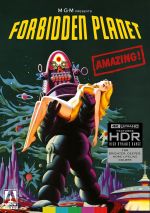
Forbidden Planet appears in an aspect ratio of approximately 2.35:1 on this 4K UHD Disc. I felt pleased with the Dolby Vision visuals.
Overall sharpness seemed good. A few shots could feel a bit soft but the majority of the flick looked tight and well-defined.
Jagged edges and shimmering created no concerns, and I detected no signs of edge haloes. Grain became light but natural and print flaws remained absent.
Planet tended to go with a subdued greenish/bluish palette and the disc replicated these colors well, with appealing range for other hues when they appeared. HDR added power to the tones.
Blacks came across as deep and rich, while shadows felt smooth. Whites and contrast earned a nice boost from HDR. I thought this wound up as a high-quality image.
I also felt pretty pleased with the DTS-HD MA 5.1 soundtrack of Forbidden Planet. Audio quality was usually good for its age.
Speech sounded somewhat brittle at times, and I noticed occasional muddiness as well. Still, the lines were always intelligible and without significant concerns.
The “electronic tonalities” were full and distinct. They showed good life and breadth throughout the film.
Effects followed suit, as they were clean and pretty powerful. The handful of louder segments demonstrated nice depth and impact.
Though not terribly ambitious, most parts of the soundfield succeeded. I thought the “tonalities” spread well across the front and rears to create a reasonably immersive presence, and effects featured good localization.
Various elements popped up in appropriate spots and blended together pretty well. Surround usage wasn’t heavy, but the back speakers added to the sense of place.
The movie also featured a lot of directional dialogue, and that side of things wasn’t always successful. Some lines appeared well-placed, while others were less effective.
Nonetheless, the localization was never bad or distracting, as the speech blended with the rest of the mix in a decent manner. Like the visuals, I thought the audio merited a “B”.
How did the 4K UHD compare to the 2010 Blu-ray? Both came with apparently identical 5.1 audio but the 4K UHD added the movie’s original 3.0 “Perspecta Stereo” mix.
That track simply used the three front speakers and no surrounds, but it did so in a more satisfying manner. The elements blended together more smoothly and directional dialogue felt better placed.
Both came with similar sound quality. I’d choose the Perspecta mix as the best option for Planet so that meant I felt we got an audio upgrade with the Arrow release.
As for the UHD’s Dolby Vision image, it became better defined and more vivid than the Blu-ray and it also lost the smattering of print flaws from the prior disc. I thought this turned into a nice step up in picture quality.
When we shift to extras, the UHD gives us a trailer and an audio commentary from film historians Barry Forshaw and Kim Newman. Both sit together for a running, screen-specific discussion of how the movie adapted Shakespeare, their experiences with Planet, cast and crew, genre domains, the film’s reception and legacy and their own thoughts about it.
Take my reference to this track as “screen-specific” with a grain of salt. The participants sporadically discuss the action as it happens, but mostly they riff regardless of the movie’s events.
This means that they largely discuss their thoughts about the movie and its place in the genre. This means the discussion feels more general than I’d prefer but it comes with some insights along the way.
The remaining extras appear on a separate Blu-ray Disc, and we get a newly-shot featurette called Unearthly Aura. Film historian/composer Neil Brand participates in this 23-minute, 29-second reel.
Brand focuses on the movie’s “score” for this chat. We get a positive view of the movie’s unusual form of music and its creators.
12 Deleted Scenes fill a total of 13 minutes, 15 seconds. Fans who hope to find anything major will feel disappointment, as these bits and pieces feel pretty inconsequential.
The most significant shows some interpretation of Alta’s effect on animals. I’m sure Planet aficionados will be delighted to see these clips, despite their forgettable qualities.
In addition, we get nine minutes, 23 seconds of Lost Footage that allows us to see various clips of test film that include various effects elements. I suppose the Planet buffs might dig them, but they bored me.
Two clips show up under the banner of MGM Parade. We get excerpts from Episodes 27 and 28 of a mid-1950s series by the same name.
Together the two snippets add up to six minutes, 14 seconds. Walter Pidgeon hosts these pieces and gives us a look at Planet.
“27” is essentially just a promo for the flick, but “28” offers a cute little chat between Pidgeon and Robby. These are worth a look for their fun archival value.
For more televised fun, we go to the 2/28/58 Episode of The Thin Man. Entitled “Robot Client”, this TV program runs 25 minutes, 36 seconds and appears here because it features Robby the Robot.
Starring Peter Lawford and Phyllis Kirk as Nick and Nora, the Thin Man series ran for two years. This program came about two-thirds of the way through Season One.
Frankly, Lawford and Kirk don’t seem right as Nick and Nora, and “Client” isn’t a very interesting show. It’s great to have for its use of Robby, but the program itself is silly and not too entertaining.
For a major attraction, we go to The Invisible Boy, a 1957 feature film lasts one hour, 29 minutes, 31 seconds. Why does the flick appear in this set? Because like “Robot Client”, it features Robby.
Boy stars Richard Eyer as Timmie Merrinoe, an underachieving kid with a scientist dad (Philip Abbott) who doesn’t spend much time with him due to all his work. Timmie gets access to abandoned robot Robby and uses him as his personal slave and buddy.
When Timmie desires to disappear, Robby literally makes the kid invisible. This spawns many goofy adventures as Timmie takes advantage of his status.
Essentially, Boy acts as a combination of Afterschool Special, horror flick and goofy Disney comedy with a little Cold War tension thrown in for good measure. While Forbidden Planet manages to work pretty well after all these decades, Boy dates badly and comes as a serious product of its era.
It produces a few decent chuckles and is cool to see due to Robby’s presence. However, it’s not a good movie.
In addition to Boy, the set includes three additional video programs. First comes the 55-minute, 31-second Watch the Skies!: Science Fiction, The 1950s and Us.
Narrated by Mark Hamill, wefind notes from filmmakers Steven Spielberg, George Lucas, Ridley Scott, and James Cameron. The program examines the significant sci-fi flicks of the 50s and how they reflected their era. We also look at a mix of trends in the genre, and we learn about how the movies dealt with science fact and used different elements as metaphors.
The presence of four legendary filmmakers helps “Skies” to an enormous degree. They give us excellent notes about the flicks that informed their views of the genre as kids, and they provide lots of insights into the era and its material.
We also find many good representative clips from the films and those help illustrate the information. This is a very enjoyable and useful program.
Next comes Amazing!: Exploring the Far Reaches of Forbidden Planet. It goes for 26 minutes, 37 seconds and features filmmakers John Landis, William Malone, Joe Dante and John Carpenter, visual effects artists John Dykstra, Phil Tippett and Dennis Muren, actors Anne Francis, Earl Holliman, Warren Stevens, Richard Anderson and Leslie Nielsen, novelist Alan Dean Foster, science fiction historian Bob Burns, film historian Rudy Behlmer, theater director Geoff Elliott, author Bill Warren, robot co-designer Robert Kinoshita, composer Bebe Barron, and sound designer Ben Burtt.
“Reaches” looks at the state of cinematic sci-fi prior to Planet and how that flick altered the genre. We then go through MGM’s aims for the film, the story’s development and Shakespearean influence, characters, performances and the tone on the set, the design and creation of Robby the robot, visual effects and other production elements, the flick’s innovative score and other audio, the film’s depiction of its monster, and the flick’s reception at the time and later.
Almost inevitably, “Reaches” occasionally devolves into frothy praise for Planet. However, given the movie’s influence and how much it impacted those involved with the program, I can easily excuse that tendency.
“Reaches” makes clear how important Planet became for filmmakers and it also throws out many good notes about the production. Granted, it’d be nice to get more details from the participants, but this still acts as a good little documentary.
Finally, we locate Robby the Robot: Engineering a Sci-Fi Icon. This 13-minute, 45-second show presents remarks from Dante, Nielsen, Foster, Burtt, Holliman, Behlmer, Malone, Carpenter, Kinoshita, Dykstra, Francis, author/science writer Steven Kotler, USC Robotics Lab co-director Professor Maja Mataric, and Robby replica builder Fred Barton.
The show covers the design and creation of Robby. It expands on the notes found in the prior documentary and gives us more details about all things Robby as well as other robotic topics.
We also get a nice close-up look at the original Robby. This turns into a pretty informative and interesting look at the mechanical legend.
Finally, we encounter two trailers - one for Planet and one for Invisible Boy - along with four Image Galleries: “Original Screenplay” (111 screens), “Posters and Lobby Cards” (50), “Black & White Promo Stills” (172) and “Colour Promo Stills” (16). All the “Galleries” offer useful material but the “Screenplay” seems most valuable of all.
Note that the Forbidden Planet trailer on the bonus features Blu-ray is the same one found on the 4K UHD disc.
It’d be good enough if Forbidden Planet merited attention solely due to its influence over 50 years of science fiction. However, the movie also continues to entertain. The 4K UHD provides good picture and audio along with a satisfying complement of supplements. This becomes a terrific release for a highly influential film.