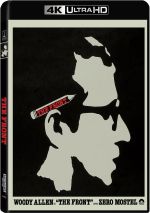
Reviewed by Colin Jacobson (May 5, 2026)
Via 1976's The Front, we find Woody Allen in an unusual - though not unique - circumstance as an actor but not a writer or director. A piece of historical fiction, the film also leans more dramatic than his own work from this era.
In the 1950s, anti-Communist fervor in the United States leads many filmmakers "blacklisted" and unable to work. TV screenwriter Alfred Miller (Michael Murphy) finds himself in this position.
Miller pays his restaurant cashier/small-time bookie pal Howard Prince (Allen) to submit a script under his name. This leads Howard to work with more clients, a choice that comes with various ramifications.
Although Hollywood tends to feel self-infatuation that leads to many movies about Hollywood, studios haven't created a whole lot of features related to the 1950s blacklist. I suspect that's because it offers such a dark chapter of cinematic history.
Hollywood would rather produce flicks that celebrate the art form. Any look at the blacklist reminds us cowardice on the part of so many in the industry, as too few took a stand against the bullying that took place as part of the post-World War II "Red Scare".
I hoped Front would offer a bracing look at the impact of the blacklist. Instead, it winds up as a bit of a mess.
While not a pure comedy, Front leans in that direction a fair amount of the time. This seems like a flawed decision, as the mirthful moments come across as an awkward fit with the basic narrative.
Perhaps if Front wanted to offer pointed satire that mocked the fools behind the blacklist, that would work. However, the film never figures out where it wants to go in that domain.
Front also bites off more than it can chew via its different narrative threads. In addition to Howard’s “success” as a writer, he ends up ensnared in the anti-Communist fervor as well.
Howard also woos network employee Florence Barrett (Andrea Marcovicci) and we see the travails of actor Hecky Brown (Zero Mostel), a TV star who deals with blacklisting. This seems like too much for a 95-minute movie.
Along with Mostel and some other cast/crew, director Martin Ritt and screenwriter Walter Bernstein both suffered due to the blacklist. As such, one would expect Front to offer a deal significant to them.
If that’s the case, it doesn’t really show. Perhaps that wanted to pack in as many different blacklist-related elements as possible and that muddied the waters.
Whatever the case, Front goes in too many directions and they often don’t really connect. It veers from Howard’s giddy misadventures to Hecky’s plight to the Howard/Florence romance to the FBI investigations to repercussions that hit Howard.
Honestly, Front probably should’ve simply told a story from Hecky’s point of view. His narrative seems the most representative of the blacklist victims.
Allen makes Howard a variation on the usual “Woody Allen Character”. He tones down the routine, though, so Howard doesn’t present a persistently comedic role.
Mostel does well in Hecky’s quieter moments of pathos, but he overdoes the role in the part’s louder scenes. I suspect both Allen and Mostel make the film more pointed toward laughs than they should because the project seems so unsure where it wants to go.
All of this leaves The Front as a moderate disappointment. While the film takes on a provocative topic, it seems too spotty to succeed.