DVD Movie Guide @ dvdmg.com Awards & Recommendations at Amazon.com.
.
Review Archive:  # | A-C | D-F | G-I | J-L | M-O | P-R | S-U | V-Z | Viewer Ratings | Main
ARROW

MOVIE INFO

Director:
Doug Liman
Cast:
Sarah Polley, Katie Holmes, Jay Mohr
Writing Credits:
John August

Synopsis:
A group of young Californians do drugs, deal drugs, go to raves, have carnal adventures and get in many kinds of trouble over the course of one action-packed night.

Box Office:
Budget
$20 million.
Opening Weekend
$4,706,795 on 1563 screens.
Domestic Gross
$16,943,454.

MPAA:
Rated R.

DISC DETAILS
Presentation:
Aspect Ratio: 2.40:1
Dolby Vision
Audio:
English DTS-HD MA 5.1
Subtitles:
English
Closed-captioned
Supplements Subtitles:
None

Runtime: 102 min.
Price: $49.95
Release Date: 9/29/2026

Bonus:
• Audio Commentary with Director Doug Liman and Editor Stephen Mirrone
• Audio Commentary with Critics Bryan Reesman and Max Evry
• “From the Word Go” Featurette
• “A View Askew” Featurette
God Short Film with Optional Commentary
• “Making Of” Featurette
• 14 Deleted Scenes
• Trailer
• Image Gallery


PURCHASE @ AMAZON.COM

EQUIPMENT
-LG OLED65C6P 65-Inch 4K Ultra HD Smart OLED TV
-Marantz SR7010 9.2 Channel Full 4K Ultra HD AV Surround Receiver
-Sony UBP-X700 4K Ultra HD Dolby Vision Blu-ray Player
-Chane A2.4 Speakers
-SVS SB12-NSD 12" 400-watt Sealed Box Subwoofer


RELATED REVIEWS


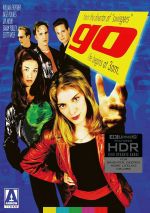
Go: Collector's Edition [Blu-Ray] (1999)

Reviewed by Colin Jacobson (August 18, 2026)

If you look up “1990s” in the dictionary, Go might be the movie pictured there. With its story of a particular party culture, it just screams “90s” to me – or at least “second half of the 90s” – a factor that makes its enduring appeal questionable almost 30 years later.

To stave off eviction, Ronna (Sarah Polley) works shift after shift as a grocery clerk so she picks up more time from Simon (Desmond Askew) because he wants the time off to make his first-ever visit to Vegas. Adam (Scott Wolf) and Zack (Jay Mohr) need Ecstasy for an all-night rave, and they usually get their supplies from Simon.

In the course of an evening, Ronna deals fake drugs, Simon gets laid and Adam and Zack work through their own secrets. All this leads to a lot of wild shenanigans.

When I said that Go feels like a period of its time, I wasn’t kidding. The movie opens with a scene at a rave, for God’s sake!

I suppose raves still happen, but boy do they seem stuck in the 90s to me. I also guess that “be-ins” still occur as well, but a movie about them would remain mired in the 1960s.

Because of this emphasis on Ecstasy and the rave, the first third of Go threatens to flop. As Ronna, Polley provides a certain tough charm, and the character has the potential to become interesting, but the movie focuses too much of the party and the drug use. In particular, a “drug cam” that shows us the stoner point of view seems self-indulgent and off-putting.

The “Ronna” part of the movie fills roughly the first third of Go, and it almost derails the flick, so if the film continued on the same path the rest of the way, I’d have to write a pretty negative review. However, once the “Ronna” segment ends, we leap back in time to see Simon as he gets her to take his shift.

From there, the film takes us on Simon’s path and we see what happens with him. A similar time shift occurs when we go into the Adam/Zack third of the flick.

Because of the drug-dealing elements, the scene in which Ronna takes over Simon’s work schedule proves pivotal, so the movie returns us to it every time it wants to launch into a different tale. Though some view it that way, this isn’t exactly the Rashomon structure.

Go tells three different but connected stories, while the “Rashomon” idea looks at the same events from different perspectives. Nonetheless, it becomes a clever way to intertwine the various plots.

And it redeems a movie that I thought would be little more than an indulgent look at the party culture of the late 1990s. When we follow Simon, Go takes on a much wilder Tarantino-esque feel – and it also becomes much more interesting.

As a character with no impulse control, Simon annoys us, but he also provides entertaining shenanigans. The “Simon” section turns into the best of the bunch.

“Adam/Zack” also works pretty well. It’s not as wild as the “Simon” part, but it throws out some good twists and offers a more overtly comedic sensibility – to a degree, at least. Go is often a pretty dark movie, and that’s what separates it from most of its peers.

Indeed, the 1990s turned into a fertile time for “one crazy night” movies about younger people. In addition to Go, we got flicks such as 1993’s Dazed and Confused and 1998’s Can’t Hardly Wait.

Though both of those shared the same kind theme, they took on very different approaches. Set in the 1970s, Dazed offered more of and affectionate look back at the era, while Wait brought the kinder, gentler teenybopper adventure set in its present day.

Both are good, but both are much sunnier than Go, a flick that includes violence, drugs and sex, all in pretty copious amounts. You don’t think anyone will die in the first two movies, whereas here you don’t know if anyone will live.

Which kind of makes Go feel like Tarantino’s take on the teen party movie. That’s a simplification, of course, but not one that the film avoids, as the old Blu-ray’s case cites a review that calls it the “son of Pulp Fiction”.

Go doesn’t live up to that Tarantino classic. Indeed, for its first third, I don’t even think it’s a very good movie.

However, the other two-thirds do a lot to redeem it. The movie remains stuck in its era and has its flaws, but it soars more than it falters.


The Disc Grades: Picture B+/ Audio B/ Bonus B+

Go appears in an aspect ratio of approximately 2.40:1 on this 4K UHD Disc. Despite its intentionally raw vibe, the film delivered a solid Dolby Vision presentation.

Sharpness worked fine. A few darker shots came across as a little soft but most of the film felt accurate.

No issues with jaggies or shimmering appeared and the transfer showed no signs of edge haloes. Grain seemed natural – albeit heavy – and print flaws failed to appear.

With a mix of lively settings – raves! Vegas! – colors got some room to shine, even if the aforementioned gritty feel meant they didn’t dazzle. Still, the hues fared nicely and received a positive bump from HDR.

Blacks appeared dark and tight, while low-light scenes brought generally good clarity. HDR added some zing to whites and contrast, though this also became limited due to the cinematography. No one will mistake this as a demo image, but the image did what it needed to do.

In addition, the movie’s DTS-HD MA 5.1 soundtrack proved satisfying. Music dominated the movie and used all five channels well. We didn’t get a ton of discrete material from the songs, but they opened up the mix in a pleasing way.

Effects tended to be more subdued, though some exceptions occurred, especially during the Vegas scenes. A long car chase provided nice movement, and a few other sequences throughout the movie allowed for decent use of the side and rear speakers.

The soundscape didn’t turn super active. Nonetheless, it utilized the elements well.

Audio quality seemed solid. Music remained the most important element, and the various songs demonstrated fine clarity and range.

Speech was clear and natural, while effects offered positive definition and accuracy. All of this was good enough for a “B”.

How did this 4K UHD compare to the film’s original Blu-ray from 2009? Though it swapped DTS-HD MA for the old disc’s Dolby TrueHD 5.1, both seemed to provide virtually identical audio.

On the other hand, the Dolby Vision UHD brought better definition as well as stringer colors and blacks and it lost the BD’s print flaws. This wound up as a major upgrade over the mediocre BD.

When we shift to extras, we begin with two separate audio commentaries, the first of which comes from director Doug Liman and editor Stephen Mirrone. Both sit together for this running, screen-specific look at story and editing, sets and locations, cast and performances, cinematography, music and production design, and a few other issues.

Liman and Mirrone provide a pretty good look at Go. It’s a little more technical than I’d like, as we don’t learn a ton about the actors or the script, but we get enough material of that sort to satisfy. The track gives us an engaging overview of the flick.

New to the Arrow release, the second commentary features critics Bryan Reesman and Max Evry. Both sit together for their running, screen-specific view of the project’s roots and development, cast and crew, factual liberties, various production details and their thoughts about it.

Evry and Reesman provide an effective chat that covers the film in a broad number of ways. Every once in a while the discussion threatens to turn into “annotated IMDB” territory, but it comes with more than enough useful material to deliver a worthwhile track.

A ”Making Of” Featurette runs six minutes, 22 seconds. It includes Liman, writer/producer/2nd unit director John August and actors Sarah Polley, Katie Holmes, Timothy Olyphant, Desmond Askew, Taye Diggs, James Duval, Breckin Meyer, Scott Wolf, William Fichtner and Jay Mohr.

Produced back in 1999, the program exists to promote the film. It tells us a lot about the story and very little about the production so you can safely skip it.

14 Deleted Scenes last a total of 25 minutes, 16 seconds. These offer a combination of finished sequences and outtakes.

All feel interesting, but the outtakes are the most fun. They show some enjoyable improv bits and allow a little of a glimpse behind the scenes.

Two new interviews follow, and we start with From the Word Go. It runs 21 minutes, 54 seconds and involves John August.

Here we learn about what brought him into movies as well as the development of his Go screenplay, its path to the screen and aspects of the production. August covers a slew of useful domains in this informative chat.

A View Askew comes next. Actor Desmond Askew becomes the subject of this 20-minute, 41-second chat.

Askew covers his career and his Go experiences. He brings some good tales from the shoot.

Shot by August during the production of Go, God offers a short film that spans 11 minutes, 23 seconds. Briefly seen in Go, Melissa McCarthy acts as the main participant.

McCarthy plays a flighty young woman who literally enjoys God as her BFF. It becomes a clever piece and I like our chance to see McCarthy as an adjunct to Go since the movie represented her film debut.

We can watch God with or without commentary from August, McCarthy and editor Doug Crise. They sit together to discuss the movie’s origins and aspects of the production in this useful little chat.

Along with the movie’s trailer, we get an Image Gallery with 27 stills that mix shots from the film and publicity photos. It lacks much of interest.

The Arrow release loses three music videos from the prior Blu-ray.

While Go should probably be in a late 1990s time capsule, it still manages to entertain more than 25 years later. The movie suffers from a few more ups and downs than I’d like, but it throws out enough wild antics to keep us interested. The 4K UHD comes with positive picture and audio as well as a solid collection of supplements. Arrow delivers a high-quality release for a largely entertaining flick.


.
Review Archive:  # | A-C | D-F | G-I | J-L | M-O | P-R | S-U | V-Z | Viewer Ratings | Main