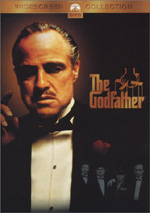
The Godfather appears in an aspect ratio of approximately 1.85:1 on this single-sided, double-layered DVD; the image has been enhanced for 16X9 televisions. The disc sported an erratic picture that displayed a mix of flaws.
Sharpness was one of the problems. The transfer suffered from heavy edge enhancement at times, so wide shots made it look like a force field surrounded some of the actors. Close-ups and two-shots could look fine, but anything broader than that became mushy and soft. No issues with jagged edges or shimmering occurred, at least, but man, that edge enhancement severely harmed the image.
Most of The Godfather featured an extremely drab palette. The movie mostly went with a very brown look, so more vibrant colors were rare. When those hues did appear, however, they remained erratic. Again, the edge enhancement and the softness tended to zap the image of its vivacity, so the colors in potentially vibrant scenes like the wedding came across as murky. A few shots showed more dynamic hues, but don’t expect much.
Black levels mainly came across as reasonably deep and dense, and contrast was fairly good for the most part. As noted in the prior paragraph, much of the film looked rather brown and dark, and shadow detail usually seemed up to the task. Most of the low-light situations appeared to be appropriately heavy but not excessively thick. Some of these shots did come across as somewhat flat and dim, but as a whole, I thought they looked fairly solid.
Where The Godfather encountered many of its problems related to print flaws. Most of these remained pretty minor. Light grain cropped up occasionally throughout the film, but it usually appeared during low-light sequences, when it would be most expected; a few daylight shots – such as those between Michael and Kay at the wedding – also demonstrated excessive grain, but those instances seemed rare. A few nicks, some grit, and a blotch or two also occurred.
What caused more concerns, however, was the surprisingly high number of little white speckles that showed up during the movie. The density of these dots varied, and the image did become cleaner as it progressed; the first half definitely displayed more of them. However, they remained a consistent distraction throughout the film, and I really was surprised at how dirty the disc could look. Between the defects and the concerns related to the edge enhancement, the transfer presented a serious disappointment; a classic like this deserved better.
I expected less of the film’s Dolby Digital 5.1 soundtrack, but it let me down nonetheless. The audio remixed the original monaural stems, and the results weren’t terribly pretty. Actually, as with the picture of The Godfather, the soundtrack combined some highs and lows, but the discrepancies seemed even wider.
On the positive side, the mix attempted a pretty wide soundstage. The audio stayed primarily located in the forward spectrum, but it spread elements out across the front speakers. Quite a lot of ambient effects cropped up in the sides, and the music showed nice stereo separation as well. Surround usage appeared minimal for the most part. During a few scenes – such as those that involved trains or planes – the rear channels kicked to life fairly nicely, but for the most part, nothing more than general reinforcement came from the surrounds.
Although some of the five-channel imaging worked well, for the most part I found this to be an awkward mix. Elements were usually placed abruptly in their locations, and they tended not to blend together very well. This left a forced tone to the mix that made it somewhat distracting; it rarely sounded natural or particularly real. Musical elements meshed together pretty nicely, though, even when they weren’t parts of the score; for example, a saxophone played in the street fit in well. Effects integration remained less successful.
However, I could excuse most of those flaws, as I don’t expect a 5.1 remix to seem tremendously well integrated. Most I’ve heard have seemed superior to this, but it remained within the norm. Unfortunately, the audio quality caused more concerns. Some elements sounded good, and those were what kept me from giving the mix a below average grade. The music usually demonstrated pretty solid fidelity. At times the score appeared a little crackly and distorted but for the most part I thought the music seemed fairly clear and bright. The score also boasted some rather nice bass response at times. The climax showed good depth to the work.
A few of the effects elements also came across as pretty powerful and dynamic. When Tom Hagen’s plane lands in LA, and when the train roars by while Michael’s in the restaurant, I found the track to offer good reproduction and force to these bits. Another scene in which thunder roars provided solid breadth and depth.
However, much of the rest of the track suffered from a rather artificial and processed sound. It appeared that someone went nuts with the reverb filter, as much of the movie provided a thin, echoed sound. This effect seemed to occur to provide the mix with a sense of ambience, but it went way out of control; almost everything echoed, and it became a definite distraction.
While the mix suffered from the awkward integration of some elements, it was really the weak sound quality that made the track seem so problematic. The piece felt unbalanced, as some parts appeared too prominent because of the processed sound. For example, the fireplace in Woltz’s house played much too strong a role during the dinner sequence; its pops and buzz drew attention to themselves in a problematic manner. When Johnny Fontaine sang during the wedding, the girls’ screams came across as synthesized; on the Bowie song called “Zeroes”, some artificial squeals appeared, and the two sounded a lot alike. Another example related to the sound of people walking in the street. Instead of making this a small element, the footsteps became rather loud and obvious, and they took away from the overall impression; I didn’t pay as much attention to the important action because I focused on those stupid feet!
Dialogue also suffered from the same reverberated quality, and many lines showed moderate edginess as well. Most of the movie seemed easily intelligible, though a few louder scenes could be tough to understand; for example, one fight between Connie and Carlo forced me to activate the subtitles to hear what they said. Distortion wasn’t a major concern throughout the movie, but it occurred more frequently than I expected, and I also heard a few fairly loud pops early in the film.
In the end, The Godfather didn’t offer a terrible soundtrack for its age, and a few aspects worked fine. However, these were marred by many problematic parts that made the audio seem somewhat weak even for an older film. I really wish this DVD included the original mono soundtrack, as it would lack the distracting artificial quality of the awkward soundfield.
A couple of subtitle notes: for one, purists will be happy to hear that the original “burned-in” English translations appeared during scenes that featured Sicilian dialogue. While the movie only provided English subtitles for most lines, an option provides French text translations to appear on top of the burned-in English words. This feature appears automatically if you select the French soundtrack.
If you compare this 2004 solo DVD to the 2001 release that came as part of the Godfather Collection package, you’ll find no differences. Both sport the same transfers and are virtually identical.
Only one extra appears here: an audio commentary from director Francis Ford Coppola, who provides a running, fairly screen-specific affair. Although the track suffered from a fair number of empty spaces, I had little problem with the gaps, largely due to the length of the movie itself; at nearly three hours, that’d be a lot of room for Coppola to cover.
I also didn’t mind the blanks too much due to the quality of the commentary itself. I wouldn’t call this a great track, but Coppola offered a lot of solid information and he did so in an engaging way. In a refreshing move, he mainly covered problems encountered during the making of the film. Many commentaries suffer from “happy talk” syndrome, but that definitely wasn’t the case here; Coppola never seemed petty or bitter – he who laughs last and all that – but he did relate the difficulties he encountered in a frank manner. Ultimately, he added a lot to the table during this interesting and informative commentary.
The Godfather earned the second position on the American Film Institute’s list of the Top 100 films. More than 35 years after its initial release, I find it hard to quibble with that choice. The Godfather remains a very solid piece of work that succeeds on almost all levels.
:
Unfortunately, the DVD seems less satisfying. Picture quality is a mess, while audio appears rather artificial and thin. A good audio commentary from director Francis Ford Coppola adds a nice level of information to the package. This is a great movie that receives poor treatment here.
To rate this film, visit the Boxed Set review of THE GODFATHER