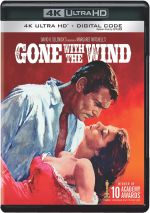
Gone with the Wind appears in an aspect ratio of 1.33:1 on these 4K UHD Discs. Disc One lasts one hour, 48 minutes, nine seconds, while Disc Two goes for two hours, five minutes, two seconds.
Though not without some minor issues, the Dolby Vision visuals of Wind looked very good.
Sharpness generally looked accurate and concise, with only a few scenes that showed some mild softness. Most of the film seemed pretty precise and well-defined.
Neither jaggies nor shimmering impacted the presentation, and I saw no edge haloes. Grain seemed light but appropriate and print flaws remained absent.
The print itself appeared miraculously clean for such an old movie. The quality of the print would seem fine for a recent movie, but for an elderly flick to look so fresh and free of faults seemed amazing.
The colors of Wind frequently became a serious treat for the eyes as they virtually leapt off the screen. The movie offered a broad palette and the film displayed these with stunning clarity and vividness, factors enhanced by HDR.
Black levels felt deep and rich, while shadow detail looked clear and appropriately opaque. HDR added emphasis to whites and contrast. The film’s inherent soft moments kept this from a grade above “B+” but this nonetheless became a fine representation of the film.
I also felt the film's DTS-HD MA 5.1 soundtrack worked pretty well. Taken from a mono source, the reixed version livened up the action a bit but the sound designers didn't try to reinvent the wheel.
The new track remained largely stuck to the center channel. Significant portions of it didn't differ from the mono mix.
I could gauge that last fact because this set also included the original DTS-HD MA monaural track, and I occasionally flipped between the two, although I listened to the 5.1 mix for the majority of the movie. It seemed as though few parts of the track strayed far beyond the center speaker.
At times the score branched out to the sides, and a few of the showier action scenes - such as attacks on Atlanta - featured moderate effects that also move to the surrounds. However, for the most part, this remained a monaural track.
The ambition on the part of the sound designers became modest. This seemed appropriate since an old film like this wouldn't hold up to intense remixing.
Quality seemed similar for both, though the 5.1 track displayed greater depth at times. Again, a lot of it sounded identical, but it's clear that the 5.1 mix showed more range, especially during the scenes that departed from the center channel.
The explosions benefited the most from the added range, as they even sparked the subwoofer mildly on a few occasions. Some portions of the score also seemed cleaner on the remix.
Dialogue sounded clear and relatively natural on both tracks. Effects displayed some slight distortion during their louder moments but they generally seemed acceptably precise.
Music featured the same moderately restricted range heard in the other components - and very typical of films from this era - but it came across as adequately smooth and listenable. Not for one second will you mistake the soundtrack of Gone With the Wind for one found on a more recent film, but it worked pretty well for the material and held up nicely under most scrutiny.
How did the 4K UHD compare to the original Blu-ray? Audio changed from Dolby TrueHD 5.1 to DTS-HD MA 5.1 but they seemed very similar, if not identical.
In terms of the Dolby Vision 4K UHD, it offered upgrades in terms of colors and blacks. Sharpness also got a boost at times, though the nature of the source restricted this growth and the higher resolution of the UHD could make the movie’s softer spots more obvious.
This meant I preferred the UHD but I couldn’t claim it blew away its Blu-ray predecessor. Still, it depicted the movie about as well as I think we could hope.
The 4K UHD includes a mix of new and old extras, and these open with an audio commentary from film historian Rudy Behlmer. Spread across the two movie discs, Behlmer offers a running, screen-specific take rhat starts with the score and how Max Steiner landed the gig and then goes through the opening credits, the history behind the tale, the creation of the book and changes from novel to screen, biographical notes about the main participants, a mix of controversies such as production difficulties, firing the original director and hiring a new one, and reshoots, sets and locations, production design and cinematic elements, cut sequences, the film’s reception, Margaret Mitchell’s lack of participation in the flick, and its legacy.
Whew! That’s a packed agenda, and Behlmer handles it all well.
Inevitably, some dead air occurs, but not much given the extreme length of the film. At times I think Behlmer concentrates a little too heavily on biographical sketches of the participants, as I’d prefer some additional notes about the movie’s creation itself.
Nonetheless, this doesn’t cause any real problems, and Behlmer cranks through the subjects well. It’s yet another informative and entertaining discussion.
On a separate “bonus” Blu-ray, we open with The Making of a Legend: Gone with the Wind, a documentary that runs two hours, three minutes, five seconds. It presents notes from Selznick executive assistant Marcella Rabwin, Eastern Story editor Katherine Brown, original director George Cukor (in 1968), Selznick secretary Silvia Schulman Lardner, associate film editor James Newcom, camera operator Arthur Arling, extra Johnny Albright, assistant director Arthur Fellows, production manager Ray Klune, assistant cameraman Harry Wolf, preview audience member William Ericson, Vivien Leigh’s secretary/friend Sunny Lash, and actors Butterfly McQueen, Ann Rutherford and Evelyn Keyes.
We also find old recordings from Clark Gable, editor Hal Kern and writer Ben Hecht plus quotes from historical memos and recreated comments by folks like author Margaret Mitchell, producer David O. Selznick, and screenwriter Sidney Howard.
“Legend” starts with details about the career of producer Selznick and then continues through a look at the life of author Mitchell and the writing of the novel as well as how Selznick acquired the property and its move to production.
We romp through the adaptation of the novel, casting and the mania about the search for Scarlett, the film’s look, visual and practical effects, costume design, issues connected to the actors and their approaches to the roles, Cukor’s departure and the hiring of Victor Fleming, rewrites, general production notes, various controversies and problems, editing and post-production, audience previews, the score, concerns with the production code, the Atlanta premiere, its success financially and at the Oscars, and its legacy.
Inevitably, some of “Legend” repeats information provided by Behlmer. However, it manages to take on many different sides of the issues, and we learn quite a lot from it.
Perhaps because his son L. Jeffrey produced it, “Legend” largely follows Selznick’s point of view, but that doesn’t make it myopic. Indeed, it covers the film’s creation in a broad manner that makes it very engaging. It pulls few punches as it lets us know all the problems that occurred before, during and after production.
Along the way, the archival materials really flesh things out well. The plethora of screen tests come as a terrific addition, especially when we see how close Paulette Goddard came to acquiring the role as Scarlett. Other historical elements add bite as well.
The program adopts some really cheesy gimmicks such as silly recreations that put now-elderly participants in various period situations. Despite those goofy moments, however, “Legend” presents a detailed and consistently engrossing look at the flick.
The Legend Lives On occupies 32 minutes, 44 seconds with notes from Behlmer, Rutherford, Maltin, Haskell, Feeney, Sexual Personae author Camille Paglia, The Filming of Gone with the Wind author Herb Bridges, Marietta Gone with the Wind Museum’s Connie Sutherland, Westmore Academy founder Marvin Westmore, Turner Enterprises chairman Ted Turner, former US Senator Max Cleland, former MGM VP Administration Roger Mayer, Road to Tara Museum’s Beth Bailey, “Windies” Robert Warren and Jan Lingner, and actors Butterfly McQueen and Patrick Curtis.
“Lives” takes on the movie’s premiere, reception and long life as well as its preservation, cast and performances, and related elements.
Though moderately entertaining, “Lives” brings us a scattershot experience. At best, it delivers some fun memories/insights; in particular, Rutherford provides great stories. Much of it feels fluffy and superficial, though, so the end result seems erratic.
Two Newsreels appear. “Dixie Hails Gone With the Wind” runs four minutes, one second and shows elements of the December 1939 Atlanta premiere. A fair amount of it shows up in “Legend”, but it’s good to get the complete clip.
The three-minute, 41-second “Atlanta Civil War Centennial” follows the 1961 celebration that included a reunion of the surviving main participants from Wind. Unfortunately, it presents no narration or other speech, but it offers a decent visual record of the occasion.
The International Prologue goes for one minute, 17 seconds and shows a text scroll that preceded non-US screenings of Wind to explain the Civil War. It’s another cool archival tidbit.
A staple of animated features, the Foreign Language Sample Scenes (2:37) lets us see parts of Wind in various tongues and shows three different scenes. We see the first in French, the second in Italian, and the third in German. Don’t expect anything exceptional, but it creates some fun.
Melanie Remembers: Reflections by Olivia de Havilland presents 38 minutes, 43 seconds of comments from de Havilland, the sole surviving main cast member of Wind. Shot in 2004, she discusses why she liked the role of Melanie and how she got it, character choices and Melanie’s look, shooting the film, her co-stars, the change in directors, the premiere, and the 1961 reunion.
As of 2004, De Havilland remained animated and engaging. Anecdotal in nature, the comments seem somewhat sugarcoated, but de Havilland nonetheless presents a good view of her perspective during this informative remembrance.
Multiple brief featurettes about The Supporting Players occupy a total of 28 minutes, 41 seconds. This area includes short programs for Thomas Mitchell, Barbara O’Neill, Evelyn Keyes, Ann Rutherford, Hattie McDaniel, Oscar Polk, Butterfly McQueen, Leslie Howard, Rand Brooks, Carroll Nye, Laura Hope Crews, Eddie Anderson, Harry Davenport, Jane Darwell, Ona Munson, and Cammie King.
It’s a shame that Howard gets relegated to this category since he really acts as one of the four leads. Nonetheless, these shorts offer quick but useful glimpses of the actors’ careers.
Hollywood Comes to Atlanta occupies 12 minutes, 36 seconds with a collection of archival clips. These 1939 snippets give us a glimpse of the movie’s Atlanta premiere and focus on a variety of different movie-related occasions. Some additional commentary might’ve been nice, but this still becomes an interesting package.
The rest of the disc comes with materials not found on prior releases, and we find a TCM Intro that fills four minutes, 31 seconds with TCM host Jacqueline Stewart in which she discusses some basics as well as the movie’s problematic racial legacy. This becomes a decent lead-in to the film.
The Influence That Endures occupies eight minutes, 22 seconds. We get remarks from Maltin, Maltin on Movies host/producer Jessie Maltin, and film historians Karie Bible, Mary Mallory, Film and Media Arts Associate Producer Dr. Emily Carman, and Steven C. Smith.
With “Endures”, we get a view of the flick’s production and its long-term legacy. It becomes a passable overview but it feels fluffy and lacks a lot of depth.
Next comes A Woman Ahead of Her Time. During this eight-minute, nine-second reel, we hear from Bible, Leonard Maltin, Jessie Maltin, Smith, Carman, Mallory,
We get a look at the Scarlett O’Hara role and its impact on films. Like “Endures”, it seems mildly informative but without much substance.
Restoring and Preserving an Epic occupies seven minutes, 13 seconds. We get notes from Carman, Bible, Jessie Maltin, Leonard Maltin, Mallory, Smith, Warner Bros, Motion Picture Imaging Senior Colorist Jan Yarbrough, WB Post Production Creative Services Sound Supervisor John Yanez, and WB Post Production Creative Services Re-recording Mixer/Sound Editor John Aspinall.
As expected, “Epic” gives us info about the work done to create this 4K UHD release. As expected, it largely seems self-congratulatory.
After this we go to two TCM programs. The Complicated Legacy of Gine With the Wind provides a live panel event from April 14, 2019 hosted by film historian Donald Bogle that also involved Jacqueline Stewart, film producer Stephanie Allain and film historian Molly Haskell.
We get some background related to the movie as well as thoughts about various elements and its social and racial impact. This turns into an engaging examination of the film that takes on the topics in a fair manner.
A Conversation About Slavery in Film lasts seven minutes, 10 seconds. Hosted by Ben Mankiewicz, he chats with Bogle.
They get into topics similar to those from “Legacy”. While fine on its own, “Conversation” does feel like an abbreviated version of “Legacy”, especially because Bogle repeats many of the same remarks from the longer panel.
Note that the 4K UHD loses a lot of extras found on prior sets – especially the packed 75th Anniversary Blu-ray. While we still get a fine array of materials, it seems like a shame that the release doesn’t include everything to become a definitive version.
Due to its status as a classic - perhaps even the classic - it's hard not to recommend Gone With the Wind, as I believe everyone should see it at least once. You can't consider yourself a literate film fan if you've never taken in this blockbuster. However, I think it's too flawed a movie to merit more than a screening or two. It's generally entertaining and moves well for a nearly four-hour program, but many of the characters are problematic and the attitudes dated and offensive.
The 4K UHD provides very good picture and audio along with a nice roster of supplements, albeit one that lacks many components found on prior releases. Despite the absence of those, this turns into a fine representation of the movie.