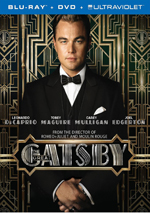
The Great Gatsby appears in an aspect ratio of approximately 2.40:1 on this Blu-ray Disc. This was a good but not great presentation.
Actually, my only complaints connected to definition. While much of the movie displayed positive to excellent delineation, a few mild exceptions occurred, mainly in wide shots. I don’t know if this came as an outgrowth of the 3D photography, but occasional elements lacked the sharpness I’d expect from Blu-ray. Nonetheless, overall clarity was good, and I noticed no signs of shimmering or jaggies. The image lacked haloes or print flaws as well.
A heavily stylized movie opted for a heavily stylized palette. Gatsby followed the modern trend and went with orange and teal much of the time, though a fair amount of red entered the image as well, such as at Myrtle’s apartment. The Blu-ray reproduced the chosen colors in a satisfying manner. Blacks seemed dense and deep, and low-light shots exhibited good delineation. The periodic softness was enough to bump this down to a “B”, though much of the flick looked very good.
While not a slambang mix, the film’s DTS-HD MA 5.1 soundtrack suited it. The soundfield opened up the events acceptably well, though not in a particularly dynamic way. Most of the audio stayed focused in the forward channels, where those speakers featured good stereo imaging for the score as well as a nice sense of delineation for effects. The various elements were accurately placed and moved across the channels well.
The surrounds contributed reinforcement most of the time but contributed a bit of unique information on occasion. The smattering of party sequences worked best, and a few other exterior pieces added pizzazz. They did enough to help create a moderately involving setting.
Across the board, audio quality remained positive. Speech blended with the material and sounded natural. No problems with edginess or intelligibility occurred. The score sounded lively and dynamic, with tight lows and vivid highs. Effects also demonstrated nice dimensionality, as they appeared clean and appropriately powerful. This wasn’t a terribly impressive soundtrack, but it did what it needed to do.
Among the disc’s extras, we mainly focus on a mix of featurettes. The Greatness of Gatsby goes for nine minutes, 14 seconds and offers comments from director Baz Luhrmann, co-writer Craig Pearce, and actors Leonardo DiCaprio, Tobey Maguire, and Elizabeth Debicki. The piece looks at the source novel and its adaptation, location scouts, casting and an early workshop for the actors. Despite the program’s brevity, it offers a mix of useful elements; I especially like the video shots from the workshop.
We get a piece from the actor via ”Within and Without” with Tobey Maguire. Luhrmann introduces the eight-minute, 41-second reel and tells us that we’ll get a video from the set created by Maguire. That’s not 100 percent – or probably even 50 percent - true, as we also see images of Maguire as he films/works along with separate interview statements from Debicki and Maguire. Still, it’s a decent little look behind the scenes.
We shift to music with The Swinging Sounds of Gatsby. It lasts 12 minutes, 17 seconds and delivers notes from Luhrmann, DiCaprio, executive music supervisor Anton Monsted, executive producer Shawn “Jay-Z” Carter, composer Craig Armstrong, and musicians Florence Welch, Bryan Ferry, Oliver Sim and Romy Madley Croft. We get ample notes about the movie’s score and songs in this tight, informative piece.
A historical program, The Jazz Age fills 15 minutes, 43 seconds with some info from Luhrmann, but it usually sticks to F. Scott Fitzgerald-focused snippets from a Ric Burns-directed episode of The American Experience. The two sides don’t always mesh all that well, but we still learn a fair amount about the author and his era.
Style comes to the fore in Razzle Dazzle: The Fashion of the ‘20s. The 16-minute, 22-second featurette includes material with Luhrmann, DiCaprio, Maguire, Debicki, costume designer/producer Catherine Martin, and actors Carey Mulligan and Joel Edgerton. Martin dominates as we learn about costumes and jewelry. She gives us a nice overview of the style choices in the film.
Fitzgerald’s Visual Poetry lasts six minutes, 55 seconds and features Martin and Luhrmann. They talk more about the challenge of adapting the original novel as well as aspects of the movie’s visual imagery. We find another involving program here.
Under Gatsby Revealed, we find five more featurettes: “Gatsby’s Party” (7:12), “Disconcerting Ride” (4:53), “Daisy and Gatsby Meet” (7:49), “The Plaza” (4:26) and “Pool Scene” (5:47). Across these, we hear from Luhrmann, DiCaprio, Pearce, Martin, Maguire, Debicki, Monsted, Mulligan and producer Catherine Knapman. They look at some specific segments of the film and give us info about their execution. The featurettes vary in quality but usually seem useful.
Including intros from Luhrmann (2:06), three Deleted Scenes occupy a total of 14 minutes, 24 seconds. We find “Nick and Jordan” (3:09), “Her Voice Was Full of Money” (2:24) and “Alternate Ending” (6:44). “Nick” develops that romance a bit more, and “Voice” delivers a minor revelation Gatsby has about Daisy. Finally, the “Ending” expands on some supporting characters, including the lead’s father. The first two seem pretty disposable, but the “Ending” offers elements of interest; it wouldn’t have worked well in the final film, but it’s fun to see.
The disc opens with an ad for Gravity. We also get a trailer for the 1926 Gatsby but not one for the 2013 version.
A second disc provides a DVD copy of Gatsby. This lacks any of the Blu-ray’s extras.
2013’s The Great Gatsby gets an “A” for ambition but falters in terms of emotional resonance. The film defines “looks great, less filling”, as it usually fails to make us care about its characters or situations. The Blu-ray provides mostly solid picture and audio along with a reasonably informative set of bonus materials. Gatsby delivers an unusual enough take on its tale to merit a look, but don’t expect much substance or emotional impact from it.