DVD Movie Guide @ dvdmg.com Awards & Recommendations at Amazon.com.
.
Review Archive:  # | A-C | D-F | G-I | J-L | M-O | P-R | S-U | V-Z | Viewer Ratings | Main
SONY

MOVIE INFO

Director:
Fax Bahr, George Hickenlooper, Eleanor Coppola
Cast:
Various
Writing Credits:
Fax Bahr, George Hickenlooper

Synopsis:
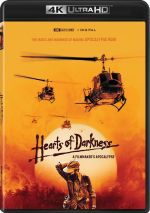
A look at the troubled production of Apocalypse Now.

MPAA:
Rated R.

DISC DETAILS
Presentation:
Aspect Ratio: 1.33:1, 2.35:1
Dolby Vision
Audio:
English DTS-HD MA 5.1
Subtitles:
English
French
Closed-captioned
Supplements Subtitles:
None

Runtime: 96 min.
Price: $29.99
Release Date: 12/9/2025

Bonus:
• “The Making of Hearts of Darkness Documentary


PURCHASE @ AMAZON.COM

EQUIPMENT
-LG OLED65C6P 65-Inch 4K Ultra HD Smart OLED TV
-Marantz SR7010 9.2 Channel Full 4K Ultra HD AV Surround Receiver
-Sony UBP-X700 4K Ultra HD Dolby Vision Blu-ray Player
-Chane A2.4 Speakers
-SVS SB12-NSD 12" 400-watt Sealed Box Subwoofer


RELATED REVIEWS


Hearts Of Darkness: A Filmmaker's Apocalypse [4K UHD] (1991)

Reviewed by Colin Jacobson (December 30, 2025)

Regarded as arguably the greatest “making of” documentary ever, 1991’s Hearts of Darkness: A Filmmaker’s Apocalypse examines the lengthy production of 1979’s Apocalypse Now. This comes mostly via footage shot by director Francis Coppola’s wife Eleanor.

We learn that the production started in February 1976 and covered 238 days of principal photography. In addition to the footage from the set, we hear from Eleanor’s private conversations with Francis; she recorded these without his knowledge and intended to use them as a diary reference.

Narrated by Eleanor, the film tells us about Orson Welles’ intentions to make his own adaptation of Joseph Conrad’s Heart of Darkness and why it didn’t happen. From there we learn about the development of Now, a loose adaptation of the Conrad work.

We hear about original plans for it under George Lucas, how Coppola took over the directorial reigns, and the move into production. We find out the financial risks Coppola took, working with the Philippines government, political complications there, ditching Harvey Keitel as the lead actor and hiring Martin Sheen, and about a million other complications that I’ll skip to leave some surprises.

In addition the Eleanor’s narration and Francis’s comments, we get interviews with other participants. This roster includes co-screenwriter John Milius, originally intended director George Lucas, co-producers Fred Roos and Tom Sternberg, production designer Dean Tavoularis, cinematographer Vittorio Storaro, special assistant to the producers Doug Claybourne, and actors Larry Fishburne, Martin Sheen, Robert Duvall, Sam Bottoms, Fred Forrest, Albert Hall, and Dennis Hopper.

For an indication of Coppola’s whacked-out mindset in the second half of the 1970s, take a look at the statement that introduces Hearts. At Cannes in 1979, he boasts that “my film is not a movie. My film is not about Vietnam. My film is Vietnam.”

Hey, Now is a terrific film, but c’mon Francis! The wild-eyed fanaticism in his eyes shows that Coppola wasn’t quite in his right mind at the time, and Hearts demonstrates what drove him to become so nutty.

And all the others involved as well, for Coppola wasn’t the only one sent around the bend during the shoot. This is a flick during which we see a drunk, naked Martin Sheen cut himself during the shoot but keep going until we see him covered in blood and crying.

There’s something you don’t find everyday, and Hearts comes with more than a few “what wrong with these people?” moments. Heck, when Sheen has a heart attack, you half expect the production to keep going anyway. Even if he died, you get the feeling Coppola would just Weekend at Bernie’s Sheen’s corpse and continue to film.

I don’t want to paint Coppola as some sort of monster, though he can come across as maniacal and obsessive. It’s obvious that the complications of the production simply pushed him to his limits and left him mentally vulnerable.

Hearts paints a good picture of these issues and shows Coppola’s descent into semi-madness - and semi-fatness, as the scariest parts of Hearts come from the shots of a shirtless Coppola. The horror, the horror!

If I wanted to find a problem with Hearts, I’d focus on the length. 96 minutes is pretty long for a “making of” documentary, but it doesn’t feel like nearly enough to capture such a messed up production.

While the film clearly doesn’t avoid controversial subjects, it still breezes through them a little too quickly and feels too much like a quick snapshot instead of a deep examination. A longer version of Hearts would prove very welcome, as it could better explore the intricacies.

On the other hand, I won’t complain that Hearts doesn’t attempt to provide a step-by-step view of the production. A more traditional “making of” documentary would lead us through pre-production, production and post-production with stops to look at each facet of those steps.

Hearts throws in a little about the project’s genesis as well as casting and gives us a denouement related to the flick’s release. However, footage from the set fills the vast majority of its space.

And that’s fine with me. That’s the tale Hearts wants to tell, and it doesn’t pretend to be a complete nuts and bolts view of the flick’s creation.

Someone else can relate the details of editing, set design, score and whatnot, as Hearts doesn’t care about those elements, and it doesn’t need to worry about them. It wants to get inside Coppola’s head, and in that regard, it succeeds.

I think the plethora of behind the scenes documentaries we’ve seen since 1991 also dims the impact of Hearts to a minor degree. 34 years ago, something like this was practically unique, but with the explosion of various digital discs, extensive “making of” programs became much more common.

Yes, it remained rare to find one this long or this willing to embrace sordid details, as too many movie-centered documentaries are filled with fluff. Nonetheless, Hearts doesn’t feel quite as unusual as it did in 1991, and the fact that we’ve gotten so many other programs of this sort slightly diminishes its impact.

But not by a lot, and Hearts of Darkness remains a fascinating look at an extremely troubled production. Rarely do we find “making of” documentaries that examine their subjects in such an unflinching way, and that access makes the program absorbing.


The Disc Grades: Picture B/ Audio C/ Bonus C

Hearts of Darkness: A Filmmaker’s Apocalypse appears in an aspect ratio of 1.33:1 on this 4K UHD Disc except for clips from Apocalypse Now, as those used 2.35:1. The Dolby Vision image looked about as good as I could expect given the nature of the project.

Unsurprisingly, those 2.35:1 shots from Apocalypse Now looked best, though don’t expect them to duplicate the glorious visuals of its 4K UHD release. While the movie showed positive clarity and vivacity, these scenes seemed softer than its individual UHD displayed.

Outside of the Now material, everything came from 16mm elements. The movie mixed photography from the Now set in the 1970s and 1990s interview clips created specifically for this film.

I suspect the producers 16mm for the 1990s stuff to make it blend better with the 1970s shots, and this worked. We got no jarring jumps from one era to the next.

Of course, the 1990s interview shots enjoyed a stability the 1970s didn’t always portray since they weren’t filmed on the fly. Both eras demonstrated pretty good delineation, though.

Of course, the limitations of 16mm meant some softness, especially from the 1970s clips, and I couldn’t claim any of the footage ever looked especially sharp. Again, this became inevitable due to the lower resolution of 16mm so I felt pleased with the sharpness given the sources.

The movie lacked jaggies or shimmering, and no edge haloes appeared. Grain leaned heavy but natural.

Print flaws cropped up via some vertical lines that sporadically manifested during 1970s footage as well as some gate hairs. Some of the outtakes from Now showed specks and marks. These remained reasonably infrequent, though, and most of the film passed without damage.

Hearts opted for natural colors, of course, and they looked fine – again, within the limits of the 16mm photography. This meant the hues never dazzled but they demonstrated pretty good range, with a modest kick from HDR.

Blacks and shadows also looked appropriate, and HDR added a bit of zing to whites and contrast. Not exactly a visual showcase, Hearts nonetheless delivered the source well.

Hearts came with a somewhat superfluous DTS-HD MA 5.1 soundtrack that opened up almost entirely when we got shots from Apocalypse Now. These expanded across the front well but didn’t do much beyond that, so don’t expect these scenes to boast the terrific multichannel audio from the Now 4K UHD.

For the rest of the project, the soundscape remained limited in scope. Segments that reflected the Now production occasionally spread across the front, but these usually remained semi-monaural and didn’t broaden much.

The documentary’s modest score offered similarly mild stereo presence. If the rear channels added anything to the experience, they failed to make themselves known, as the soundfield felt highly oriented toward the front speakers.

Sound quality felt perfectly acceptable. Speech always seemed natural and concise, as the interviews and narration showed nice delineation.

Music was subdued but appropriate, with decent range as warranted. Effects seemed fine, with good clarity, albeit not up to par with the Apocalypse Now 4K’s track. Nothing here excelled, but the mix worked fine given the nature of the project.

Only one extra appears here: a new program simply titled The Making of Hearts of Darkness. It runs 37 minutes, 35 seconds and brings notes from filmmaker Francis Ford Coppola, children Sofia and Roman Coppola, and co-writer/co-director Fax Bahr.

The program looks at the Apocalypse Now shoot from the Coppola POV as well as some aspects of the Hearts creation. The mix of Coppola memories and Hearts nuts/bolts turns this into a solid overview.

Note that prior releases of Hearts included a commentary from Francis Ford Coppola and Eleanor Coppola that this 4K UHD loses. I don’t view this as a terrible loss because that discussion proved light on details and heavy on dead air, but I still wish it’d appeared here for completeness.

An unusually provocative ‘making of’ documentary, Hearts of Darkness: A Filmmaker’s Apocalypse provides a ringside view of a troubled and difficult production. With greater access than expected, we get to see the good, the bad, and the really ugly. It remains a fascinating piece. The 4K UHD offers fairly good picture and audio plus a new featurette, This remains a solid documentary and the 4K UHD becomes its best representation.

.
Review Archive:  # | A-C | D-F | G-I | J-L | M-O | P-R | S-U | V-Z | Viewer Ratings | Main