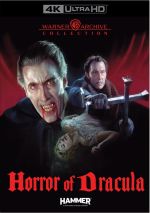
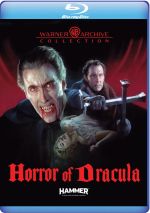
Horror of Dracula appears in an aspect ratio of approximately 1.66:1 on this 4K UHD Disc – well, for some versions, as we also got 1.85:1 for US cuts. This set came with four different cuts of the flick, all of which showed similar picture quality.
Though inconsistent, the Dolby Vision image usually satisfied.
Sharpness seemed a bit up and down, as occasional shots felt a little soft. Nonetheless, the majority of the film offered appropriate delineation, and it could like pretty impressive at times.
No issues with jagged edges or shimmering occurred, and edge haloes remained absent. Plenty of grain meant no signs of digital noise reduction, and print flaws failed to materialize.
Albeit with a bit of a blue tint, the movie’s hues tended to feel lush much of the time. Most of the movie exhibited rich, full tones, and HDR gave them a boost.
Blacks were dense and deep, while shadows offered nice clarity and delineation. HDR added punch to contrast and whites. The nature of the source meant this didn’t become a visual showcase, but I nonetheless felt pleased with this presentation.
Unfortunately, the movie’s DTS-HD MA 5.1 soundtrack held up less well. Speech tended to seem somewhat brittle, though the lines showed decent clarity and never lost intelligibility.
The score tended to be on the rough, edgy side. Effects worked a little better, as they showed reasonable accuracy, but they came with some distortion at times as well.
Don’t expect much from the 5.1 soundscape, as it added little to the affair. Most of the mix remained monaural, with music as the component that used additional channels the most actively.
Weirdly, those occasions came and went without much logic, so the track would go from expansion to the side speakers back to mono abruptly. If the soundscape ever did much – or anything – with the rear channels, I failed to discern those instances, so the mix stayed focused on the front.
The disc also offered the original DTS-HD MA monaural track, and it came with audio quality that seemed fairly similar to its multichannel partner. That said, while music still demonstrated roughness, those issues felt less intrusive than during the 5.1 mix, as the balance meant the score became less “in your face” via the mono version.
Dialogue remained boxy but the lines came across as a bit more natural than during the 5.1 version, and effects also demonstrated a little less distortion. Neither soundtrack worked especially well but I preferred the original mono to the flawed 5.1 version.
How did the 4K UHD compare to the prior Blu-ray from 2018? Both came with seemingly identical monaural tracks but the UHD added the awkward and clumsy 5.1 mix.
The UHD’s Dolby Vision image brought improvements in terms of colors, blacks and delineation. Although the original photography meant limits to the upgrades – and the superior resolution could highlight some of the soft shots – this turned into a decent step up over the 2018 BD.
While the 2018 release included no extras other than a trailer, this 2026 4K UHD packs a bunch of materials. We get four separate versions of the film.
On Disc One, we locate a 1.66:1 Director’s Cut (1:22:20) and a 1.66:1 UK Theatrical Version (1:21:49). Disc Two provides the US 1.85:1 Director’s Cut (1:22:20) and the US 1.85:1 Theatrical Version (1:21:54).
The main differences we get revolve around elements deemed to be too gruesome cut from theatrical issues. These don’t add up to much but since the Director’s Cut becomes the best option since it represents the original filmmakers’ intentions.
How does the framing vary between the 1.66:1 and 1.85:1 versions? The latter essentially sliced some information off the top and bottom of the frame but left the sides largely untouched.
This made the UK versions superior. They represented what the Hammer folks wanted and gave us the most accurate framing.
We can watch “1.66:1 Director’s Cut” with or without an Introduction from Hammer Films Chairman/CEO John Gore (3:16). He discusses the scene restored to this version and touts the movie and the Hammer resources in this fairly superfluous reel.
Five (!) audio commentaries appear as well. Alongside the Disc One Director’s Cut, we start with a circa 2012 track in which film historians Jonathan Rigby and Marcus Hearn offer a running, screen-specific look at the source and its adaptation, characters/story and modifications to the screenplay, cast and performances, set design, music, editing/various cuts of the film, its reception and legacy.
Overall this becomes a good look at the movie. Rigby and Hearn make the track move at a nice pace and give us plenty of useful info about the film.
Rare for a program like this, they even criticize some elements, though those mainly relate to Michael Gough’s performance. Expect a useful session here.
All the remaining commentaries come new to this 2026 release. Another to accompany the Director’s Cut, we get a running, screen-specific chat from Rigby and Professor of Film Philosophy Lucy Bolton in which they cover some production elements but they mainly concentrate on their thoughts about the film.
That makes this essentially an appreciation of Dracula, one that focuses on a lot of praise. When we get movie-making details, Rigby largely repeats notes from the 2012 chat so this becomes an energetic but not especially informative track.
With Disc One’s 1.66:1 UK Theatrical Version, we locate a commentary from podcasters Lizbeth Myles and Paul Cornell. Via their running, screen-specific piece, they go over their feelings about the flick and a few cast/crew notes.
Expect a track similar to the one from Bolton and Rigby, as Myles and Cornell largely just chat about how much they like the film. They seem perky but they don’t really tell us anything substantial about the movie.
Disc Two brings the remaining pair of commentaries, and with the 1.85:1 US Director’s Cut, we hear from film historians Constantine Nasr and Dr. Steve Haberman. They sit together for a running, screen-specific view of story/characters/adaptation, genre domains, cast and crew, themes and symbolism, and various related domains.
The best of the five tracks, Nasr and Haberman bring a rich view of the flick. Though they inevitably repeat a few facts heard elsewhere, they relate a solid production overview along with connected insights during this fine chat.
Finally, writer/filmmaker/film programmer Heidi Honeycutt and cult movie expert Toby Roan give us a commentary for 1.85:1 US Theatrical Version. During their running, screen-specific track, they provide another recording that essentially exists as an appreciation of the film.
Of the three tracks that lean toward praise for the movie, this one probably fares the best, as it feels less gushing and more even-handed than the Rigby/Bolton or Myles/Cornell sessions. If you only want to screen one of the three “appreciation” chats, I’d recommend this one, even if it doesn’t seem especially heavy on insights.
In terms of other extras, Disc One brings a program called Proving Them Wrong that spans 38 minutes 14 seconds. It brings a conversation between Rigby and actor/Christopher Lee's niece Dame Harriet Walter.
"Wrong" looks at the life and career of Christopher Lee. This becomes a pretty good summary, especially since Walter can offer so many personal experiences.
Various odds and ends complete Disc One. We get two versions of the UK Trailer - one with text, one without - and also textless titles (1:41) that show that film footage on its own.
A Censor Card (0:13) simply displays the "warning" that ran in front of the movie in the UK. Clapperboards (1:20) gives some raw - and dull - silent snippets from the shoot.
Along with titles in Italian (0:47) and Spanish (3:20), Disc One concludes with an 8mm Colour Cutdown (8:28) that represents the abbreviated version of the film fans could purchase to run at home. It looks terrible but exists as a curious artifact.
On Disc Two, The Road to Dracula goes for 58 minutes, 58 seconds. It delivers info from biographer Tony Dalton, magazine editor/publisher Richard Klemensen, and film historians Stephen Laws and Wayne Kinsey.
The documentary examines the life and career of director Terence Young, the development of Curse of Frankenstein, and the lead-in to Dracula. We find a solid overview of what led Fisher toward Dracula and related domains.
Gothic for Christians lasts 25 minutes, 11 seconds. Written by Haberman, it brings narration from Doug Bradley
P>
The program covers religious elements and themes in this version of Dracula. "Gothic" turns into an effective investigation of these areas.
Disc Two concludes with more of the same sorts of bits and bobs on the other platter. We get two versions each - one with text, one without - of US and German trailers.
An 8mm Black and White Cutdown (11:00) gives us another severely edited rendition of the film. Like the color one on Disc One, it also looks terrible but offers a decent historical piece.
A seminal genre film, Horror of Dracula offers a taut tale. It brings some interesting changes to the source and packs a punch. The 4K UHD provides very picture along with erratic audio and lots of supplements. I feel pleased with this compelling movie and recommend this as the best version we’re ever likely to find.