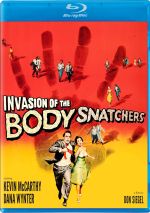
Invasion of the Body Snatchers appears in an aspect ratio of 1.85:1 as well as 2.00:1 on this Blu-ray Disc. The filmmakers shot the film with 1.85:1 in mind but the producers wanted to screen it at a 2.00:1 “SuperScope” ratio.
So that makes both correct – in a manner of speaking – but I prefer 1.85:1. Basically, the 2.00:1 zoomed the sides and cropped the top/bottom to achieve its dimensions.
Granted, these alterations remain modest, so it’s not like a 2.35:1 movie panned/scanned to 1.33:1. Still, the 1.85:1 felt more natural.
As for picture quality, sharpness worked fine for the most part. Although interiors tended to feel a little mushy, the movie usually demonstrated appealing accuracy.
No issues with jagged edges or shimmering materialized, and I saw no edge haloes. Grain seemed appropriate and outside of some frame dirt and a few thin lines, print flaws failed to become an issue.
Blacks seemed reasonably dense and rich, while shadows delivered appealing clarity. Though not without concerns, the image seemed positive overall.
In addition, the film’s DTS-HD MA monaural audio suited a movie of this one’s age and origins. Speech could feel a little reedy but the lines remained easily intelligible and without edginess.
Music showed decent range and effects brought generally solid accuracy, with only a little distortion along the way. The mix seemed more than adequate.
When we shift to the set’s extras, we get a whopping four audio commentaries, the first of which involves filmmaker Joe Dante and actors Kevin McCarthy and Dana Wynter. All three sit together for a running, screen-specific look at the actors’ experiences and careers as well as some filmmaking notes.
Dante appears as moderator and fan. He does well in both roles, as he gives us some good facts along with his ability to ensure the actors engage in the chat.
McCarthy and Wynter do pretty well overall, though McCarthy inevitably dominates. All three participants mesh well to turn this into a largely worthwhile track.
For the second commentary, we hear from film historian Richard Harlan Smith. He provides a running, screen-specific view of the source and its adaptation, other versions of the story, cast and crew, production elements and the flick’s release/legacy.
Smith makes this a pretty traditional film historian track and he does well. He maintains a brisk pace and gives us lots of good details about the flick.
Next we get a commentary with film historians Steve Mitchell and Nathaniel Thompson. They sit together for a running, screen-specific view of topics similar to those covered by Smith.
Inevitably, this means a fair amount of repetition. Indeed, we hear about a prank played by the lifecast crew for the third time!
Mitchell and Thompson tend to look at the movie more from an interpretative point of view than Smith did. They make this an enjoyable chat, even if Mitchell’s utter inability to say Wynter’s first name accurately on a consistent basis becomes irritating, especially since he can’t decide if he wants to mispronounce it as “Dayna” or “Danna”. (Wynter went with “Donna”.)
Though reasonably fun, the Mitchell/Thompson discussion does feel fairly redundant after Smith’s session. You won’t mind the time you spend with them but you won’t learn as much as you’d like – at least not if you already played the first two.
The final commentary comes from film scholar Jason A. Ney. During his running, screen-specific piece, he covers the source and its adaptation as well as production elements and cast/crew.
On its own, this becomes a strong track. However, four commentaries in and we can’t help but find an awful lot of information we already got elsewhere.
Ney does delve into the original story in more detail than the others so we find a moderate amount of fresh material. However, we still find a lot of repetition - yes, that means the same story about the lifecast prank again.
Objectively, Ney’s commentary probably proves best of the bunch, or at least a tie with Smith’s. When heard as the final of four, though, it can feel redundant.
We find three featurettes. The Fear Is Real goes for 12 minutes, 27 seconds and brings us remarks from filmmakers Larry Cohen and Joe Dante.
Those two talk about their experiences with Invasion as well as how it influenced them. “Fear” becomes a decent examination of the movie from their perspectives.
The Stranger In Your Lover’s Eyes spans 11 minutes, 55 seconds. Here director Don Siegel’s son Kristoffer Tabori reads some of his dad’s notes and then he offers a few of his own remarks.
A visual essay, Siegel’s remarks go through his involvement in Invasion along with various notes connected to his work. Tabori digs into family relations.
After all those commentaries, “Eyes” comes with some redundant material. Still, it’s good to hear Siegel’s own thoughts and Tabori adds some useful notes as well.
Finally, I No Longer Belong runs 21 minutes, nine seconds. This one delivers thoughts from biographer Matthew Bernstein.
Producer Walter Wanger’s life and career becomes the focus of “Belong”. Inevitably, the featurette also repeats some thoughts found elsewhere, but Bernstein expands on our knowledge about Wanger to make “Belong” useful.
The disc concludes with trailers for the 1956 and 1978 editions of the flick.
The initial adaptation of a novel that’d see multiple film versions, the 1956 Invasion of the Body Snatchers continues to work well after 70 years. While I prefer the 1978 take on the story, this first movie still seems spooky and eerie. The Blu-ray offers largely positive picture and audio as well as a solid selection of supplements. Expect a strong mix of horror and sci-fi from this classic.