Reviewed by Colin Jacobson (December 17, 2025)
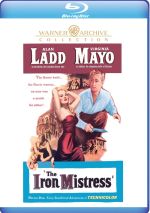
For most people in 2025, the name “Bowie” connects to the late great rock star David. Prior to the 1970s, though, that moniker primarily linked to 19th century frontiersman Jim Bowie, the subject of 1952’s The Iron Mistress.
In 1825, country bumpkin Jim Bowie (Alan Ladd) heads to New Orleans to sell lumber from his family’s farm. He immediately befriends painter – and future naturalist – John James Audobon (George Voskovec), a connection that leads to a misunderstanding with sophisticated Narcisse de Bornay (Douglas Dick).
After they patch up matters, they become pals and Jim meets Narcisse’s beautiful but haughty sister Judalon (Virginia Mayo). As Jim rises through society in terms of status and wealth, he finds himself challenged to succeed in matters of love.
Anyone who enters a 1950s biopic with the expectation of historical fidelity qualifies as delusional. Like most of its genre, Mistress plays fast and loose with the facts.
As such, I tend to look at movies such as Mistress from a perspective of pure entertainment and not judge them on their accuracy. Even with all its alterations to the actual events depicted, do we get an enjoyable film here?
Meh. Despite occasional moments that work, most of Mistress just seems plodding and flat.
Part of the problem stems from our star. I get the sense that Bowie should provide a charismatic character but we never find that in Ladd’s performance.
Instead, Ladd’s Bowie just seems monotonous and dull. He fails to make the part lively in any fashion, so we’re stuck with a one-dimensional lead.
In addition, Mistress creates a barely coherent narrative. Given that its comes from a largely fictionalized version of Bowie’s biography, it perplexes me that the film delivers such a loose story.
Oh sure, it follows some general trends, mostly related to Judalon. However, the tale doesn’t create a consistent thread otherwise, and even the romantic side comes and goes almost at random.
The other actors fare better than Dishwater Ladd, but they can’t overcome the void at the top. Their roles don’t exactly stand out as memorable either.
This means the movie lives or dies with Ladd’s Bowie, and that leans toward the latter. Again, we do find sporadic moments of good drama, especially during a well-staged scene in which Bowie duels another man in the dark.
Outside of that, though, Mistress tends to fizzle. With a miscast main actor, the end product bores more than it entertains.
Footnote: although Jim Bowie’s last name traditionally gets pronounced “Boo-ie”, the film treats it as “Bow-ie” ala David. This seems to be incorrect in the case of Jim, as “Boo-ie” appears to be right.