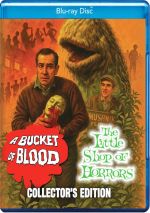
The Little Shop of Horrors appears in an aspect ratio of 1.37:1 on this Blu-ray Disc. Though I’ve seen many better transfers for old films, this one was more than acceptable.
Sharpness varied but was usually nice. Although some shots tended to be a little fuzzy, overall definition was good, so the majority of the movie displayed solid delineation.
No issues with jaggies or moiré effects occurred, and edge haloes remained absent. The film came with a good layer of grain but a smattering of small specks manifested through the film.
The black and white photography looked fine most of the time. Blacks seemed dark and tight, and contrast usually worked well, though some shots felt a bit bright. This became a largely appealing image.
I thought the movie’s DTS-HD MA monaural soundtrack seemed dated but adequate. In terms of dialogue, the lines remained intelligible and offered reasonable clarity, without much edginess.
Neither music nor effects boasted much range or dimensionality, but both appeared clean and accurate enough, without distortion or problems. This mix felt acceptable for its vintage.
How did the 2026 remaster compare to the last Blu-ray from 2023? Though it went with LPCM monaural versus the prior release’s DTS-HD MA mono, I thought the two sounded very similar.
In terms of visuals, the biggest change came from aspect ratio, as the 2023 disc went with 1.85:1. I strongly suspect Shop ran theatrically at 1.85:1 since 1.37:1 was pretty darned defunct on movie screens by 1960.
The question became whether the 1.37:1 cropped from the sides or instead opened up the tops/bottoms in an open matte presentation. I vote for the latter, as the 1.37:1 image showed no obvious indications of excised material on the right or left and it also brought an awful lot of headroom.
I don’t know why this disc’s producers went with 1.37:1 instead of the theatrical 1.85:1. This might appeal to folks who first encountered the film on TV but I’d still prefer the original theatrical dimensions.
Outside of aspect ratio, the 2026 and 2023 presentations seemed awfully similar, though the 2026 brought print flaws absent from the 2023. Combine the cleaner scan and the theatrical aspect ratio and the 2023 became the superior release.
Among extras, we find an EP Mode VHS Version of Shop that spans one hour, 12 minutes, 30 seconds. This looks predictably awful.
Why include this badly flawed presentation? Because so many people initially experienced Shop on cheap videotapes, I guess this exists as nostalgia fodder.
Which seems fine, I suppose. However, I can’t imagine anyone will prefer to view the film that way so the VHS version becomes a gimmick more than anything else.
A Stills Gallery presents 23 frames that represent publicity images and covers from prior releases. Liner Notes includes a decent essay from Calvin Jennings.
Finally, a Roger Corman Trailer Reel that spans 53 minutes, 44 seconds and includes ads for Monster From the Ocean Floor, Five Guns West, Beast with 1,000,000 Eyes, Apache Woman, The Day the World Ended, It Conquered the World, Attack of the Crab Monsters, Not of This Earth, The Undead, Teenage Doll, Sorority Girl, War of the Satellites, Machine-Gun Kelly, The Brain Eaters, Beast from Haunted Cave, The Wasp Woman, A Bucket of Blood, Ski Troop Attack, Little Shop of Horrors, House of Usher, Pit and the Pendulum, Creature from the Haunted Sea, Battle Beyond the Sun, The Terror, Dementia 13, and Tomb of Ligeia. Though the quality of the clips tends to seem meh to bad, this still turns into a nice compilation.
66 years after its release, The Little Shop of Horrors remains remembered for its 1980s adaptation and its early big screen appearance from a young Jack Nicholson. Otherwise, we get a movie with a clever premise and iffy execution. The Blu-ray provides mostly good picture as well as acceptable audio and a few bonus materials. Though this 2026 Blu-ray works fine in its own right, the 2023 release stands as the superior of the pair.
Note that this Blu-ray for The Little Shop of Horrors comes packaged with another Roger Corman movie of its era: 1959’s A Bucket of Blood. I thought each deserved its own review.