|
PARAMOUNT
|
| |
|
MOVIE INFO
|
|
Director:
David S. Ward
Cast:
Tom Berenger, Charlie Sheen, Corbin Bernsen, Margaret Whitton, James Gammon, Rene Russo, Wesley Snipes, Dennis Haysbert
Writing Credits:
David S. Ward
Tagline:
When these three oddballs try to play hardball, the result is totally screwball.
Synopsis:
She's beautiful, smart, goal-oriented, and she just inherited the Cleveland Indians. Unfortunately, she wants to move the franchise to Miami, and a losing season is her only ticket to Florida. So she signs the wildest gang of screwballs that ever spit tobacco. They're handsome, but they're hopeless! Her catcher (Tom Berenger) is a washed-up womanizer who struck out in life. Her ace pitcher (Charlie Sheen) is a punked-out crazy who struck out with the law. And her third baseman (Corbin Bernsen) is more concerned about fielding endorsements than grounders. Throw in a busload of other misfits and you've got yourself a hilarious line-up that's destined for disaster. Or is it?
Box Office:
Budget
$11 million.
Opening Weekend
$8.836 million on 1541 screens.
Domestic Gross
$49.797 million.
MPAA:
Rated R
| |
|
DVD DETAILS
|
Presentation:
Widescreen 1.85:1/16x9
Audio:
English Dolby Digital 5.1
English Dolby Surround 2.0
French Monaural
Subtitles:
English
Closed-captioned
Supplements Subtitles:
English
Runtime: 106 min.
Price: $ 14.99
Release Date: 4/10/07
Bonus:
• Audio Commentary with Writer/Director David S. Ward and Producer Chris Chesser
• “My Kinda Team” Featurette
• “A Major League Look at Major League” Featurette
• “Bob Uecker: Just a Little Bit Outside” Featurette
• “A Tour of Cerrano’s Locker”
• Alternate Ending
• Photo Gallery
• Previews
| |
|
PURCHASE @ AMAZON.COM
|

| |
|
EQUIPMENT
|
Sony 36" WEGA KV-36FS12 Monitor; Sony DA333ES Processor/Receiver; Panasonic CV-50 DVD Player using component outputs; Michael Green Revolution Cinema 6i Speakers (all five); Sony SA-WM40 Subwoofer.
| |
[an error occurred while processing this directive]
|
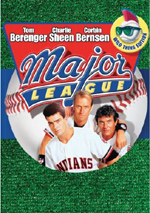
Major League: Wild Thing Edition (1989)
|
|
Reviewed by Colin Jacobson (March 28, 2007)
Back in the late Eighties, baseball-related movies enjoyed a bit of a renaissance. However, other than their connection to the sport, they didn’t present many similarities. Eight Men Out provided a sad look at historical events, while Field of Dreams presented a more nostalgic take on things. Bull Durham used baseball as the backdrop for a romantic comedy.
On the broader side of the street, 1989’s Major Leagues went for a wacky comedy. The flick looks at the then-perennial losing Cleveland Indian franchise. When her husband dies, former showgirl Rachel Phelps (Margaret Whitton) takes over as the team’s owner. She wants to relocate the Indians to Miami, so she intentionally fields a squad that she expects will stink up the joint. If the Indians draw fewer than 800,000 fans, she can void their lease and make the move to Florida.
From there the film leads us through its collection of has-beens and never-wases. We meet broken-down catcher Jake Taylor (Tom Beringer), manager Lou Brown (James Gammon), rough-hewn jailbird fire-baller Rick Vaughn (Charlie Sheen), voodoo-worshiping Cuban refugee Pedro Cerrano (Dennis Haysbert), high-priced underachiever Roger Dorn (Corbin Bernsen), junk-balling, tired-armed veteran pitcher Eddie Harris (Chelcie Ross) and speedy but light-hitting Willie Mays Hayes (Wesley Snipes). Each player possesses talent, but each one also suffers from a fatal flaw.
That’s exactly what Rachel wants, of course, as she expects this motley crew will lead the league in losses and allow her departure to Miami. However, against all odds, the squad starts to put things together and turn into winners. The film follows their progress as well as some personal issues, primarily between Jake and his ex-wife Lynn (Rene Russo).
While I feel extremely reluctant to refer to a minor piece of entertainment like Major League as a classic, I suppose it’s turned into one – sort of. It often comes up in fan polls of the best baseball movies, and it’s endured as a well-liked flick over the last couple of decades. I guess that counts for something.
Personally, I can’t regard League as anything particularly special, but I must admit it possesses a certain charm that still makes it enjoyable. On the surface, it doesn’t offer a whole lot – and that doesn’t change when you try to dig a little deeper. This is a lightweight goofball comedy without aspirations to be anything more than that.
And whaddya know? It usually succeeds. League is a rarity: an actual “R”-rated comedy. That breed of film nearly went extinct until recently, as studios preferred the added ticket sales that usually come with a “PG-13”. Note that League earns its “R” solely for language. There’s no violence to be found, and I recall no nudity beyond some brief butt shots of the players in the locker room. Neither is enough to get an “R”, so it’s the flick’s liberal use of the “F” word that snares its rating.
So this means League is really more of a “PG-13” at heart. “R”-rated comedies usually offer copious amounts of sex and/or nudity, neither of which enters into this equation. I think it’s a bit unfair to saddle League with the more restrictive rating, but that’s the way the MPAA works.
Not that the “R” seems to have hurt it much over the years. Indeed, it’s such a gentle little piece that I don’t see any reason not to allow younger teens to see it; there’s virtually nothing objectionable on display if you don’t mind the profanity. The movie itself seems like prime material for teen kids, as its general simplicity favors the tastes of that age group.
This doesn’t mean League is so unsophisticated that it lacks pleasures for adults, though. Yeah, it is pretty unsophisticated, but it manages to eke out enough wittiness to make it work. The flick goes for many easy laughs and doesn’t possess a lot of originality, but it manages to package in enough crude amusement to succeed.
A good cast helps, as we find a nice roster of quality performers.
None of them make their characters more than two-dimensional, but they don’t need to do so. Except for perhaps Beringer’s Jake, they work best as glorified cartoons, as that fits the flick’s tone.
Speaking of whom, the story tends to sag a bit when we focus on Jake and Lynn. There’s really not much spark there, and their moments feel awkwardly integrated. I get the impression that thread exists a) to attract a female crowd, and b) to feign heart and depth. I don’t know if the former succeeded, but the film didn’t need the latter. This isn’t a rich love story like Bull Durham. I’d have preferred a little more time with the players and less with Lynn.
One can’t claim to find a particularly coherent story here either. The thread about Rachel’s attempts to sabotage the team’s success collapses after a while and plays only a minor role. Actually, I think it’s pretty irrelevant from the start. Yeah, I guess the thread makes us root for the Indians even more, but I don’t find those elements to offer much substance or purpose otherwise. It seems especially perplexing when Rachel still fights the team after it’s clear she won’t be able to break the lease. They’re making you money, honey – enjoy the ride!
I suppose Major League isn’t the sort of flick one should nit-pick, though. I could never refer to it as a tight, creative comedy, but I can call it a fun experience. This is lightweight but amusing stuff.
|
The DVD Grades: Picture B-/ Audio B/ Bonus B
|
|
Major League appears in an aspect ratio of approximately 1.85:1 on this single-sided, double-layered DVD; the image has been enhanced for 16X9 televisions. Although the transfer showed its late-Eighties roots, it usually looked pretty decent.
Sharpness manifested a few flaws, but not too many. Much of the flick seemed accurate and well-defined. Occasionally the movie tended to be a bit iffy, but those instances didn’t pop up with frequency. No jagged edges or shimmering materialized, and edge enhancement remained minimal. Source flaws were a non-concern, as the flick showed few defects. A few minor specks cropped up but nothing else could be seen.
Like many movies of its era, this one came across as a little messy. Tones could seem a bit blotchy, though they usually remained reasonably natural. Blacks were similarly decent but unexceptional, as the dark segments could have been tighter. Shadows varied, though they were acceptably concise. Dark-skinned characters suffered the worst, as they got lost in the low-light scenes. Otherwise, those shots were fine. Overall, the flick presented an acceptable transfer.
Similar thoughts followed for the Dolby Digital 5.1 soundtrack of Major League. I expected a pretty low-key soundfield for a comedy, and the mix usually followed suit. However, it managed to open up acceptably for baseball scenes. These offered good breadth and plopped us in the stadiums pretty well. Otherwise the track stayed subdued, though it managed good stereo imaging for music and a decent sense of atmosphere. Don’t expect anything terrific, but the mix fit the material.
Audio quality seemed good. Speech was concise and natural, with no edginess or other distractions. Music showed nice life and vivacity, while effects were clean and reasonably accurate. Again, there wasn’t much to make the track stand out, but it was good for its era and story.
For this “Wild Thing” edition of Major League, we get a decent mix of extras. We open with an audio commentary from writer/director David S. Ward and producer Chris Chesser. Both sit together for this running, screen-specific chat. They cover locations and sets, musical choices, cast, characters and performances, shooting the baseball sequences, cut scenes, and a few other production elements.
Though it offers a decent overview, the commentary never becomes more involving than that. Neither participant seems very engaged in the process, and they reflect basics without great detail. Occasionally the track picks up a bit, especially toward the end; the climactic game presents the best info. We do get a reasonable recap of the main topics, but we don’t find a terribly memorable discussion here.
Next we get a mix of featurettes. My Kinda Team: Making Major League goes for 23 minutes, 10 seconds as it combines movie clips, archival materials, and interviews. We hear from Ward, Chesser, former catcher Steve Yeager (in 1988), and actors Charlie Sheen, Tom Berenger, Corbin Bernsen, Dennis Haysbert, Wesley Snipes (in 1988), Chelcie Ross and Bob Uecker. We hear about the project’s genesis and development, cast, performances and training the actors, shooting the baseball scenes and filming in Milwaukee, and thoughts about the flick’s success.
Perhaps the best aspect of “Team” stems from the presence of the main actors. It’s good to see Berenger, Sheen and Bernsen show up for this kind of retrospective, and the others help flesh it out as well. We don’t get a ton of insight, and some bits repeat from the commentary, but “Team” serves as a decent little recap.
A Major League Look at Major League runs 14 minutes, 27 seconds and features Indians broadcasters Tom Hamilton and Rick Manning as well as ballplayers Paul Byrd, Aaron Boone, Jason Michaels, Jensen Lewis, and Grady Sizemore. They chat about the flick and compare it to their experiences in baseball. This becomes a surprisingly fun look at the movie through real players’ eyes. No, it’s not exactly analytical, but it’s entertaining as the jocks tell us how it matches their real-life experiences.
For Bob Uecker: Just a Little Bit Outside, we find a 12-minute, 43-second piece with notes from Uecker, Boone, Hamilton, Michaels, Sheen, Lewis, Manning, Sizemore, Ward, Chesser, and Ross. We learn a bit about Uecker’s career and his work in the film. At times this threatens to become a puff piece with little purpose other than praise for Uecker. However, he offers many funny comments about himself and his work. Add to that a generous helping of deleted or alternate takes and this ends up as a good program.
A Tour of Cerrano’s Locker fills 97 seconds. In character, Dennis Haysbert lets us see all of Pedro’s voodoo relics. It’s a marginally interesting archival piece.
Though we don’t find a set of deleted scenes, we do encounter an Alternate Ending. This four-minute and 19-second clip casts the Rachel character in a radically different light. Chesser offers some notes to explain why the scene failed to make the cut. He and Ward also discuss this in the commentary, so if you listen to that first, you’ll know what to expect. Personally, I’m very glad they changed this part of the flick, as I think it’s a terrible twist.
Next we find a Photo Gallery. This collection features 120 shots, but don’t get too worked up about that number. Most offer fairly bland shots from the set and promotional images. More intriguing are some pictures from deleted scenes, a notion that makes me wonder why those segments fail to appear on the DVD.
The DVD opens with a few ads. We get promos for Tommy Boy, Airplane!, and Ferris Bueller’s Day Off. These also appear in the disc’s Previews area. No trailer for Major League shows up on the DVD.
While I wouldn’t classify Major League as one of the better baseball movies, it boasts a charm that makes it enjoyable. Sure, the flick misfires at times, but it does enough right to succeed. The DVD presents decent to good picture and audio along with a smattering of useful extras. All of this comes at a cheap price of less than $15, so Major League earns my recommendation.
|
|
[an error occurred while processing this directive]
|
|