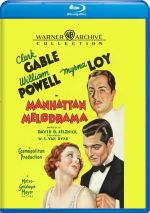
Manhattan Melodrama appears in an aspect ratio of 1.37:1 on this Blu-ray Disc. Given the film’s advanced age, it came with anomalies, but it largely satisfied.
Sharpness usually fared well. A few shots came across as a little ill-defined, and I can’t claim the movie exhibits especially precise delineation on a consistent basis.
Nonetheless, the image stayed mostly distinctive and concise. I saw no problems with jagged edges or shimmering, and edge haloes remained absent.
Grain seemed fairly natural. The film lacked obvious print flaws.
Blacks seemed deep and dense, and low-light scenes demonstrated positive clarity. Overall, the image held up well over the years.
As for the DTS-HD monaural soundtrack of Manhattan, it never stood out as great, but it seemed more than acceptable when I considered its age.
<
Speech occasionally showed some edginess. However, those moments occurred infrequently, and the lines always remained intelligible.
Effects remained well within the realm of acceptability for their age and only showed minor distortion. Music lacked much dynamic range and the score heard during the opening credits sounded shrill.
However, those elements fared better through the movie proper, although the score remained metallic. Nothing here excelled but the track worked fine for something from 92 years ago.
As we shift to extras, we get a September 9, 1940 Lux Ratio Theater Broadcast adaptation of Manhattan Melodrama. It runs 58 minutes, 48 seconds and brings back William Powell and Myrna Loy to reprise their film roles, with Don Ameche as a substitute for Gable.
More than many films, Manhattan loses a lot of impact without its visuals. Since they only rely on their voices, the actors tend to overplay their parts so we lose the subtlety of the movie.
In particular, this impacts Powell. Much of his appeal in the cinematic version comes from the manner in which he conveys his emotions related to Jim's relationship with Blackie, and that goes bye-bye in the radio adaptation.
In addition, without Gable's roguish charm, Blackie seems more like a jerk. Ameche feels miscast, as he lacks Gable's charisma.
Ameche also sounds so much like Powell that their shared scenes can create confusion. The broadcast adaptation becomes a good addition thanks to its archival value, but it doesn't really work on its own.
Along with the movie’s trailer, we find two vintage shorts from 1934. We get The Big Idea (19:13) and Roast Beef and Movies (16:15).
Idea stars Ted Healy and “His Three Stooges” in a story where a man (Healy) tries to come up with story ideas but gets interrupted by the Stooges and others. It seems tedious and exists mainly as an excuse for different scenarios.
Beef offers a similar plot in which three schemers try to sell movie concepts to a studio. While more entertaining than Idea, it still doesn’t go much of anywhere.
It merits notice simply because it offers a Stooge alone. Billed as “Jerry Howard” – closer to his real name of “Curly Horwitz”- we get a rare glimpse of a single Stooge without the other two.
Thanks to a fine cast, Manhattan Melodrama becomes a perfectly watchable effort. The movie never really excels, but the actors keep us with it. The Blu-ray comes with generally positive picture and audio as well as a smattering of supplements. Watch it for its stars.