Reviewed by Colin Jacobson (February 4, 2026)
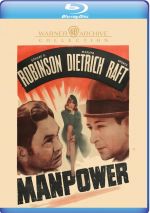
Actors Edward G. Robinson and George Raft and director Raoul Walsh stand high on the list among those most associated with 1930s/1940s gangster movies. However, their partnership for 1941’s Manpower avoids the crime genre.
After a leg injury hobbles him, LA power line worker Hank McHenry (Robinson) takes a gig as foreman. His crew includes his pal Johnny Marshall (Raft) and Antoine “Pop” Duval (Egon Brecher).
When Pop dies on the job, they get to know his daughter Fay (Marlene Dietrich). She marries Hank for money and stability but falls for Johnny and thus creates a tense love triangle.
It feels perverse to unite Raft and Robinson for the first of only two joint efforts and avoid their bread and butter genre, especially with White Heat director Walsh behind the camera. The second Raft/Robinson flick – 1955’s A Bullet for Joey - plopped them in the film noir domain, so at least that one seemed like a better fit for those two.
Potentially, that is, since I never saw Joey. Despite the casting of Raft and Robinson outside of the mobster realm, I still hoped Manpower would work, especially given the involvement of Walsh and Dietrich.
Although those three actors become a big attraction in theory, in reality they prove detrimental. This feels especially true because all seem far too old for their roles.
During the shoot, Raft and Dietrich were 39 and Robinson was 47. Their characters come across as though they should be at least a decade younger.
This goes for the supporting cast, as we get similarly “aged” actors in parts that just feel off from that point of view. Their antics seem more logical for considerably younger people than this middle-aged crew.
Even without this issue, Manpower becomes a less than coherent tale. It tries to mix romance, comedy and thrills but it can’t connect these in a sensible manner.
The flick flips from one domain to another without clarity. Better-made movies could meld tones well but that doesn’t become the case here.
Indeed, our three leads often feel like they exist in different movies. Raft continues with his usual tough guy demeanor, and Dietrich sticks with the tired – so tired! – vibe delightfully spoofed in 1974’s Blazing Saddles.
Robinson manages to go against type with the ebullient Hank. He turns into the only role with actual dimensionality and Robinson makes him a likable character.
The fine supporting cast adds to the experience too. We find good folks like Alan Hale Sr., Eve Arden and Ward Bond, all of whom add some charge to the proceedings.
Along with miscast leads, though, the scattered nature of the story and the inconsistent sense of tone negate the smattering of positives, though. Even with a lot of talent involved, Manpower never clicks.