DVD Movie Guide @ dvdmg.com Awards & Recommendations at Amazon.com.
.
Review Archive:  # | A-C | D-F | G-I | J-L | M-O | P-R | S-U | V-Z | Viewer Ratings | Main
WARNER

MOVIE INFO

Director:
Max Reinhardt, William Dieterle
Cast:
James Cagney, Jean Muir, Dick Powell
Writing Credits:
Charles Kenyon, Mary C. McCall Jr.

Synopsis:
Two couples and a troupe of actors have an encounter with some mischievous fairies in the forest.

MPAA:
Rated NR.

DISC DETAILS
Presentation:
Aspect Ratio: 1.37:1
Audio:
English DTS-HD MA Monaural
Subtitles:
English
Closed-captioned
Supplements Subtitles:
None

Runtime: 144 min.
Price: $21.99
Release Date: 8/4/2026

Bonus:
• Audio Commentary from Film Historian Scott MacQueen
• “A Dream Comes True” Vintage Featurette
• Olivia de Havilland Screen Test
• 8 Vintage Shorts
• Trailer


PURCHASE @ AMAZON.COM

EQUIPMENT
-LG OLED65C6P 65-Inch 4K Ultra HD Smart OLED TV
-Marantz SR7010 9.2 Channel Full 4K Ultra HD AV Surround Receiver
-Panasonic DMP-BDT220P Blu-Ray Player
-Chane A2.4 Speakers
-SVS SB12-NSD 12" 400-watt Sealed Box Subwoofer


RELATED REVIEWS


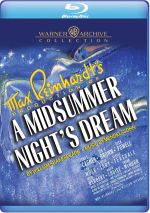
A Midsummer Night's Dream [Blu-Ray] (1935)

Reviewed by Colin Jacobson (August 12, 2026)

With 1935’s A Midsummer Night’s Dream, we get the third cinematic adaptation of William Shakespeare’s late 16th century play. This Hollywood version delivers the first sound edition, though, as the two prior attempts brought silent flicks.

Athenian Duke Theseus (Ian Hunter) plans to marry Hippolyta (Verree Teasdale), Queen of the Amazons. Hermia (Olivia de Havilland) loves Lysander (Dick Powell) but her father (Grant Mitchell) betroths her to Demetrius (Ross Alexander) against her wishes.

Additional romantic domains ensnare others, all of which leads to confrontations in a forest led by Fairy King Oberson (Victor Jory) and Queen Titania (Anita Louise), both of whom encounter their own conflicts. When actors who prepare a play and mischievous Puck (Mickey Rooney) arrive as well, a mix of complications result.

Old Billy Shakespeare threw an awful lot at the stage with Dream. That synopsis makes matters semi-vague, as a more detailed summary would require more paragraphs than really seem necessary.

Admission time: I never viewed Dream in any form until I watched this Blu-ray for the 1935 version. As such, some of my thoughts about the film may stem more from Shakespeare’s play and less from this cinematic adaptation.

Should you infer from that statement that I didn’t like this Dream. Ooh, that’s a bingo!

One prominent issue stems from the sheer number of characters. Dream packs its tale to the gills with various participants, a number of whom don’t seem especially necessary.

Despite the supposed focus on the various lovers, the story flits about in ways that leave different characters on the sidelines for extended periods. When they appear, their narratives seem to progress almost at random.

Do these choices stem from the Shakespearean source or do the filmmakers simply adapt the play in a confusing manner? I don’t know, but I do feel that this production becomes a scattered mess too much of the time.

It doesn’t help that at no point do I find any reason to invest in the characters. None of them boast real life and the actors tend to overplay to the hilt.

Special notice must go to Rooney’s Puck. While I get the role intends to be impudent, Rooney offers arguably the most irritating performance in cinematic history.

Woefully miscast Powell and James Cagney don’t help. Obviously the studio used them for box office reasons, as both fail to fit their roles in the slightest and they seem horribly out of place.

On the positive side, the film’s score works well and Dream brings a lavish production for its day. Even given the limitations of the era’s effects, it still often looks great and displays immense ambition.

Indeed, I can’t help but suspect Walt Disney took inspiration from this version of Dream for his 1940 animated classic Fantasia. Many parts of Dream can feel like live-action segments from Fantasia.

As much as I respect the cinematic aspects of Dream, the movie itself becomes a chore to watch. With overwrought performances and a muddled sense of narrative, the flick doesn’t work.


The Disc Grades: Picture B-/ Audio C+/ Bonus B

A Midsummer Night’s Dream appears in an aspect ratio of 1.37:1 on this Blu-ray Disc. This became a somewhat spotty presentation.

Admittedly, some of the visual issues likely stem from the original cinematography. Dream used a moderately airy feel to suit the fantasy elements, and it also came with lots of ambitious for the era effects.

Nonetheless, a fair amount of the film seemed soft for no apparently photographic purpose. Definition varied from very good to oddly tentative without consistent rhyme or reason.

Otherwise, I felt pleased with the image, as I witnessed no signs of jaggies or moiré effects and edge haloes failed to manifest. Grain seemed appropriate and print flaws didn’t interfere.

Blacks leaned a little gray but they usually offered reasonable depth, and low-light shots brought positive clarity. Despite various positives, this still ended up as an inconsistent image.

I also thought the film’s DTS-HD MA monaural seemed a little erratic for its era, mainly due to a tinnier than typical impression. Dialogue remained intelligible but could veer somewhat metallic.

Similar impressions greeted music and effects, as both appeared moderately thin and without range. Even given the standards of the period, the mix felt somewhat lackluster.

The disc includes a mix of extras and these launch with an audio commentary from film historian Scott MacQueen. He provides a running, screen-specific look at the source and its adaptation, cast and crew, aspects of the production and the film’s reception/legacy.

Taped in 2007, MacQueen gives us a thorough look at the creation of the film. Via the use of 1930s documents, he delivers a strong historical perspective and fleshes out those elements with plenty of other details to turn this into a terrific chat.

Entitled A Dream Comes True, we get a circa 1935 featurette about the creation of Dream that spans seven minutes, 30 seconds. It offers a glossy and contrived view of the production but still brings an interesting time capsule.

Next comes a Screen Test (8:38) of Olivia de Havilland’s audition for a planned film called Danton that never came to fruition. That makes it an intriguing look at the young de Havilland.

Along with the movie’s trailer, we wrap with eight shorts. This section presents Shake Mr. Shakespeare (20:11), Warner Bros. Studio Café (1:51), Presenting Mr. Dick Powell (1:31), Presenting Miss Anita Louise (1:19), Presenting Miss Jean Muir (0:58), Presenting Mr. Frank McHugh (1:25), Presenting Mr. Ian Hunter (1:06), and Presenting Miss Olivia de Havilland (1:04).

Via Shake, we locate a 1930s musical reel in which a filmmaker falls asleep and then imagines Shakespearean characters come to life and pursue careers in Hollywood. It seems as silly as that concept implies.

Café shows Dream actor Joe E. Brown and fellow thespian Pat O’Brien as they eat lunch and talk about the movie. This becomes nothing more than an ad for the flick but it shows some cleverness.

As for the six Presenting reels, each shows the respective actors as they offer tidbits meant to promote Dream. They lack substance but offer some vintage charm.

Thanks to a ‘spare no expense’ approach from the studio, this 1935 A Midsummer Night’s Dream often becomes a visual delight. However, the rest of it flops, as the adaptation suffers from poor pacing, awkward storytelling and a slew of terrible performances. The Blu-ray brings positive picture and audio as well as a nice batch of bonus features. The movie becomes a lovely failure.


.
Review Archive:  # | A-C | D-F | G-I | J-L | M-O | P-R | S-U | V-Z | Viewer Ratings | Main