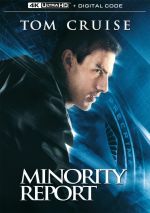
Minority Report appears in an aspect ratio of approximately 2.39:1 on this 4K UHD Disc. Overall, the Dolby Vision presented seemed to replicate the original material well.
Sharpness came across as solid. Only a smidgen of softness emerged, as the majority of the movie remained distinct and accurate.
Jagged edges and moiré effects displayed no concerns, and edge haloes were absent. Grain could seem heavy but this matched visual choices and the image lacked print flaws.
Like I stated in the body of the review, Report featured a very desaturated image. It used the bleach bypass process to remove colors from much of the film, which often left it with white-skinned actors and very subdued tones in general.
The movie showed a cold, bluish palette for the most part. It warmed up a little at the Hineman greenhouse, as the natural setting displayed slightly stronger tones, but the colors remained mostly desaturated.
The only scene that offered genuine life came from Anderton’s flashback to Sean’s kidnapping, as it featured bright and lively hues that seemed startling after all the coldness. The disc replicated the colors well and HDR gave those bolder instances good power.
Contrast played an important role in Report, as Spielberg gave the movie a bright, blown-out look much of the time. It showed harsh white lighting on occasion, which made the contrast unusual.
In any case, black levels looked dark and dense, while shadow detail was appropriately opaque but not too thick. Though the white light dominated some scenes, quite a few low-light sequences occurred as well, and those looked clear and distinct.
HDR offered added punch to whites and contrast as well as greater depth to blacks. Ultimately, the picture of Minority Report provided a vivid and accurate representation of the original material
The DTS-HD MA 5.1 soundtrack of Minority Report also seemed satisfying. The soundfield presented an active and lively piece that constantly engaged the five main speakers.
The film showed distinctive imagery throughout the movie that placed different auditory elements accurately within the spectrum and meshed them together nicely. Music provided strong stereo imaging, and effects popped up from the appropriate locations.
Quieter scenes displayed natural ambience, while the many action set pieces involved engrossing and vibrant imaging. A number of segments stood out in that regard, but the chase scenes that involved vehicles seemed most impressive, as the different elements zoomed about the room effectively.
Audio quality also seemed positive. Speech consistently appeared natural and crisp, and I noticed no issues related to edginess or intelligibility. Music sounded bright and dynamic as the disc neatly replicated the score.
Effects packed a nice wallop when necessary, as these elements seemed clean and distinct at all times. Bass response came across as deep and tight, and the low-end added a good layer of depth and oomph to the package. I anticipate high quality from the audio heard in Spielberg movies, and Minority Report largely matched my expectations.
How did the 4K UHD compare with those of the Blu-ray from 2010? Both came with identical audio.
The Dolby Vision 4K UHD delivered upgrades in terms of sharpness, colors and blacks. This turned into an effective step up in picture qualoty.
No extras appear on the 4K UHD disc but a Blu-ray packed with supplements presents plenty. First up comes an “interactive guide” called The Future According to Steven Spielberg.
The main component here provides a 34-minute, three-second program during which director Spielberg discusses wanting to work with Tom Cruise and coming onto the project, some story/character elements, creating the science fiction as realistically as possible, sets and locations, costumes and props, previz, futuristic technology and various effects, cast and performances, sound design and music, and general thoughts.
Spielberg has never produced a commentary – and probably never will – but he’s always an engaging interview subject. He covers a mix of movie topics well here, so we learn a lot about the flick. It becomes a nice chat.
<
Along the way, “Future” allows you to choose to branch off onto a mix of other elements. These include storyboards and concept art, interviews with cast and crew, and behind the scenes footage/stills. For the interviews, we get 69 snippets that last a total of one hour, three minutes and 30 seconds.
Across these, we hear from actors Tom Cruise, Max Von Sydow, Kathryn Morris, Colin Farrell and Samantha Morton, author’s daughter Isa Dick Hackett, screenwriter Scott Frank, ILM visual effects supervisor Scott Farrar, Philip K. Dick biographer Gregg Rickman, science and technology advisor John Underkoffler, production designer Alex McDowell, producer Bonnie Curtis, Oblong Industries CEO Kwindla Hultman Kramer, director of photography Janusz Kaminski, prevision creators Kurt Mattila and Matt Checkowski, costume designer Deborah Scott, visual effects supervisor Henry LaBounta, composer John Williams, ILM compositing supervisor Scott Frankel, ILM art director Alexander Laurant, stunt cooordinator Brian Smrz, ILM visual effects producer Dana Friedman, ILM computer graphics supervisor Barry Armour, ILM sequence supervisor Steve Braggs, ILM software developer Steve Sullivan, ILM visual effects editor Michael Gleason, special effects supervisor Michael Lantieri, sound designer Gary Rydstrom, and producer Gerald L. Molen.
Through all of these interactive elements, we find plenty of nice material, but the interface annoys. I’d like to be able to view the pieces without having to constantly branch off from the main program.
Also, some of them appear more than once, so if you’re not paying close attention, you may get stuck with repeated clips. I like parts of the interactive guide but could live without the hassle of its navigation.
Note that many of the interview clips appear in subsequent featurettes. I can’t claim that all of them can be found elsewhere, but we find a lot of them along the way. That makes the format even more frustrating, as you’ll clearly have to sit through much of this material more than once.
An unusual featurette called Inside the World of Precrime follows. It goes for 10 minutes, 11 seconds and gives us a reel that tells us about the greatness of the precrime program. The show treats “precrime” as reality, which makes it clever and fun.
For info about the story’s author and its adaptation, we head to the 14-minute, 18-second Philip K. Dick, Steven Spielberg and Minority Report. It features notes from Hackett, Rickman, Underkoffler, Frank, and McDowell.
This delivers info about Dick’s life and career as well as aspects of the Report tale and its move to the screen. The parts that discuss Dick’s biography are the most interesting; I’d have liked more of those as well as a good comparison between the original text and the film. Too much of the piece seems banal and just throws out bland notes about the movie, though.
Minority Report: Future Realized fills six minutes, 22 seconds and features Unterkoffler. This one looks at circa 2002 technology that reflects concepts seen in the movie. At times it feels like an ad for Unterkoffler’s firm, but it still gives us a reasonably interesting take on the topic/
For the next piece, we get the nine-minute, 43-second Minority Report: Props of the Future. In this, McDowell takes us on a tour of various props from the film. This becomes a fun way to get a closer look at these elements.
Highlights from Minority Report: From the Set splits into two areas. We get “The Hoverpack Sequence” (6:06) and “The Car Factory Sequence” (2:57).
These offer remarks from McDowell but mostly concentrate on video from the shoot. I like that kind of material, and these clips offer some nice behind the scenes elements.
Next comes Minority Report: Commercials of the Future. It goes for three minutes, 55 seconds and features remarks from McDowell and Frank.
They discuss the way the movie’s future society involves advertising and how the flick’s ads were created. This becomes another intriguing take on the material.
Under Previz Sequences, we get two segments. These cover “Hoverpack Sequence” (2:10) and “Maglev Escape” (1:43).
Both use split-screen to show the original previz animation along with the final movie footage. I’m not a huge fan of previz shots, but these depict the material well.
“From Story to Screen” goes into two areas. The Story/The Debate lasts nine minutes, 36 seconds and features Spielberg, Cruise, Frank, Curtis, Molen and screenwriter Jon Cohen.
Spielberg and Cruise discuss their prior desire to work together and the origins of their collaboration, and we also hear about the writers’ approach to the adaptation of the short story and some basic discussion of exposition and philosophical issues. The program sets up the movie relatively well and seems moderately interesting.
The other element of “From Story to Screen”, The Players runs nine minutes, 27 seconds and it includes remarks from Cruise, Spielberg, Farrell, Von Sydow, Morton, and Morris, and Kaminski.
As with many of the other pieces, this one suffers from too many film clips, and we also hear too much general praise for Spielberg. We get some decent information about the shoot as well as as bland descriptions of the characters.
Kaminski gives us some nice notes about his visual approach to Agatha, and the behind the scenes snippets seem engaging. Otherwise, “Players” comes across as somewhat superficial and unengaging.
“Deconstructing Minority Report” divides into five smaller areas. The World of Minority Report - An Introduction takes nine minutes, 21 seconds and includes statements from Spielberg, Cruise, McDowell, Kaminski, Williams, and Curtis.
We hear about the “think tank” organized to envision a society of the future, the choice of Washington as a location, the approach to visuals in DC, Spielberg’s use of the film noir visual language and his desire to film the “ugliest, dirtiest movie I’ve ever made”, and also some notes about the score. Overall, “Introduction” provides a fairly general featurette that offers a decent look at the film as a whole.
Up next we see Precrime and Pre-cogs, an eight-minute, 20-second program. It includes comments from Spielberg, Kaminski, McDowell, Lantieri, Scott, and property master Jerry Moss.
They go over the design of film, including the sets, visual clutter, the pre-cog sculpture, the pre-cog chamber, various costumes, and the weapon design. The show provides a quick but decent look at these topics.
For specifics about The Spyder Sequence, we move to this five-minute, 24-second piece. It features McDowell, LaBounta, Rydstrom, Williams, and Kaminski.
It covers the visual design of the spyders, shows some rough CG animation and pre-effects plates, and it takes us through the various processes. The program seems somewhat superficial, but it offers some nice notes about sound design, scoring for the spyders, and problems related to camerawork and lighting.
Pre-cog Visions lasts four minutes, 51 seconds, and gives us comments from Spielberg, Mattila, Checkowski, Cruise, and Underkoffler. They discuss the concepts behind the previsions, memories of witnesses and their influence on the design as well as the interface for the previsions screen.
It offers a good look at the approach to these distinctive visuals. Interestingly, it also gives us some glimpses of murder shots that seem not nearly as evident in the final flick.
The final component of this area, Vehicles Of the Future takes five minutes, 10 seconds. It features Spielberg, Frankel, Rydstrom, vehicle designer Harald Belker, McDowell, and Lantieri.
As one might expect, they discuss the different vehicles, and we hear about the Mag-Lev cars, the Lexus and background cars, and the flying hovership. We learn about the visual and sound design in this quick but reasonably interesting featurette.
After this we move to “The Stunts of Minority Report”. First we get The MagLev Escape, which goes two minutes, 58 seconds and includes statements from Cruise and Smrz. While the behind the scenes shots still seem good, the verbal information comes across as puffy. We get a little about the mechanics of the stunts that involve
In Hoverpack Chase, we get a three-minute program that involves McDowell, Lantieri, Smrz, Spielberg, and Kaminski. We hear about the physical construction of the set for this scene as well as camera considerations and wire challenges. The “before and after” visuals seem cool, but the other comments appear less useful.
For the final stunt featurette, we learn about Car Factory. It goes for two minutes, 48 seconds, and provides notes from Farrell, Cruise, Curtis, and Smrz.
It goes over the basic elements of that scene. Like the other segments, the comments seem somewhat flat, but the shots from the set offer some fine material.
The next section covers “ILM and Minority Report”. An Introduction lasts four minutes, 31 seconds and features statements from Cruise, Farrar, Laurant, Friedman, and Spielberg. Essentially this offers a general discussion of the scope of ILM’s work, and it provides a reasonably useful overview of these topics.
From there we go into ILM’s specific work on the film. Holograms takes three minutes, nine seconds, and features Armour, Braggs and Sullivan. It provides a good little explanation of how they wanted the holograms to look and how they did it.
Next we learn about the Hall of Containment. It goes three minutes, nine seconds and includes Scott Farrar, ILM sequence supervisor Lindy DeQuattro, and Friedman. As always, the behind the scenes shots offer the best moments, but this gives us a decent chat about the methods used to bring the Hall to life.
After this we get notes about the MagLev in this three-minute, 12-second piece. We hear from Laurant and ILM sequence supervisor Thomas Martinek.
They cover the Mag-Lev design process and its challenges as well as the execution of them. This gives us another nice chat about the topic, and it includes some good “before and after” shots.
Hovercraft and Hoverpacks takes three minutes, eight seconds and features Friedman, Frankel, and Farrar. We get a discussion of the creation of these elements and the mechanics that surround them. Again, the program seems brief but reasonably informative and engaging.
For the last “ILM” program, Cyber Parlor goes one minute, 58 seconds and provides statements from Gleason. Another nice discussion, it’s mostly fun to see the shots without the effects. The program also identifies the “conceited performer”.
The last featurette, Final Report runs three minutes, 58 seconds, and consists of comments from Cruise and Spielberg. Even though the disc touts this as an “in-depth discussion”, don’t expect anything substantial here.
Mainly Spielberg tells us how great Cruise is while Cruise tells us how great Spielberg is. The program offers little of use and seems bland.
Production Concepts breaks down into 13 subdomains, and one of those – “Vehicles” – then splits into three smaller sections. Each of these includes concept art, preliminary sketches, and storyboards.
They consist of between six and 43 frames per section for a total of 291 images. The art seems interesting, and the Blu-ray’s display improves on that of the DVD. The latter made the elements awfully small, but here they better fill the screen.
Next we find a collection of three Storyboard Sequences. These film the boards and run them alongside movie audio.
We get looks at the “MagLev Sequence” (two minutes, eight seconds), the “Alley Chase” (three minutes, 36 seconds), and the “Car Factory” (three minutes, 19 seconds). This presentation works well, as the film audio helps bring the art to life.
The disc finishes with three trailers for Minority Report.
As a movie, Minority Report showed some weaknesses but it seemed generally intriguing and involving. It provided a compelling and lively piece of work that marks something different from Steven Spielberg. The 4K UHD features representative picture quality along with excellent sound and a good set of extras. This isn’t great Spielberg, but it’s enjoyable, and the 4K UHD brings it home well.