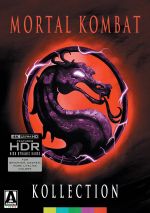
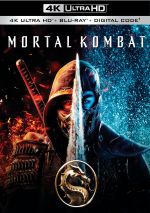
Mortal Kombat appears in an aspect ratio of approximately 1.85:1 on this 4K UHD Disc. This became a generally satisfying Dolby Vision presentation.
Sharpness usually worked fine, though low-light shots could lean a bit soft. I couldn’t help but wonder if some grain reduction impacted these.
Light grain did pop up at times but it seemed surprisingly minor during the darker bits. That said, these didn’t display obvious signs of tampering so the scan may represent the source accurately and these dimly-lit scenes may simply have always looked a bit ill-defined
No issues with jaggies or moiré effects manifested, and I saw no edge haloes. Print flaws remained absent.
While exteriors tended to feature a fairly natural palette, other shots often emphasized orange, red or blue. The hues looked bold within those choices, and HDR added punch to the proceedings.
Blacks felt deep and dense, and HDR gave whites and contrast extra zing. Outside of some softness, I thought this became a solid presentation.
From the opening shout of “Mortal Kombat”, the movie’s DTS-HD MA 5.1 proved active – and loud, as it blasted from my speakers. The soundscape used all five channels on a nearly constant basis.
Of course, the many action scenes became the most involving, but score also involved the whole spectrum. The handful of quieter sequences also managed good broadness and engagement.
Audio quality packed a good punch, with effects that appeared full and dynamic. Music followed suit, and both of these elements boasted bold low-end.
Speech seemed natural and concise. This turned into a rock-em, sock-em soundtrack.
How did the 4K UHD compare to the Blu-ray version? Although I expected virtually identical audio when I compared the UHD’s DTS-HD MA 5.1 track to the BD’s DTS-HD MA 5.1 mix, the former proved substantially more active and dynamic.
The UHD’s Dolby Vision image also became a clear upgrade, as it showed superior definition, colors and blacks. In terms of both audio and picture, the UHD became a major step up compared to its 2011 Blu-ray predecessor
Only minor extras showed up on the 2011 Blu-ray, but the Arrow release packs a slew of components, and we launch with two separate audio commentaries, both recorded specifically for this set. The first comes from director Paul WS Anderson, as he delivers a running, screen-specific look at how he came to the project, story/characters, sets and locations, visual domains, stunts and action, cast and performances, effects, editing, photography and related topics.
A veteran of the format, Anderson knows what to do with chats of this sort. He makes this an engaging and informative piece.
For the second commentary, we hear from comic book expert Dave Baxter. During his running, screen-specific chat, he talks about the history of the video games, aspects of their adaptation to the screen and connected domains.
It seemed weird to me that a comic book guy would discuss a movie taken from a video game, but Baxter easily overcomes any concerns. He provides a great look at these subjects and makes this a lively and useful conversation.
A mix of video programs ensue. Cage Match spans 16 minutes, 13 seconds and involves actor Linden Ashby.
He discusses his experiences with video games, how he came to Kombat, his character and performance, and aspects of the production. Ashby gives us a solid overview.
Levelling Up goes for 16 minutes, 16 seconds. Here we find remarks from cinematographer - and sequel director - John R. Leonetti.
The chat looks at Leonetti's family history in Hollywood as well as his work on this film and his eventual shift to the director's chair. Leonetti covers these topics well.
Next we go to Quarters to Millions. During this 18-minute, 16-second piece, we get notes from producer Lawrence Kasanoff.
"Quarters" discusses the path Kombat took to go from arcades to the big screen along with aspects of the production and its sequel. Expect another informative reel here.
The Heavyweight occupies 15 minutes, 43 seconds. Goro designer/suit performer Tom Woodruff Jr. becomes the subject here.
Woodruff tells us about how he brought Goro to life as well as some other aspects of his career. We get worthwhile insights here.
From there we hit A Journey Behind the Scenes. Created in 1995, it fills 15 minutes, 10 seconds and involves Anderson, Kasanoff, Ashby, fight choreographer Pat Johnson, visual effects supervisor Alison Savitch, and actors Robin Shou, Cary-Hiroyuki Tagawa, Bridgette Wilson, Christopher Lambert and Talisa Soto.
A promo reel, "Journey" gives us notes about story/characters, cast and performances, stunts and action, and effects. While "Journey" exists to sell the movie, it comes with some good shots from the set and includes enough substance to merit a look.
In the same vein, Behind the Scenes runs 12 minutes, 46 seconds and consists purely of glimpses of the production. It becomes an appealing compilation.
On-Set Soundbites breaks into segments with Anderson (0:39), Ashby (0:28), Shou (0:16), Tagawa (0:47), Wilson (0:48) and Lambert (0:37) as they offer brief thoughts about the film. The promotional nature makes these remarks fairly forgettable, and the brevity of the snippets makes the absence of a "Play All" option irritating.
Along with one trailer and six TV spots, an Image Gallery consists of 598 stills that mix shots from the film, promotional materials and behind the scenes elements. I like the content but Arrow should’ve broken these into smaller subsets, as the inclusion of nearly 600 frames in one compilation makes these awkward to access.
Back in 1995, Mortal Kombat emerged as the first successful movie adaptation of a video game. I don’t know why, as I can’t find anything appealing about this dull, dumb action flick. The 4K UHD comes with good picture and audio as well as a solid mix of supplements. Stick with the video game and skip this forgettable film.
Note that as of May 2026, this Arrow 4K UHD version of Mortal Kombat comes only as part of a two-film “Mortal Kombat Kollection”. It also includes 1997’s sequel Mortal Kombat Annihilation.