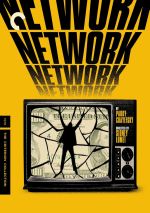
Network appears in an aspect ratio of approximately 1.85:1 on this Blu-ray Disc. This will never be a movie that looks great, but the Blu-ray served it pretty well.
Sharpness seemed decent to good. Sporadic examples of softness occurred, but these largely appeared to stem from the source photography.
As I alluded, this was simply never a particularly dynamic presentation. The image looked reasonably concise.
No issues with jaggies or moiré effects occurred, and I noticed no edge haloes. Grain felt appropriate and print flaws remained absent.
Network went with a subdued palette, and the tones tended to look a little drab at times. However, this seemed connected largely to the visual design; when the movie invested in brighter colors, they seemed accurate and lively.
Blacks were acceptably deep, and shadows showed adequate to good clarity. This wasn’t a showcase image, but it worked fairly well given the movie’s design.
The film’s LPCM monaural soundtrack didn’t excel but it satisfied given the movie’s ambitions. The mix consisted almost entirely of dialogue.
Effects were minor considerations; they seemed acceptably clear but played such a small role that unless they displayed serious distortion, they rarely mattered.
The film also featured virtually no score. The most prominent music heard came from the Howard Beale Show theme. It sounded pretty clear and bold, as it included some nice low-end punch as well.
Dialogue was pretty good, as a few reedy lines emerged, but most of the dialogue was reasonably natural and concise. This was a more than adequate track for a chatty movie.
How did the 2026 Criterion Blu-ray compare to the original BD from 2011? Though it changed from DTS-HD MA to LPCM, both monaural soundtracks seemed virtually identical.
Visuals demonstrated some upgrades, mainly via a cleaner print used. Otherwise, the two seemed fairly similar, as the 2026 BD brought mild improvements in colors and sharpness but nothing revelatory.
The Criterion release mixes old and new extras, and we open with an audio commentary from director Sidney Lumet. He offers a running, screen-specific chat. Lumet looks at the film’s themes, tone and visual style, cast, characters and performances, his background in live TV and the flick’s prescient elements, locations and sets, and a few production notes.
We get a decent commentary but not one that stands out as particularly memorable. The best moments come from Lumet’s memories of the early days of TV.
I like his remembrances and think these become illuminating. He also tosses out some nice insights into the performances and other nuances.
Unfortunately, there’s too much dead air, and at times Lumet offers basics that don’t really tell us much. He comes across as a curmudgeon when he berates the lousy state of modern TV. Lumet’s commentary has enough to make it worth a listen, though.
Next comes a modern documentary called The Making of Network. This one-hour, 25-minute, 31-second program includes notes from Lumet, producer Howard Gottfried, editor Alan Heim, production designer Philip Rosenberg, director of photography Owen Roizman, newscaster/reporter Walter Cronkite, and actors Lance Henriksen, Faye Dunaway, Ned Beatty, and Kathy Cronkite.
The show covers writer Paddy Chayefsky and the script’s development, Chayefsky’s history with Lumet and how the director came onto the project, and Chayefsky’s vision for the story. From there we go through cast and characters, a spotlight on the movie’s signature “I’m mad as hell” scene, rehearsals and shooting the film, and many anecdotes from the production.
We also learn about editing, reactions to the film and its legacy, the movie’s visual style and set design, and general thoughts. Finally, the piece includes notes from Walter Cronkite about his relationship with Lumet, a few comments about the early days of TV news and its development, and reactions to the film.
While “Making” covers a lot of good subjects, I can’t say I care for its disjointed presentation. Some of that stems from the fact it really exists as six featurettes connected together.
I’ve seen that format many times and think it works better elsewhere. Here it comes across as a bit scattered.
Still, we get more than a few nice tidbits about the film. Despite the somewhat less than coherent presentation, the show goes over the requisite subjects well. Some of this repeats from the commentary, but there’s plenty of new information to pique our interest.
From 2025, Paddy Chayefsky: Collector of Words runs one hour, 29 minutes, one second. It delivers statements from filmmakers James L. Brooks, Mel Brooks, Aaron Sorkin, Oliver Stone, Judd Apatow, Billy Ray, Justin Simien, Phil Alden Robinson, writers Merrill Markoe, Alan Zweibel, Sam Wasson and Tom Fontana, journalists Julia Turner and David Itzkoff, commentator Keith Olbermann, film producer Mike Medavoy, and actors Rob Lowe, Bryan Cranston, Jason Alexander, Robert Klein, Jeff Daniels, Dustin Hoffman, Billy Crystal, Dabid Steinberg, Norbert Leo Butz, Delbert Mann, Jeff Garlin, and Richard Kind.
"Words" offers a retrospective appreciation of Chayefsky's work, with a smidgen of information about his career as well. Though it comes with sporadic insights, it leans hard into movie clips and praise, so it doesn't become the most effective program.
Along with the film’s trailer, the set concludes with a booklet that mixes credits, art and an essay from political commentator/columnist Jamelle Bouie. It finishes the package well.
Note that the Criterion release loses a few extras from the 2011 Blu-ray. It drops an excerpt from the Dinah! TV show with Chayefsky as well as a nearly hour-long interview with Lumet. I don’t know why the Criterion release loses these – rights, I’d assume – but I miss them.
At this point, Network seems better remembered as a catch phrase than as a film, which is an ironic fate for a picture determined to knock such simpleminded behaviors. I found the movie to be a flawed but compelling work that had enough strengths to merit a viewing. The Blu-ray provides restricted but good picture and audio along with a collection of bonus materials. Network remains an involving flick, and this Blu-ray presents it well.