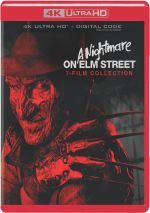
Wes Craven’s New Nightmare appears in an aspect ratio of 1.85:1 on this 4K UHD Disc. This wound up as a solid presentation
Sharpness usually worked fine. A few wide shots could be a little tentative, but most of the movie boasted positive delineation.
I noticed no problems with shimmering or jaggies, and edge haloes failed to manifest. Grain seemed light but adequate, and the film lacked print flaws.
Nightmare opted for a largely natural palette that turned a bit more garish during overt horror scenes. The colors came across well and enjoyed added punch from HDR.
Blacks offered positive depth, and low-light shots seemed good, as shadows displayed appropriate smoothness and clarity. HDR brought extra emphasis to whites and contrast. Expect a strong image here.
Downconverted to Dolby TrueHD 7.1, I also felt pleased with the involving Dolby Atmos soundtrack of New Nightmare. The audio used all the channels to a good degree, and I found that both effects and music cropped up from all around frequently in the film.
Sounds moved well among channels, and panning sounded smooth and realistic. This meant the soundfield provided a well-placed experience.
Audio quality seemed good as well. Dialogue felt natural and distinct, and I detected no problems related to intelligibility.
Effects seemed clear and accurate, with solid dynamic range and no distortion. The score seemed acceptably clean and crisp as well, and I found that low end seemed strong. This became the best of the Nightmare soundtracks.
How did the 4K UHD compare to the original Blu-ray? The Atmos track opened up matters to some degree, though given that New Nightmare exists as the only one of the original seven films in the franchise that came with 5.1 audio theatrically, this remix acted as less of a step up than what I heard from its predecessors.
Visuals showed the expected improvements, as the 4K UHD looked cleaner, tighter and more dynamic than its BD version. This wound up as an impressive upgrade.
Almost all the existing extras appear here as well with some new one, and we open with an audio commentary from writer/director Wes Craven. He provides a running, screen-specific look at story/characters and connections to prior Nightmare movies, sets and locations, cast and performances, effects, music, editing and related domains.
Though he occasionally just describes the movie’s story, Craven usually offers nice insights. He covers a lot of ground and makes this a solid chat despite the narration.
We get five featurettes found on the Blu-ray, and Becoming a Filmmaker runs eight minutes. It brings notes from Craven as he examines his background and what brought him to movies. Craven offers an engaging look at his history.
With An Insane Troupe, we get a 57-second clip that features Craven as he looks at aspects of scary movies. It becomes a forgettable snippet.
Next comes the two-minute, 10-second Two Worlds. It provides remarks from Craven while he chats about the nature of New Nightmare. Though a bit redundant after the commentary, “Worlds” adds some insights.
The Problem with Sequels goes for one minute, 41 seconds and features Craven. He tells us his thoughts about challenges connected to sequels in this short but interesting chat.
Finally, Filmmaker fills four minutes, 43 seconds with comments from Craven. Here he looks at his orientation as a movie creator. Craven provides decent valedictory notes.
Recycled from an old DVD package, Welcome to Prime Time includes 13 short segments that fill a total of 49 minutes, 53 seconds. Across these, we hear from Craven, New Line CEO Bob Shaye, Friday the 13th creator Sean Cunningham, special effects creator Lou Carlucci, special makeup effects artist Dave Miller, New Line chairman Sara Risher, Freddy's Dead director Rachel Talalay, and actors Heather Langenkamp, Robert Englund and John Saxon. We also get an “Alternate Ending Version” for the 1984 movie as part of this compilation.
These clips examine the real-life influences for the original Nightmare, the film's development and the horror genre circa the early 1980s, casting and performances, effects and costumes for Freddy, the production of the first film and its release. The 1984 flick really does remain the focus here.
Which makes me wonder why these segments got attached to the seventh film in the series. Nonetheless, the content satisfies.
Another carryover from the DVD days, Conclusion brings 10 sequences and occupies a sum of 17 minutes, 27 seconds. Here we get notes from Shaye, Englund, Nightmare on Main Street author Mark Edmundson and filmmaker Clive Barker.
The segments look at Gothic horror and the impact on Nightmare as well as story/character interpretation. Again, I don't know why this ends up on the disc for the seventh film and not the first but it comes with useful material.
Two new to the 4K UHD
featurettes finish the disc.
"Confessional" looks at the Freddy character and Englund's take on the role. It's good to get some fresh interviews and we find worthwhile notes here.
Note that the BD included the film’s trailer but the 4K UHD dropped it.