|
WARNER
|
| |
|
MOVIE INFO
|
|
Director:
Sam Wood
Cast:
Groucho Marx, Chico Marx, Harpo Marx, Kitty Carlisle, Allan Jones, Walter Woolf King, Sig Ruman, Margaret Dumont, Edward Keane
Writing Credits:
James Kevin McGuinness (story), George S. Kaufman, Morrie Ryskind
Synopsis:
Arts patron Mrs. Claypool intends to pay pompous opera star Lassparri $1,000 per performance. Hey, maybe that's why they call it grand opera! Grand comedy, too, as Groucho, Chico and Harpo cram a ship's stateroom and more than wall-to-wall gags, one-liners, musical riffs and two hard-boiled eggs - all while skewering Lassparri's schemes and helping two young hopefuls (Kitty Carlisle and Allan Jones) get a break. To save the opera, our heroes must first destroy it. And they must also gain ocean passage as stowaways, pull the wool (if not the beards) over the eyes of City Hall, shred legal mumbo-jumbo into a Sanity Clause, pester dowager Claypool (Margaret Dumont) and unleash so much glee that many say this is the best Marx Brothers movie. Seeing is believing.
Box Office:
Domestic Gross
$3.000 million.
MPAA:
Rated NR
| |
|
DVD DETAILS
|
Presentation:
Fullscreen 1.33:1
Audio:
English Monaural
Subtitles:
English
French
Spanish
Closed-captioned
Runtime: 91 min.
Price: $19.97
Release Date: 5/4/2004
Bonus:
• Audio Commentary with Film Historian Leonard Maltin
• “Remarks on Marx” Documentary
• Groucho Marx on the Hy Gardner Show
• Two Vintage Shorts
• Trailer
| |
|
PURCHASE @ AMAZON.COM
|

| |
|
EQUIPMENT
|
Sony 36" WEGA KV-36FS12 Monitor; Sony DA333ES Processor/Receiver; Panasonic CV-50 DVD Player using component outputs; Michael Green Revolution Cinema 6i Speakers (all five); Sony SA-WM40 Subwoofer.
| |
[an error occurred while processing this directive]
|
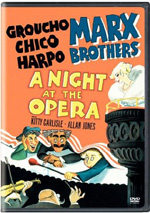
A Night At The Opera (1935)
|
|
Reviewed by Colin Jacobson (April 29, 2004)
While 1933’s Duck Soup landed the Marx Brothers on the AFI 100 list, its follow-up achieved a different form of immortality. Along with 1937’s A Day at the Races, 1935’s A Night at the Opera inspired the titles of early albums from the band Queen. Maybe that’s not as good as the AFI, but it should count for something!
At the start of Opera, we meet grifter Otis B. Driftwood (Groucho Marx). He tells wealthy widow and social climber Mrs. Claypool (Margaret Dumont) that he’ll get her into high society, and he arranges for her to invest in the New York Opera. This leads to her involvement with its director, Herman Gottlieb (Siegfried Rumann), and provokes some comic moments among the trio.
In the meantime, we encounter star performer Rodolfo Lassparri (Walter King) and his idiotic dresser Tomasso (Harpo Marx). The former beats the latter, so fellow singer Rosa (Kitty Carlisle) comes to Tomasso’s rescue. Lassparri longs to become Rosa’s paramour, but she loathes the bully and adores Ricardo (Allan Jones), a bit singer in the opera.
Fiorello (Chico Marx) arrives on the scene. He studied music with Ricardo and decides to become his old pal’s manager to get him ahead in the opera. Lassparri and Rosa get hired by the New York Opera and sail from Europe to the US. Rufus accompanies Mrs. Claypool, while Fiorello, Ricardo and Tomasso stow away so they can try to get their chance in New York. Rufus reluctantly agrees to help, and the rest of the flick follows their adventures.
One won’t find a great deal of variety from the various Marx Brothers movies, as they all employ fairly similar frameworks. This allows the Marx boys themselves to prosper but leads to more than a few dead spots.
In the case of Opera, this mainly comes from the love triangle between Rosa, Ricardo and Lassparri. I got the feeling the filmmakers included this kind of material because they felt they had to do so. Just like Disney animated films seem to use comedic sidekicks as a crutch, it feels as though the filmmakers figured that audiences required romance and musical moments to make the experience complete.
Unfortunately, those elements prove to drag down Opera badly. Rosa and Ricardo couldn’t possibly be duller, and their romantic and musical sequences seem eminently skippable.
The Marx Brothers remain the only memorable elements, and the movie collapses without them onscreen. It occasionally runs into some problems even with them, mainly due to poor direction and odd pacing. A few sequences go on too long, such as the sequence in which Groucho and Chico discuss a contract. This bit feels like it came straight from the vaudeville stage and plods along until it wears out its welcome. It doesn’t help that the boys occasionally pause and mug as though they wait for the audiences to cease their laughter. This looks odd on a movie screen, at least when viewed without a crowd.
Don’t expect much of a story from Opera. Really, it comes across mainly as a collection of sketches connected by a loose plot. The different elements feel like excuses for the gags.
Nonetheless, Opera enjoys plenty of funny moments. As always, Groucho presents the most amusing bits. He talks a mile a minute and remains the charming scoundrel with an everlasting pack of scams. I suppose someone doesn’t think he’s the best Marx Brother, but I can’t imagine this. He’s usually very entertaining.
As for the others, I must admit I often don’t like Harpo. He mugs relentlessly and usually comes across more as cute than funny. Still, he gets some good bits here, such as his introduction in which he wears a series of absurd outfits. Chico is the weakest link. I never really understood the point of his stereotypical Italian and he only sporadically presents amusing moments. It doesn’t help that he engages mainly in puns, which don’t do a lot for me. (Note: the DVD’s extras discuss the roots of Chico’s ethnic humor, so I now do have a better understanding of the character, but it still seems odd and not terribly funny to me.)
A Night at the Opera accentuates the best and worst elements of the Marx Brothers’ movies. It doesn’t give us much of a story and it suffers from plenty of dull moments. However, the natural comedic skills of the Marx boys make it entertaining and amusing more often than not. I can’t call it a great flick, but it presents a lot of funny bits.
|
The DVD Grades: Picture B-/ Audio C/ Bonus B-
|
|
A Night at the Opera appears in an aspect ratio of 1.33:1 on this single-sided, double-layered DVD; due to those dimensions, the image has not been enhanced for 16X9 televisions. Although it clearly showed its age at times, Opera mostly offered a nice picture.
Sharpness seemed quite good. Occasionally, I felt some wider shots came across as a bit indistinct, but those instances failed to occur frequently. In general, the movie looked well-defined and concise. I saw no concerns with jagged edges or moiré effects, and I also detected only small signs of edge enhancement.
Black levels appeared pretty firm and distinctive. The dark tones looked consistently deep, and contrast was nicely presented. A few low-light shots seemed slightly dense, but mostly the shadows came across as accurately depicted.
Given the age of Opera, one might expect a plethora of print flaws, but not too many interfere with the image. Grain seemed somewhat heavier than normal, and occasional instances of specks, grit and marks cropped up throughout the movie. However, these caused only minimal distractions, as the movie mainly looked pretty clean. At times the movie seemed to skip some frames, as occasional examples of apparently missing material occurred. During the audio commentary, Leonard Maltin mentions the excision of some references to Italy that occurred during World War II; I don’t know if these jumps resulted from those cuts, but this seemed possible. In any case, I mostly felt quite pleased with the image and thought it held up nicely after almost 70 years.
While not bad for its era, the monaural soundtrack of A Night at the Opera presented a more mediocre experience, even when I adjusted for its age. Dialogue appeared somewhat dull and murky, though the lines failed to demonstrate any edginess or problems with intelligibility. Music offered surprisingly decent bass response but nonetheless sounded a bit boomy and shrill most of the time, without great clarity. The same went for effects, which lacked much dimensionality or detail.
None of those factors came as a surprise; after all, recording technology remained in its infancy in 1935. The biggest distraction came from the background noise that accompanied the film. Hiss seemed heavier than usual, and some light rumble also came with the audio. Admittedly, I’ve heard many worse soundtracks for films of this era, but I still didn’t find much to the audio of Opera to make it stand out from the crowd.
This DVD includes a decent little collection of supplements. We start with an audio commentary with film historian Leonard Maltin. He offers a running, screen-specific piece that starts out really well. Maltin gets into topics connected to the development of the film, some material that was edited during World War II, the cast and participants, the historical context, comparisons to other Marx flicks, the style of director Sam Wood and problems there, and other issues.
For the first act or so, Maltin tosses out lots of great information that helps fill out our understanding of the flick. For example, we hear that although the movie didn’t start as a stage production, the Marx Brothers took a live version on the road to polish the material. Unfortunately, Maltin starts to peter out around a third of the way through the movie, and for the final hour, we get only sporadic bouts of decent notes. Maltin goes silent much of the time and also occasionally provides little more than a description of the film. Enough good material appears here to make the commentary worth a listen, but don’t expect much after the initial half-hour.
Next we get a new documentary called Remarks on Marx. In this 33-minute and 55-second piece, we see movie clips and archival materials and hear comments from actor Dom DeLuise, director Robert B. Weide, writer Irving Brecher, comedy writer Anne Beatts, writer/director/actor Carl Reiner, film historian Robert Osborne, writer Larry Gelbart and actor Kitty Carlisle Hart. They discuss the origins of the Marx nicknames, their comedic characteristics, their early work and comedic style, their arrival at MGM and their development there, some specifics about Opera and its participants, and various anecdotes.
The program provides a fairly concise examination of the topics, but it does become somewhat redundant when combined with the commentary. Not a ton of new information appears here, which makes it less useful than I’d like. Nonetheless, it moves briskly and seems generally entertaining. It’s also cool to hear from Carlisle, as it’s nice to get the perspective and stories of someone actually involved in the production.
After this we find Groucho Marx on the Hy Gardner Show. In this five-minute and 20-second snippet, Groucho tells of the pranks he and his brothers played on producer Irving Thalberg. We hear the same stories elsewhere, but it’s fun to get them from the source.
In addition to the film’s trailer, we follow this with two vintage shorts. The gently comedic “How to Sleep” features Robert Benchley and runs 10 minutes, 38 seconds, while “Sunday Night at the Trocadero” presents a little light comedy and some music during its 20 minutes and 15 seconds. Neither seems terribly entertaining, though the Benchley piece is infinitely better than the lame “Trocadero”. In any case, they round out the DVD in a nice way since they give us a look at material from the era we might have seen along with the main attraction.
A Night at the Opera seems too inconsistent and slow to turn into a true success. However, the movie enjoys more than a few moments of comic brilliance, and those help make the dull spots more palatable. The DVD presents pretty good picture along with average audio and a fairly decent set of extras. Ultimately, Opera is an inconsistent movie and disc but one with more charms than flaws.
Note that A Night at the Opera can be purchased on its own or as part of a five-DVD set called The Marx Brothers Collection. The latter also includes A Night in Casablanca, A Day at the Races, Room Service, At the Circus, Go West and The Big Store. The last four movies come on two “double feature” discs and are exclusive to the boxed set; you’ll have to buy it to get them. Since the five-DVD package retails for the same price as Opera, Casablanca and Races combined, it becomes a great deal for fans who already want to own those three flicks; the two other discs essentially then come for free.
|
|
[an error occurred while processing this directive]
|
|