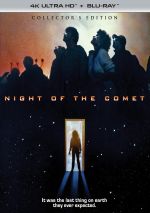
Night of the Comet appears in an aspect ratio of approximately 1.78:1 on this Blu-ray Disc. An erratic presentation, the movie showed its age.
Sharpness varied. The movie usually looked acceptably detailed but rarely much more than that. Not too many scenes looked really ill-defined, but few came across as particularly distinctive; most of Comet was acceptably concise and no more.
Jagged edges and shimmering caused no concerns. I encountered no signs of edge haloes or noise reduction.
Print flaws became a distraction at times. Though never especially heavy, I did notice moderate examples of specks and marks. Again, these didn’t ruin the image, but I thought it could/should have been substantially cleaner.
Colors seemed erratic. They displayed the usual Eighties murkiness much of the time, but they also occasionally looked reasonably vibrant and distinct. For the most part, the hues came across as somewhat messy.
Black levels tended to appear somewhat inky, while shadow detail was a little too dense much of the time. Interiors seemed fairly flat and muddy. This was a mediocre presentation.
Although the disc advertises a DTS-HD MA 5.1 soundtrack, you’ll not find any multichannel goodness here. If you activate the 5.1 option, you’ll find material that comes from nowhere other than the front center channel.
If you switch to the DTS-HD MA 2.0 mix, you’ll still get mono, though it offers awkward mono. The material tends to lean toward the left side of the spectrum.
So what happened to the promised 5.1 track? I have no idea.
I suspect someone screwed up the authoring, as I’m not sure how else to explain the circumstance. This isn’t a case of a conservative multichannel remix, as instead, there’s literally no audio from anywhere other than the front center.
The quality of the material seemed average for its age. Speech was intelligible and lacked edginess, but the lines tended to be somewhat thin and tinny.
Music lacked much range, as the score and songs were clear but without pizzazz. Effects also didn’t muster a lot of punch and they occasionally showed some roughness. This was a decent track for its age but not anything memorable.
Packed with extras, Comet launches with three separate audio commentaries. In the first, we hear from actors Catherine Mary Stewart and Kelli Maroney. Along with moderator Edwin Samuelson, they talk about their casting, characters and performances as well as sets/locations, cast and crew, costumes, and the film’s legacy.
Apparently long-time friends, Maroney and Stewart show a nice chemistry and they make this a pleasant chat. The discussion can sputter at times – especially in the flick’s second half – but it comes with enough charm and worthwhile material to make it worth a listen.
For the second commentary, we find thoughts from writer/director Thom Eberhardt. Along with moderator/disc producer Michael Felsher, the filmmaker examines the project’s origins and development, story/characters, inspirations and influences, cast and performances, sets and locations, music, effects, visual design, stunts/action and connected subjects.
Eberhardt builds a good head of steam early in the track and maintains that forward momentum the rest of the way. We get lots of useful information in this strong piece.
The final commentary features production designer John Muto. Also paired with Felsher, he discusses how he got into movies and aspects of his career, his work on Comet and other domains connected to the film.
This becomes another satisfying chat. Muto provides a fine examination of his efforts and related domains to turn this into an informative discussion.
More from the lead actors comes in Valley Girls at the End of the World. It goes for 14 minutes, 59 seconds and offers additional thoughts from Stewart and Maroney.
Recorded separately, they talk about their characters/performances and other thoughts about the film. Some of the info from the commentary repeats, but we still get a nice overview.
During The Last Man on Earth?, we get a 12-minute, 31-second chat with actor Robert Beltran. He discusses his career, how he came to Comet, his character and his approach to the role, and other thoughts about his experiences.
Unlike the others, Beltran covers areas that bothered him. As such, this turns into a frank and informative piece.
Curse of the Comet fills six minutes, 32 seconds. It brings info from makeup effects designer John B. Miller.
He covers aspects of his career and his work on Comet. Miller offers a nice take on his makeup creations.
In addition to the film’s trailer, we find two photo galleries. “Film Photo Gallery” shows 39 shots from the movie and a few ads, while “Behind the Scenes Photo Gallery” displays 57 images.
These mostly offer snaps from the set, but we also find some storyboards and concept art. “Behind the Scenes” becomes the more interesting of the pair.
A second disc delivers a DVD copy of Comet. It includes all the same extras as the Blu-ray.
Over the last few decades, Night of the Comet developed a good cult following, but I can’t figure out why. Dull and amateurish, the movie comes with few positives and leaves me entirely cold. The Blu-ray presents mediocre picture and audio along with a pretty strong package of bonus materials. If you love the movie, you’ll want this Blu-ray, but I can’t recommend it to non-fans, as I think the flick is a dud.