|
SONY
|
| |
|
MOVIE INFO
|
|
Director:
Joshua Logan
Cast:
William Holden, Kim Novak, Betty Field, Susan Strasberg, Cliff Robertson
Writing Credits:
Daniel Taradash, William Inge (play)
Tagline:
Electrically attracted to each other ... Overwhelmingly engulfed by it ... Guiltily in love!
Synopsis:
It's Labor Day weekend, and fresh off a freight train is Hal Carter (William Holden), a happy-go-lucky drifter who's looking for a brand new start in life. A robust, handsome show-off, Hal has come to Kansas to seek gainful employment in his old fraternity brother Alan's family granary. But despite his high hopes and expectations, Hal's ambitious plans soon go away when his sexual magnetism attracts every woman in town, including 19-year-old Madge Owens (Kim Novak) - the alluring young beauty queen who also happens to be Alan's girlfriend.
MPAA:
Rated NR
| |
|
DVD DETAILS
|
Presentation:
Aspect Ratio: 2.55:1/16x9
Audio:
English Dolby Digital 5.1
English Monaural
Subtitles:
English
Closed-captioned
Supplements Subtitles:
None
Runtime: 113 min.
Price: $39.99
Release Date: 8/3/2010
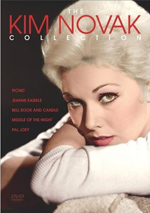
Available Only As Part of “The Kim Novak Collection”
Bonus:
• “Kim Novak’s Hollywood Picnic” Featurette
• Trailer
| |
|
PURCHASE @ AMAZON.COM
|

| |
|
EQUIPMENT
|
Panasonic 50" TH-50PZ77U 1080p Plasma Monitor; Sony STR-DG1200 7.1 Channel Receiver; Panasonic DMP-BD60K Blu-Ray Player using HDMI outputs; Michael Green Revolution Cinema 6i Speakers (all five); Kenwood 1050SW 150-watt Subwoofer.
| |
[an error occurred while processing this directive]
|
Picnic: The Kim Novak Collection (1955)
|
|
Reviewed by Colin Jacobson (July 30, 2010)
Ever watch a movie and wonder if it was based on a play? Probably not, but if this does occur, here's an easy way to tell: if characters in the movie make statements such as "sure is a scorcher today! Oh, when will this hot weather end! We sure could use some rain!" then you're probably dealing with an adapted play. Granted, I can think of at least one exception, as Do the Right Thing often used similar phrases, but I'm sure Spike Lee wanted to convey that stage-based feeling with his film.
(Why do so many stage characters discuss the weather? I figure it's because plays have few other ways to convey this information. Movies can show heat, rain, snow, etc. more graphically, but it's not so easy on stage, especially when dealing with such a non-visual quality like high temperatures; other elements can be faked, but heat's a lot tougher to show.)
This is the kind of information that occurred to me while I watched
Picnic, a 1955 flick based upon the Pulitzer Prize winning play by William Inge. I thought of such issues because the movie itself gave me little about which I cared. Picnic isn't a terrible film, but it's kind of a silly one that lacks much real substance.
Picnic also clearly comes from a stage play because we see lots of scenes in which characters get really upset and emote heavily for no apparent reason. That's one part of plays I've never really understood. Oh, I know stage actors have to emote more broadly than screen performers just because the audience can't see them as clearly; they have to play to the cheap seats, as it were. Maybe that's the reason stage characters always get so worked up about things as well; since subtle emotions are lost on stage, they have to go for the broad feelings to register with the crowd.
Frankly, I don't much like stage plays, mainly because of their overly broad qualities, but I usually care for filmed plays even less. Too many of these do little to modulate the material for the big screen; they come across simply as photographed versions of the originals with few attempts to adapt the work.
I never saw a stage version of Picnic so I can't say how many similarities it shares with its Hollywood sibling. Clearly the locations have been opened up a great deal. Unlike something such as
A Raisin in the Sun - which rarely leaves its one-room setting - Picnic offers a wide variety of locales, so at least it takes advantage of the cinematic medium in that way.
Unfortunately, that's the only way it does so, as the remainder of the movie sounds and feels like a play. Characters in those projects always talk about the big things they're going to do someday, and all of the ways life has disappointed them. Plays are filled with big old monologues about such issues, and so is the movie version of Picnic.
It's all much roil and toil without purpose, though. I really have little idea what point Picnic serves. The characters are all pretty flat, with little insight into their beings other than as cardboard cutouts. As a romance, it lacks sizzle or spark, though maybe it's hotter than I think but I was just too annoyed at the fact everyone seems to think Kim Novak - who I thought looked kind of odd here - is so much more beautiful than the rather cute Susan Strasberg. I've never understood why Hollywood has so much trouble with this issue; it's so rare that a supposedly bland or unattractive character actually is.
That's not the only casting problem. It doesn't help that star William
Holden is supposed to play a guy who's apparently in his mid-twenties when the actor was actually 37 at the time! Holden does a better job than I'd expect - he looked pretty buff in the role - but I still have a hard time accepting him as so young.
While I don't find Picnic to be a complete dud, it seems clear that the movie hasn't aged well. It's a part of the Fifties that feels stuck in that era and doesn't translate well to modern times. Add to that an awkward "staged" feel to the whole project and you have a less-than-compelling movie.
(One possibly interesting aside: Picnic shares a lot of connections to Disney movies. In A Bug’s Life, the play is mentioned as one that the ant colony performed. Picnic also provides a character named Mrs. Potts, the name of a Disney matron in Beauty and the Beast. Also, Disney regular Verna Felton - known for her role as Cinderella’s Fairy Godmother among many others - appears in the film (as Mrs. Potts, natch). By the way, Felton also performed the voice of Wilma's mother on The Flintstones. I think I might have heard Betty Lou Gerson – 101 Dalmatians’ Cruella De Vil - in Picnic as well, but I was unable to substantiate this impression.)
|
The DVD Grades: Picture C+/ Audio B/ Bonus C-
|
|
Picnic appears in an aspect ratio of approximately 2.55:1; the image has been enhanced for 16X9 televisions. The disc packed two movies - Picnic and Jeanne Eagels - onto one dual-layered disc. That might’ve been too much for one DVD to handle, and I think it affected the attractiveness of the presentation.
Actually, compression artifacts weren’t a major concern. Mosquito noise crept in at times, and I noticed occasional instances of blockiness, but those weren’t my biggest complaint. Instead, basic definition tended to be problematic. Close-ups looked fine, and two-shots weren’t bad, but wider shots were rather soft and fuzzy. Since the movie offered more than a few of those, the flick could often suffer from a lack of good delineation.
Jagged edges weren’t an issue, but instances of shimmering cropped up with minor frequency. Edge haloes appeared but were fairly light. Source flaws remained virtually absent, though. The movie came free from any notable print defects, which came as a positive.
Colors worked fine. At times, they tended to be slightly brownish, but the hues usually appeared natural and full. Blacks were dark and dense, while shadows showed pretty good clarity. The transfer mixed good and bad elements, which left it as a “C+”; the inconsistent definition remained my biggest issue.
I felt more pleased by the surprisingly strong Dolby Digital 5.1 soundtrack. The front spectrum offered some nice breadth, with an attempt to spread audio across the three channels that's much better than we normally hear for movies this old. When necessary, movement could be good; for instance, the opening shot of a train cranked from one side to the other in a convincing manner.
Surround usage wasn’t tremendous, but it contributed depth to the audio. Again, the louder bits like the train used the back speakers well, and sequences such as the big picnic provided nice reinforcement from the rear. None of this dazzled, but given the movie’s age and modest sonic ambitions, I thought the soundscape worked nicely.
Audio quality held up well over the last 55 years. Speech could be a little reedy, and a lot of it was clearly dubbed; those elements lacked a very natural quality. However, the lines were always perfectly intelligible, and they offered typical sound for recordings of their era.
Effects came across pretty nicely. That loud train at the open packed a good roar, and other components showed reasonable clarity. They weren’t particularly impressive, but again, they seemed more than competent given their vintage.
Music fared best of all. The score boasted good vivacity and range, and this became the one aspect of the mix that transcended its age. While not up to modern standards, the music sounded notably more dynamic and full than I expected. That was the main reason this satisfying mix earned a solid “B”.
Only minor extras accompany the film. In addition to the flick’s trailer, we got a featurette called Kim Novak’s Hollywood Picnic. In this 17-minute, 13-second piece, we hear a chat from author Stephen Rebello and actor Kim Novak as we watch stills and footage from her career. Novak chats about her career in general as well as many specifics about aspects of Picnic and the folks with whom she worked. The featurette concentrates on good details and doesn’t stray off-topic too often, so it provides a concise little look at Novak’s impressions of Picnic.
I didn't find Picnic to be a terrible film, but it's a dated and not very compelling one. It made an awkward shift from the stage to the screen and just never really became involving. The DVD’s picture shows highs and lows that make it average in the end. The audio works quite well, but the set’s supplements don’t give us much. As a DVD, this is a decent to good release, but the movie itself just doesn’t do a lot for me.
Note that this release of Picnic comes only as part of a five-film “Kim Novak Collection”. The two-DVD set also includes Jeanne Eagels, Bell, Book and Candle, Middle of the Night and Pal Joey.
|
|
[an error occurred while processing this directive]
|
|