Reviewed by Colin Jacobson (August 19, 2026)
Nearly 20 years after Jonas Brothers became a huge success, Nick Jonas finds himself as a member of a boy band on the popular decline. If that's not typecasting, what is?
Though he once dreamed he'd become a rock star, Rick Power instead married his Irish girlfriend Rachel (Marcella Plunkett) and moved to Dublin, where they live with their teen daughter Aja (Beth Fallon). Rick continues to work as a musician via a gig as vocalist in a wedding band called "Bride and Groove".
During a show, Rick meets Danny Wilson (Jonas), part of a fading group who wants to embark on a solo career. They bond and when Danny eventually enjoys a hit thanks to a song Rick wrote, Rick's life takes an unexpected new turn.
Those of us who lived through the 1980s might remember a band called Danny Wilson. They didn't last too long but they scored a top 25 US hit with a piece of pop perfection called "Mary's Prayer".
Less remembered: they took their name from a 1952 Frank Sinatra movie called Meet Danny Wilson. That occurred after legal advice got them to change their original band moniker: "Spencer Tracy".
No, really.
What's the point of this little look at musical and cinematic history other than to fill some space? I bring this up to point out that Ballad can lean too clever-clever at times.
And it doesn't stop with the decision to name the Jonas character after either a 1980s band or a 1950s Sinatra flick - or both. C'mon - "Rick Power" is a guy who writes ballads?
Ugh. And that “ugh” doesn’t even include the choice to play “Mary’s Prayer” in the background at one point.
Beyond these unfortunately cutesy choices, Ballad kicks to life at times. However, these moments occur too infrequently to make this a satisfying tale.
Part of the issue stems from the manner in which Ballad too often stretches credulity, and not just because Bride and Groove seem way tighter than one would anticipate from a wedding band or the awkward choice to replace live vocals from Rudd and Jonas with autotuned crooning. Those decisions took me out of the film but they didn’t become the only eyebrow-raising moments.
Never mind that the movie touts Danny’s hit as world-sweeping instantly. Apparently it literally instantly infiltrates all locations – even PAs at Irish shopping malls – and becomes so famous that brides expect wedding bands to know it like two weeks after its release. Apparently no one raises an eye when Rick plays a ceremony bruised and battered, too.
Even without these decisions, Ballad simply goes down the wrong path. The story just makes more sense as a guy who missed out on his musical dream and gets a second shot instead of the bitter Ahab-esque quest it delivers.
Oh, Ballad wants to give us something uplifting in the end, but it makes Rick obsessed and borderline psychotic too much of the time. Honestly, the plot choice to show that Danny – or at least Danny’s manager (Jack Reynor) – wants to cheat Rick out of his rightful royalties feels like a terrible choice for a flick like this.
Ballad comes across like a tale that wants to be a light feel-good comedy. Instead, it focuses too much on Rick’s downward spiral and these choices don’t work.
While we see Rick’s collapse into semi-madness, Danny does… not much of anything. In a more logical tale, we’d see how Danny wants to do the right thing but instead, we get… not much of anything.
Ballad focuses so heavily on Rick’s story that Danny enjoys no arc. The movie can’t decide whether to make him the nice guy forced into bad behavior by the urging of others or if it wants him to come across as a celebrity who doesn’t think the rules belong to him.
Without any balance, this ends up as Rick’s story, and that turns into an obstacle. Of course, like all movies of this sort, Rick gets a wacky sidekick (Peter McDonald) to come along for the ride as comic relief.
Except laughs never result. Rick’s pal Sandy feels like nothing more than the plot device he is.
Even the movie’s ending feels like a cop out. No spoilers, but we get a “have it all” finale that seems wrong for the tale in question.
Rudd’s natural charm helps make Rick more engaging than he should be, but that doesn’t turn into enough to allow Power Ballad to succeed. The premise sporadically gives the film some zing but it comes with too many inconsistencies and contrivances to click.
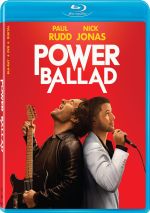
Footnote: why does the cover art make the right-handed Paul Rudd left-handed?
Second footnote: who thought this movie should come with an “R”-rating? It would get “PG-13” without the ample profanity, and the film never needs those “F-bombs”.