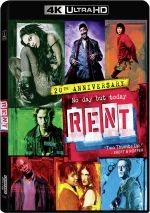
Reviewed by Colin Jacobson (January 5, 2026)
A new rock musical called Rent first emerged in 1993 and then hit Broadway in 1996. It became an immediate smash.
Less than a decade later, Rent made it to movie screens. However, even with successful director Chris Columbus behind it, the movie didn’t find much of an audience, as it took in only $31 million worldwide.
Perhaps audiences simply thought the tale seemed dated, as Rent takes place in the late 1980s/early 1990s. We go to NYC’s East Village and meet some young bohemians who reside there.
Set across one year that spans Christmas Eve 1989 to Christmas Eve 1990, Rent comes from the POV of aspiring filmmaker Mark Cohen (Anthony Rapp). He lives with roommate Roger Davis (Adam Pascal), a rock musician and former drug user now positive for HIV.
Roger exists in a couple with fellow HIV-positive stripper – and current heroin addict - Mimi Marquez (Rosario Dawson) while Mark pines for former girlfriend Maureen Johnson (Idina Menzel), a bisexual who left him for lesbian Joanne Jefferson (Tracie Thoms).
Along with philosophy professor Tom Collins (Jesse B. Martin) and drag queen Angel Dumott Schunard (Wilson Jermaine Heredia) – both of whom have AIDS - some of them answer to landlord Benny Coffin (Taye Diggs) - their former friend who married into society - as they gotta pay the rent!
As I noted, when Rent made it to Broadway in 1996, it became an immediate sensation, one that rubbed me intensely the wrong way. Did I react negatively to Rent because I saw it and disliked it?
No, but my exposure to parts of the show on TV led me to believe it’d offer a feeble stab at a rock musical. My view almost 30 years ago felt that these kinds of productions favored the “Broadway showtunes” vibe too heavily to come across as convincing rock music.
And that perspective hasn’t really changed since 1996, though my opinions mellowed with age. Although I still don’t feel rock musicals pull off the “rock” part of the equation well, I can’t muster the extreme youthful disdain for Rent that I felt back in its heyday.
Which led this 4K UHD into my player. Like most others, I skipped Rent theatrically in 2005 and also didn’t check out either its DVD or Blu-ray releases, probably because my 1990s POV remained stuck in my head 20 years ago.
Now that I’ve finally seen a version of Rent, I can offer a more educated take on it beyond my semi-knee-jerk feelings of the 1990s. Does the older and theoretically wiser me find enjoyment from the cinematic production?
Nope. If anything, Rent probably works less well in 2026 than in 1996 because the entire project seems so Of Its Time.
I say this not because Rent takes place across 1989/1990, of course, as it’s not the story’s era that dates it. Instead, it’s simply the manner in which Rent comes stuck firmly in a mid-1990s mindset that seems less than universal.
Like Rent, Hair came out during its own specific era and that clearly dates it in some way. However, the “hippie culture” maintains a place in the public consciousness in a way that allows it to seem more universal than a tale about struggling artists in 1989-1990 NYC does.
Granted, Rent comes with characters who represent archetypes with whom we should theoretically identify. Even if someone in Idaho might not get the bohemian artiste NYC lifestyle, the roles show general personalities that could make anyone connect to them.
However, Rent never depicts any of its characters beyond basics. Some of this stems from the simple number of “main roles” we get, as Rent comes with no true protagonists and needs to cover eight different parts semi-equally.
A better-made project could probably do this in a competent manner. Rent doesn’t, so we’re left with a mix of underdeveloped folks with whom we fail to really bond.
A bigger issue in terms of how audiences circa 2026 can relate stems from the manner in which Rent often feels more like a social and political statement than a compelling narrative. Given how much medical treatment for HIV and AIDS has improved over the last three decades, I think we forget how we viewed those as a virtual death sentence in the mid-1990s.
Indeed, a close friend of mine started what became a long-term relationship with a guy who was HIV+ back in 1996. The boyfriend tended to behave in careless and self-destructive ways because he figured he was doomed anyway.
The mid-1990s fatalism attached to HIV/AIDS at the time pervades Rent, and that gets back to how it feels extremely Of Its Time. No, there’s nothing wrong with art that exists to represent its era, but this means it might feel much less relateable 30 years down the road.
The decision to make literally half of the main characters HIV+ or with full-blown AIDS feels partly like the social commentary I mentioned, but I think it also exists as a tacky stab at tension. With four roles afflicted by a disease that felt like an unstoppable path to death in 1989-90, the movie wants to keep viewers on the edge as we wait for one of them inevitably to die.
Which – spoiler alert? – does happen, though I won’t reveal to whom. When we find a demise, the movie lacks punch because this feels like such a cheap and obvious attempt to stir emotions.
Whatever one thinks about Rent, it wholly lacks subtlety. It could more easily get away with its broadness on a stage but when brought to a movie screen, these excesses seem more problematic.
The utterly perplexing choice of Columbus as director becomes one obstacle. Best known for family flicks such as Home Alone or the the first two Harry Potter projects, he seems utterly unsuited for a theoretically gritty rock musical about the downtrodden in NYC.
And Columbus proves completely wrong for the film. While he attempts to give it an air of seriousness, that tone never takes.
Rent never makes it settings seem as seedy as they should, and the characters all seem much more well-fed and healthy than one would expect. Columbus just can’t bring the needed darkness to the project, as an air of caution pervades the film that implies Columbus and the studio feared that a dark version of the tale would be too off-putting for so-called Middle America.
In particular, Columbus can’t find a way to bring the movie’s many song and dance scenes to life. These tend to feel stiff and without the fluidity and spark they need.
It probably doesn’t help that so much of the cast seems too old for their parts. After all, Rent looks at 20-somethings who struggle to survive, so it takes on a different air when most of the actors are in their 30s.
Of the eight leads, six played their roles on stage. Original Mimi Daphne Rubin-Vega couldn’t appear due to pregnancy, and original Joanne Fredi Walker-Browne passed because she felt the part needed a younger actor.
Good move, Fredi! Too bad your peers didn’t make the same move.
Hey, I get it, as it’d be tough to turn down a chance to play in a major motion picture. Still, given that the six returning castmembers varied in age from 33 to 36 during the film’s shoot, their “advanced ages” stand out like a sore thumb.
Interesting, the producers did bring in younger actors for the cinematic Mimi and Joanne. Thoms was 29 and Dawson 25.
And that makes the stage performers’ ages seem even more anachronistic. This doesn’t become a fatal flaw but it does make the movie feel off.
As mentioned earlier, I went into Rent with the sentiment that its songs would lean more “showtune” than “rock”, and I figured correctly. While Larson’s work utilizes the tools of rock, none of them feel like “real rock”.
That said, I admit that many of them seem pretty catchy. While I don’t like the stylistic choices, I can’t argue that they don’t seem reasonably enjoyable.
My 1990s self simply reacted negatively because the hype presented Rent as a revolutionary rock musical. It simply doesn’t live up to that press, and although I find the songs pleasant, they don’t connect on a deeper level than that.
Nor does anything else about the film adaptation of Rent, honestly. Because I never saw the stage version, I can’t compare and determine how many of the movie’s problems stem from the basic source and how many come from the cinematic take on it.
All I know is that Rent the movie becomes a fairly tedious experience. It follows a trite path and never turns into a quality exploration of its characters or situations.