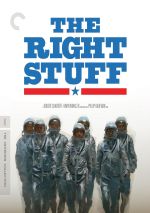
The Right Stuff appears in an aspect ratio of approximately 1.85:1 on this 4K UHD Disc. Overall, the Dolby Vision image looked pretty good.
Sharpness usually appeared positive, as only a few exceptions occurred. Some shots came across as slightly soft, a factor abetted by the photographic style, as cinematographer Caleb Deschanel opted for a semi-gauzy look at times. Even so, most of the movie felt well defined and distinct.
Jagged edges and moiré effects caused no problems, and no edge haloes manifested. Other than defects found in archival footage, I saw no print flaws, and we got natural – albeit sometimes heavy – grain.
Stuff featured a natural and warm palette that came across well here. The colors always remained tight and accurate, with added punch from HDR.
Black levels became deep and dense, while shadows seemed nicely delineated. HDR brought extra power to whites and contrast. Even with the drawbacks inherent in the source, this became a consistently pleasing presentation.
The film’s remixed DTS-HD MA 5.1 soundtrack worked well, as I found it tough to believe this audio came from a 43-year-old flick. The soundfield seemed broad and vivid.
In addition to the expected solid stereo imaging for the score, effects demonstrated great activity and involvement. The front speakers boasted fine breadth and dimensionality, so elements seemed accurately placed and moved smoothly across the speakers.
The surrounds kicked in with a lot of useful material as well. General ambience worked well throughout the movie, and the louder scenes displayed terrific vividness.
For example, the flight deck on Glenn’s Navy carrier created a great sense of place, and the jet flights immersed us in the action. Even press conference shots demonstrated a nice feeling of the location. The soundfield really complemented the visuals.
Audio quality also worked well, especially when I considered the age of the material. Speech lacked any problems like edginess, as the lines consistently sounded natural and distinct.
Some of the synthesized parts of the score appeared slightly dull, but most of the music came across as bright and dynamic. The score mostly was clear and crisp.
Effects also functioned well. A few jet shots displayed slight distortion, but those examples stayed minor, and the other elements seemed concise and accurate.
Bass response sounded deep and firm and also presented a solid bang. Overall, the audio of The Right Stuff functioned well.
In addition to this remix, the disc also provided the film’s original DTS-HD MA 5.1 70mm soundtrack. For the most part, it strongly resembled the newer version.
Audio quality felt virtually identical, and both boasted similar soundscapes. The remix seemed a bit more active and aggressive when compared to the 1983 track, but I didn’t sense major differences.
Did I have a preference? I tend to veer toward theatrical audio so I’d opt for the 1983 70mm track but both worked well.
How did the 4K UHD compare to the original Blu-ray from 2013? Both offered what appeared to be the same 5.1 remix, though the 2013 disc lacked this one’s 1983 70mm track.
The UHD’s Dolby Vision visuals brought upgrades in terms of accuracy, colors and blacks. It became a nice upgrade.
Note that Criterion also produced their own Blu-ray version of Right Stuff. Though Criterion usually packages 4K UHD and Blu-ray copies together, the 4K UHD set lacks the Blu-ray.
On a separate “extras only” Blu-ray, the Criterion issue mixes old and new components. In the “old” category, we open with two separate scene-specific audio commentaries.
For each of the tracks, we watch 24 minutes, 29 seconds of the movie along with the remarks of various participants. The programs jump between various parts of the film and both of the commentaries cover the exact same movie snippets.
Admittedly, this doesn’t sound as intriguing as a full-length commentary might. However, at least it prevents us from sitting through the whole 193-minute flick to hear only 49 minutes of statements.
The “cast commentary” involves General Chuck Yeager and actors Ed Harris, Dennis Quaid, Fred Ward, Barbara Hershey, Veronica Cartwright, Pamela Reed, Donald Moffat, David Clennon, Jeff Goldblum and Harry Shearer. All sat separately for this heavily edited piece that covers topics like preparation for the roles, stories from the set, and the real-life events behind the movie.
On the “filmmaker commentary”, we hear from director Philip Kaufman, co-producers Robert Chartoff and Irwin Winkler, composer Bill Conti, cinematographer Caleb Deschanel, and visual effects supervisor Gary Gutierrez. They touch on some of the same topics heard in the first track, and they also get into the technical elements of making the movie.
With so many participants, there no way these commentaries won’tt become disjointed, and that’s the main problem here. While they definitely go through a lot of good material, the subjects jump so quickly and so radically that it can become disorienting.
There’s enough worthwhile information on display here to allow the commentaries to prosper anyway, but I don’t much care for the format. It makes the details less intelligible and coherent.
Though split into two parts, a pair of featurettes really comprise one longer program. Realizing the Right Stuff runs 21 minutes, nine seconds and comes narrated by actor Levon Helm.
It presents info from Kaufman, Chartoff, Winkler, Deschanel, Yeager, Quaid, Harris, Ward, Reed, Cartwright, Goldblum, Shearer, Clennon, Moffat, Hershey and author Tom Wolfe.
Among the topics covered, we hear about adapting the book, getting studio support, casting, various locations and shooting logistics, recreating historical materials, research by the actors, and various anecdotes from the shoot. Essentially “Realizing” follows the movie from its genesis through the end of principal photography.
T-20 Years and Counting picks up with the post-production process. In this 11-minute, 27-second program, we hear from Wolfe, Chartoff, Winkler, Kaufman, Deschanel, Cartwright, Quaid, Harris, Moffat, Ward, Shearer, Gutierrez, and Conti.
This piece covers visual effects, failed attempts with motion control, experiments, editing, adding the score, the Washington DC premiere, and the movie’s reception and the connection to Glenn’s presidential campaign.
Overall, “Realizing” and “Years” offer a decent look at the film. The pair hit on all the major topics and do so in a reasonably entertaining and concise manner.
Still, I can’t help but feel that they seem rushed. At about 32 and a half minutes, the two together create an acceptably long program, but it just doesn’t seem like enough.
Subjects fly by awfully quickly, and most fail to get much exploration. The pair give us a moderately satisfying but somewhat hurried examination of the making of the movie.
Lastly, The Real Men with the Right Stuff runs 15 minutes, 29 seconds. It looks at exactly what the title implies: the actual guys involved with the reality behind the flick.
We get some quick comments from Wolfe. However, we mostly hear from Yeager, Commander Scott Carpenter, Colonel L. Gordon Cooper, and Captain Walter M. Schirra.
Easily the best of the “old” programs, “Real” gives us a tight and fun examination of their experiences. They also discuss the liberties taken by the movie. We get a surprisingly full look at what they did, and they all seem nicely blunt and honest.
You won’t find any actual dirt dished here. However, it presents the facts in a lively manner and becomes entertaining and informative.
Next we locate 13 deleted scenes. These fill a total of 10 minutes, 54 seconds, and nothing major appears here, as most of the pieces offer minor cuts from existing scenes.
The longest shows Cooper as he chats with Slayton and Grissom about how to smooth over the nurse during the try-out process. Otherwise, these are all fairly short bits that are mildly interesting to see at most.
After the film’s theatrical trailer, we shift to components new to the Criterion release. Under Academy Visual Projects, we find a 20-minute, 23-second circa 2019 interview with Kaufman.
The filmmaker discusses how he came to the project, casting, audio, and effects. Though some of this repeats from elsewhere, Kaufman provides good thoughts.
An Interview with Visual Effects Supervisor Gary Gutierrez spans 13 minutes, 33 seconds and brings his thoughts about storyboards, how he got the job and details of his work. This also echoes info from other extras but Gutierrez summarizes the effects nicely.
Taped an Interview with Sound Designer Mark Berger and Randy Thom goes for 19 minutes, 22 seconds as the pair watch some movie clips and discuss what they did for them. I like this approach and we get a lot of strong insights about their choices.
Conducted by film editing historian Bobbie O’Steen, an Interview with Co-Editor Stephen A. Rotter occupies 18 minutes, 55 seconds and explores how he got the job as well as aspects of what he did. We find more useful material here.
The package concludes with a booklet that includes credits, photos and an essay from critic Michael Sragow. It offers a decent finale to the set.
Note that the Criterion release drops a 1998 PBS documentary about John Glenn and an “Interactive Timeline to Space”.
A vivid and heroic epic, The Right Stuff tells a dynamic tale with fervor and might. It treats its subject in a gripping and mythological way that makes it a consistent treat to watch. The 4K UHD provides very good picture and audio as well as a solid mix of supplements. After 43 years, I still love this movie, and the 4K UHD replicates it well.