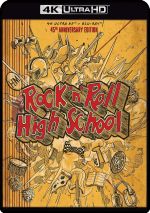
Rock ‘n’ Roll High School appears in an aspect ratio of approximately 1.85:1 on this Blu-ray Disc. Given the movie’s age and origins, I felt pleased with this presentation.
Overall sharpness worked well. A few interiors leaned slightly soft but the majority of the movie appeared accurate.
I noticed no issues with jaggies or moiré effects, and the movie lacked edge haloes. Grain seemed natural and print flaws remained absent.
Colors seemed good, as the hues were pretty peppy and dynamic. The natural palette offered lively reproduction.
Blacks were reasonably dark and tight, while low light shots demonstrated nice delineation. Only the occasional soft spot kept the image from “A-“ status.
The DTS-HD MA monaural soundtrack of Rock ‘n’ Roll High School seemed dated and mediocre, as I expected. Effects appeared dinky and failed to offer great clarity.
Speech consistently sounded thin and reedy. Not much edginess interfered, but the lines seemed a bit shrill.
Music worked the same way, except I also noticed distortion connected to many of the songs. The music lacked dimensionality most of the time.
A couple of elements showed decent low-end, but usually we were stuck with a flat presentation that featured no real presence. This wasn’t an awful track given the movie’s age and origins, but it wasn’t good, either.
How did this 2024 Blu-Ray compare with the original 2010 BD? The lossless DTS-HD audio here offered mild improvements over the iffy Dolby Digital version on the old BD, but the flaws inherent in the source limited growth.
On the other hand, the 2024 Blu-ray offered superior delineation, colors and blacks, and it also lost print flaws. Though the 2010 disc looked okay, the 2024 disc clearly upgraded it.
The 2024 set mixes old and new extras, and we find a whopping five audio commentaries, two of which come from prior releases. Originally from a 1997 laserdisc, the first includes remarks from director Allan Arkush, producer Michael Finnell and screenwriter Richard Whitley.
All three sit together for their running, screen-specific chat. The guys make this a terrific commentary.
We learn a lot about the film’s gestation and various changes made along the way, casting, finding a band and aspects of the flick’s music, the low budget and dealing with producer Roger Corman, locations, deleted scenes, influences and inspirations, and plenty of anecdotes. We find tons of good details, all wrapped in a lively and fun piece.
I especially dig the tales about working with the Ramones – it sounds like they behaved exactly the way you’d expect. I really like this amusing and informative commentary.
Created for the 2005 DVD, the next commentary comes from executive producer Roger Corman and actor Dey Young. Both sit together for their running, screen-specific conversation. Unfortunately, it proves significantly less interesting than its sibling.
Don’t expect to learn much from Corman and Young. They talk a little about the production, the movie’s legacy, and Corman’s work on other flicks. The latter elements are the most interesting; though off-topic to a degree, at least we get a decent feel for how Corman dealt with film productions.
Otherwise, this commentary is a dud. Lots of dead air occurs, and when the pair talk, they mostly just name participants or praise the film. This makes the track slow and tedious. Skip it and stick with the “original” commentary.
For the next track, we hear from director Allan Arkush and actors PJ Soles and Clint Howard. All three sit together for their running, screen-specific look at cast, characters and performances, costumes and sets, inspirations and influences, working with the Ramones, and various production stories.
While a substantial improvement over the Corman/Young piece, this one’s not as good as the Arkush/Finnell/Whitley discussion. Arkush dominates, though the actors still chime in with a fair amount of content.
We find moderate amounts of redundancy, as more than a few of the details from the original track reappear here. Occasionally we find different thoughts about the subject matter, though Arkush tends to remain consistent.
Overall, the director/actors commentary seems satisfying, though it never becomes better than pretty good – and not because of the redundant elements. This one just tends to be a little too heavy on praise, as we get a lot of fluff about the film’s wonderful legacy.
That side of things doesn’t wear us down, and the enthusiasm of the participants can be contagious. Nonetheless, this remains a good but not great chat.
The fourth commentary features Screenwriters Richard Whitley and Russ Dvonch. Dvonch also had a small role in the flick as the freshman.
They discuss script, character and story issues, cast and performances, music, sets and locations, influences and inspirations, working under the Corman umbrella and general thoughts about the film.
After three prior filmmaker commentaries, one might wonder how much remains to be said about High. Plenty, as evidenced by this chat – well, for the movie’s first half, at least.
During the initial 45 minutes or so, Whitley and Dvonch offer a nice little tutorial in screenplay writing, and they fill in some gaps missing elsewhere, so finally someone explains how this low-budget production obtained an unreleased Paul McCartney song!
For the flick’s second half, however, the guys peter out pretty seriously. Oh, they still through out some decent insights from time to time, but their remarks tend to become more banal and also less frequent.
They use music to give themselves a break and they’ll often say they don’t want to yammer over the Ramones. This comes across like nothing more than a way to excuse their relative lack of material.
Which is a shame. The first half of the commentary is a consistent delight, while the second half is often a bore.
The former engendered enough goodwill in me to let me make it through the latter, but the manner in which the track sags remains a disappointment. Still, it’s better to have half of a good commentary rather than a consistent dull one.
New to this 2024 release, we find a commentary with author Stephen B. Armstrong. He delivers a running, screen-specific view of cast and crew, influences, production notes and his view on the film.
Because Armstrong wrote a book about High, I figured his discussion would give us a good overall history of the film. This proved incorrect.
Oh, Armstrong occasionally delivers useful notes about the flick and those involved. However, too much of the time he just tells us what he likes about the film or he narrates it, so this becomes an erratic and disappointing piece.
Additional components appear on a separate Blu-ray disc, and a featurette called Back to School: A Retrospective goes for 23 minutes, 46 seconds. We hear from Arkush, Corman, Young, actors Clint Howard, Mary Woronov, Marky Ramone and Loren Lester, and story writer Joe Dante.
It covers the project’s origins and development, visual inspirations, finding a band and impressions of the Ramones, casting and working on the roles, shooting some scenes and blowing up the school, the physical toll taken on Arkush and his one-time replacement, and the flick’s legacy. Inevitably, since the commentaries get into so much material, a fair amount of repetition occurs here.
Nonetheless, we get a reasonable level of new information. The show moves through the production briskly and proves to be fun and enjoyable.
Staying After Class runs 16 minutes, two seconds and provides notes from Soles, Young and actor Vincent Van Patten. They chat together and discuss how they got their roles, working with the Ramones and others, and general memories of the shoot.
Nothing earthshaking appears here, though it is interesting to learn that Soles had to fight off Rosanna Arquette for her part. Still, it’s fun to see the three leads together after all these years.
We hear more from the director via An Interview with Allan Arkush. During the 11-minute, 35-second piece, Arkush chats about his musical experiences prior to making the film, getting the production going, music, and the movie’s legacy.
We’ve already heard a ton from Arkush, and he doesn’t have much new to offer here. He remains chatty and engaging, but it’s tough to find unique material in this piece.
Film critic Leonard Maltin conducts a four-minute, 36-second Interview with Roger Corman as they discuss the film’s origins and other general aspects of the production. This comes from a longer interview about Corman’s career, and it doesn’t offer much of interest.
Class of '79 brings a one-hour, 14-minute, seven-second documentary. It involves Arkush, Dante, Dvonch, Whitley, Soles, film historian Nathaniel Thompson, editor Larry Bock, director of photography Dean Cundey, and assistant editor Mark Helfrinch.
The program looks at Arkush's youthful interest in both music and movies and his early career, aspects of New World Pictures and how led to the education of Arkush and Dante, and the development of the High story/script. "Class" also digs into the tale's path to the screen, casting and performances, sets and locations, photography, effects, editing, music, and the flick's release.
Inevitably, we find more repetition from elsewhere here, and the limited roster of participants feels like a negative. Nonetheless, "Class" turns into a solid overview and it comes with enough new info to work.
For thoughts from the only surviving Ramone, we get a 19-minute, 44-second Interview with Musician Marky Ramone as he discusses his new place in the band at the time as well as aspects of the movie shoot. He delivers a solid collection of memories.
Allan Arkush's 2019 Sunday Slasher Intro spans five minutes, 30 seconds as he sends a greeting to a Chattanooga festival audience and discusses his own high school experiences and some movie moments. Arkush gives us a lively chat.
With Happy Birthday, Joey (3:56), Arkush offers a greeting for a "birthday bash" and tells some stories about his memories of Joey Ramone. We find some enjoyable notes.
The Real Riff Randell (2:07) involves Arkush with his friend Gail, an inspiration for the movie character. Ths becomes a short but engaging reel.
For a final clip with Arkush, we go to Who Wrote Rock 'n' Roll High School? (6:59) and tells us the "real story" of the script. It's a load of nonsense but it's amusing.
From 1991, we find a made-for-TV sequel called Rock 'n' Roll High School Forever (1:31:31). At Ronald Reagan High School, prankster and band vocalist Jesse Davis (Corey Feldman) butts heads with strict new principal Dr. Vador (Mary Woronov).
The 1979 movie focused on the Ramones. In the 1991 sequel, the band of choice becomes Canadian pop rockers The Pursuit of Happiness.
Forever touts TPoH as the "band of the 90s". That didn't quite prove true, as they achieved moderate success in their home country but got next to no traction in the US.
Whereas the 1979 movie offered a fairly coherent plot along with its comedic shenanigans, Forever never figures out where it wants to go. While ostensibly about Jesse's pursuit of musical success and some romance, the film mostly meanders across different characters and situations that go nowhere.
Forever attempts to channel the spirit of the original but it seems like a lame copy. Feldman seems annoying as ever, and Woronov's attempts to play an even more overtly Nazi-esque role seem silly.
Allegedly Forever built a cult audience over the years. If so, I can't figure out why, as it offers a witless mess.
15 minutes, 23 seconds of Audio Outtakes from the Roxy presents the Ramones’ performance for the flick. As described in text at this piece’s start, the movie overdubbed the music and didn’t use this show. That makes this a cool addition to the package.
In addition to the movie’s theatrical trailer, we get two original radio ads and a TV spot. Trailers from Hell (2:18) features filmmaker Eli Roth.
He talks about his fondness for the film and aspects of the promo. I appreciate his affection for the flick but he comes with a tenuous grasp on history, as he thinks School came out before some of her earlier flicks like Carrie and Halloween and he also believes the Ramones were completely unknown in 1979. Wrong!
This Blu-ray loses a text intro from Arkush along with some photo galleries.
I can’t say that I dig Rock ‘n’ Roll High School as much in 2026 as I did in 1985, but I think the flick still offers a kick. It doesn’t take itself seriously and it provides a good laugh. The Blu-ray offers very good picture, passable audio and a superb selection of supplements. High remains a fun little flick.
Note that this Blu-ray only comes paired with the movie’s 4K UHD version. Shout chose not to release a solo Blu-ray for this specific release of High School.
This means Blu-ray fans without 4K UHD players will need to buy this package to get the movie’s BD – at least in this 2024 Shout incarnation. In addition to the 2010 disc I linked in the review, Shout produced a prior updated BD in 2019.
Like this 2024 disc, the 2019 version also indicated it came from a 4K scan of the original negative. Did Shout do a second 4K scan for 2024?
I don’t know and I never saw the 2019 disc so I can’t compare. Because it includes a new-to-2024 commentary and moves all the non-commentary extras to a second disc, the 2024 Blu-ray definitely doesn’t simply replicate the 2019 one, but they may share the same scan.