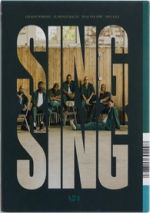
Sing Sing appears in an aspect ratio of 1.66:1 on this Blu-ray Disc. Taken from a 16mm source, I suspect the disc reproduced the original image, but it came with anomalies along the way.
Some of these felt inherent to the film stock in question, mainly related to sharpness. While much of the movie offered pretty good delineation, I saw more softness than would’ve been the case with a higher-resolution format.
The other major issue came from print flaws, as Sing Sing came with a mix of specks, scratches and marks. As became the case with 2024’s The Brutalist, this occurred intentionally, but it still seemed like an odd- and distracting – choice.
No issues with jagged edges or moiré effects materialized, and I saw no edge haloes. A decent layer of grain came with the presentation.
Sing Sing preferred a stylized palette one that leaned toward reds, yellows, and oranges along with some blues. These seemed fairly well represented, if not impressive given the source.
Blacks appeared reasonably tight, while low-light shots offered positive clarity. Given the choices on display, I thought the image merited a “B-, but objectively, the debris and softness made it a less than impressive presentation.
Downconverted to Dolby TrueHD 7.1, the movie’s Dolby Atmos soundtrack suited the story. While it lacked a lot of ambition, it made sense for this character journey.
Music showed good stereo presence, and effects broadened in a moderate manner. Nothing impressive popped up in that realm, as ambience ruled the day, but the soundscape formed a natural impression.
Audio quality satisfied, with music that seemed warm and appealing. Speech came across as concise and natural.
Effects lacked anything to push the envelope, but those elements felt accurate and without distortion. This became a perfectly adequate mix for a quiet drama.
When we shift to extras, we start with an audio commentary from writer/director Greg Kwedar, producer Monique Walton, editor Parker Laramie and director of photography Pat Scola. All four sit together for this running, screen-specific look at story and characters, cast and performances, sets and locations, photography and editing, music, costumes and production design, and related domains.
While I can’t claim it ever becomes fascinating, this track nonetheless examines the production in a reasonably positive manner. We don’t get a fascinating chat but the discussion comes with enough substance to merit a listen.
Three Deleted Scenes span a total of 17 minutes, three seconds. The first two give us a bit more character material with our leads, while the third extends the audition/interview segments with former inmates.
Scenes one and two seem fine but unnecessary in the overall story. “Auditions” runs too long to fit the final film, as we get enough of those clips already.
Some featurettes follow, and Trust the Process spans 15 minutes, 26 seconds. It comes with info from Kwedar, Walton, executive producer John “Divine G” Whitfield, co-writer Clint Bentley, and actors Colman Domingo, Jon-Adrian “JJ” Velazquez, Clarence “Divine Eye” Maclin, Miguel Valentin, Robert Sanchez, Paul Raci, Sean San Jose, and Sean “Dino” Johnson.
The program examines story/characters, the project’s roots and development, cast and performances, sets and locations, and general thoughts. We get a mix of insights and happy talk here.
Sing Sing Correctional Facility Premiere goes for two minutes, 42 seconds and gives us remarks from Whitfield, Maclin, Kwedar, and Johnson, as we also see the movie’s screening at the correctional facility. It lacks substance.
Thanks to an excellent lead performance from Colman Domingo, Sing Sing remains a more than watchable prison story. However, an lack of creativity and odd tonal choices make it less successful than it should be. The Blu-ray comes with decent picture and audio as well as a handful of bonus materials. Outside of strong acting, this becomes a mediocre movie.