|
WARNER
|
| |
|
MOVIE INFO
|
|
Director:
Richard Fleischer
Cast:
Charlton Heston, Edward G. Robinson, Leigh Taylor-Young, Chuck Connors, Joseph Cotten, Brock Peters, Paula Kelly
Writing Credits:
Harry Harrison (novel), Stanley R. Greenberg
Tagline:
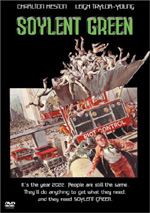
It's the year 2022 ... People are still the same. They'll do anything to get what they need. And they need Soylent Green.
Synopsis:
Working well again in the futuristic genre following Planet Of the Apes and The Omega Man, action titan Charlton Heston portrays Thorn, a detective prowling the dark streets of a polluted, overpopulated Big Apple gone rotten in 2022. He's trailing a murderer - and the trail leads to a stunning discovery. Vividly realized, Soylent Green's world gains its power not just from its social effects, but from its heart - a human dimension magnified by the performance of legendary Edward G. Robinson in his moving screen farewell.
MPAA:
Rated PG
| |
|
DVD DETAILS
|
Presentation:
Widescreen 2.35:1/16x9
Audio:
English Monaural
French Monaural
Subtitles:
English
Spanish
French
Closed-captioned
Runtime: 97 min.
Price: $19.98
Release Date: 8/5/2003
Bonus:
• Audio Commentary with Director Richard Fleischer and Actor Leigh Taylor-Young
• “A Look At the World of Soylent Green” Vintage Documentary
• “MGM’s Tribute to Edward G. Robinson’s 101st Film”
• “Charlton Heston: Science-Fiction Legend”
• Trailer
• Cast and Crew
| |
|
EQUIPMENT
|
Sony 36" WEGA KV-36FS12 Monitor; Sony DA333ES Processor/Receiver; Panasonic CV-50 DVD Player using component outputs; Michael Green Revolution Cinema 6i Speakers (all five); Sony SA-WM40 Subwoofer.
| |
[an error occurred while processing this directive]
|
Soylent Green (1973)
|
|
Reviewed by Colin Jacobson (October 28, 2003)
Is it possible to discuss Soylent Green and not mention the film’s very famous ending? Is it possible to know of Soylent Green and remain unaware of its very famous ending? I can’t answer the latter, but I’ll try to execute the former and not elaborate on the conclusion to this 1973 science fiction flick.
Set in the year 2022 – which doesn’t sound so far in the future now - Green depicts a pretty dystopian future. We meet Thorn (Charlton Heston), a detective in a horribly overpopulated New York City, and his assistant Sol (Edward G. Robinson); in a world that no longer features actual books, the elderly Sol acts as a living history text for Thorn. It’s hot all the time, energy must be recharged through the pedaling of stationary bikes, and food is at a premium. Most of the population exists on a tasteless form of natural food product; Soylent Green seems to be the most popular kind of meal.
A goon named Gilbert (Stephen Young) gets the assignment to kill a rich and privileged man named William Simonson (Joseph Cotten) because the latter’s become “unreliable” to some unnamed organization. This occurs while his bodyguard Tab Fielding (Chuck Connors) and live-in prostitute Shirl (Leigh Taylor-Young) shop for food on the black market. (Apparently she comes with the apartment; referred to as “furniture”, she’ll pass on to the next tenant if he wants her.)
The cynical, hard-boiled Thorn leads the investigation to find out who killed Simonson, but not until he lifts some prize food and other materials from the dead man’s apartment. The plot thickens when he checks into Fielding’s abode. He meets the bodyguard’s “furniture” Martha Phillips (Paula Kelly) and discovers that Fielding seems to be living beyond his means.
As Thorn investigates the case, he gets to know Shirl better, and an inevitable romance develops. Thorn slowly starts to discover the corruption behind the system. He also leads us gradually and inexorably toward the movie’s much-touted ending.
At times, Green wears its era on its sleeve. The movie makes clear its environmental message, especially during the opening montage. It presents a cautionary tale, I suppose, in that it warns us of the path we’ll take if we continue to pollute and ruin the earth.
However, Green avoids many of the period trappings. To be sure, the movie seems rather dated in a lot of ways. The music and production values scream “early Seventies”, and a laughably primitive video game doesn’t help; sure, we’re supposed to understand that technological advancement ground to a halt at some point, but I expect the residents of 2022 could salvage something more sophisticated than what looks like an early version of Asteroids.
Despite the visual and auditory reminders of the era, at least Green fails to come across like a drippy hippie escapade. Another flick in a similar vein, 1971’s Silent Running, seems like little more than propaganda. Annoyingly dreamy and insufferable, Running is barely watchable more than 30 years later.
Green may remind us occasionally of its environmental message, but it doesn’t hit us over the head with it. It seems significantly more cynical than I’d expect for the era. Perhaps the effects of Watergate and Vietnam affected it, but I was pleased to see that it lacked the expected dippiness.
Despite these moderately pleasant surprises, Green presented a generally lackluster flick. The movie seemed a little too dependent on its big ending. Since most people will know the concluding revelation before they ever watch the film, they can judge its merits as a thriller without consideration of that element.
Movies with surprise endings can often find it hard to thrive when one knows the conclusion. Something like The Sixth Sense still works well on a second viewing, but others fall flat. Green falls somewhere in between the two extremes. Because I knew the ending, I also was aware of exactly where the story would go. There was no tension behind the unfolding of the plot.
That rendered Green a bit toothless, but it still had its moments. The movie became most interesting in its depiction of the horrid future society. Green’s conception of a flawed future lacked the flair and style of something like Blade Runner, but it gave us an unusually crude and rough presentation. It tossed in some cool and creative elements like the “scoopers” used to halt a riot; they concisely showed us just how dehumanized the future society had become.
Green included a couple of other powerful moments like that, but these weren’t enough to make it a great film overall. The story came across as a little too predictable, which meant it couldn’t quite overcome the foreknowledge most of us possesses in regard to its ending. Soylent Green featured some intriguing elements and well executed segments, but overall it remained fairly average as a film.
Trivia note: when she appeared in Playboy back in the late Sixties, Paula Kelly was the first model to expose pubic hair. Why do I know these things?
|
The DVD Grades: Picture C+/ Audio C+/ Bonus B-
|
|
Soylent Green appears in an aspect ratio of approximately 2.35:1 on this single-sided, single-layered DVD; the image has been enhanced for 16X9 televisions. Green offered an erratic transfer that varied from very good to fairly murky.
Like much of the rest of the picture, sharpness seemed inconsistent. Much of the time the movie looked nicely distinct and accurate. However, more than a few scenes demonstrated moderate softness and appeared somewhat indistinct. I saw no issues connected to jagged edges or shimmering, but some mild edge enhancement showed up occasionally.
Print flaws didn’t create consistent concerns, but they appeared sporadically throughout the flick. White specks were the most obvious and frequent problem, and I also noticed occasional examples of marks, debris, and other spots. Exterior shots demonstrated some of the dirtiest scenes, such as the images of the marketplace at the start of chapter 17. These elements seemed intentional to communicate the pollution of the environment, though the application of this was inconsistent and showed a lot of marks in addition to the haziness. Otherwise, the image wasn’t excessively flawed for a movie of this generation, but it could have seemed cleaner.
Colors usually came across as reasonably well defined. The hues occasionally appeared somewhat bland and muddy, but those occasions seemed rare. Mostly the tones were acceptably accurate and distinctive, and sometimes they seemed pretty vivid. Black levels appeared fairly dense and tight, and low-light shots came across as fairly easily visible; they didn’t suffer from excessive darkness, though some other scenes were a bit on the murky side. Soylent Green never presented a great transfer, but more of it looked good than bad.
The monaural soundtrack of Soylent Green seemed fairly average for its age. Speech lacked much depth or vivacity, but the lines remained easily intelligible and free from edginess. Some awkward looping occasionally marred the presentation, though. Effects failed to deliver much life, but they also didn’t seem problematic in many ways. The elements were clean and acceptably accurate, and they showed only mild issues related to distortion; the riot in chapter 17 came across as a bit rough, but it didn’t become terribly shrill.
Music appeared somewhat infrequently and seemed average when we did hear it. The score and source music sounded decently distinct but they lacked much range and favored the treble side of the equation. Not much about the audio for Soylent Green presented problems, but not much about it stood out as terribly positive either.
To my surprise, Soylent Green comes with a pretty decent set of extras. It begins with an audio commentary from director Richard Fleischer and actor Leigh Taylor-Young. The pair sit together for this running, screen-specific track. An erratic piece, it offers some good information but doesn’t ever become anything special. On the positive side, more than a few nice notes about the flick appear. For example, we get information about changes between the original book and the film, Heston’s behavior on the set, and working with Edward G. Robinson at the end of his career. That last topic generates some touching anecdotes and remarks. Unfortunately, the pair go silent much of the time, and the commentary drags periodically. This means that it never becomes more than fairly average, but the track presents enough good material to merit a listen.
Next we find a couple of featurettes. Created at the time of the film’s original release, A Look At the World of Soylent Green runs 10 minutes and quickly covers the flick. It opens with a look at a few prior cinematic attempts to envision the future and then gives us some basic details about Green. This mostly just recaps story points, and it gets some wrong, such as when it refers to the corrupt Thorn character as “scrupulously honest”. However, it merits a look if just for the behind the scenes shots that pop up occasionally.
Another period program, MGM’s Tribute to Edward G. Robinson’s 101st Film lasts four minutes and 50 seconds as it shows a party for the actor. We saw a little of this in the prior featurette. It covers a ceremony that celebrated the actor’s achievement. Heston reads some affectionate telegrams from notables like Frank Sinatra to Robinson, and then the actor himself delivers a short address. George Burns even shows up along the way. The piece doesn’t seem terribly interesting, but it’s a nice addition for historical purposes.
A text piece, Charlton Heston – Science-Fiction Legend fills five screens with notes about the actor’s career in the genre. Essentially this acts as little more than a glorified filmography. We learn of Heston’s sci-fi flicks but don’t get much detail about them. It’s a pretty insubstantial effort.
Lastly, the DVD includes a couple of minor components. We get the movie’s theatrical trailer. While this offers anamorphic enhancement, oddly, it uses a windowboxed approach, so it has big bars on the sides. Avoid this ad if you want to skip spoilers; it reveals quite a lot about the story. As with most Warner Bros. DVDs, the Cast and Crew area only lists the names of participants; no additional details about them appear.
30 years after its original release, Soylent Green has become known better as a punchline than as a movie. The flick itself relies a little too heavily on its famous ending for power and doesn’t seem great on its own, though it has some very good moments. The DVD presents erratic but generally positive picture and audio, and it tosses in a few moderately useful extras. Nothing about the DVD or the movie stand out as particularly noteworthy, but fans of the flick should feel reasonably pleased with this release.
|
|
[an error occurred while processing this directive]
|
|