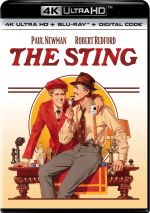
The Sting appears in an aspect ratio of 1.85:1 on this 4K UHD Disc. At least partially due to the source, this became a decent but inconsistent image.
Sharpness became one of the issues, as an awful lot of the film seemed less than distinctive. The image veered from pretty accurate elements to mushy ones, with a lot more of the latter than I'd expect.
No jagged edges or shimmering appeared, and I saw no edge haloes. Grain varied and often seemed more modest than I'd anticipate, so I suspected some noise reduction, though not to an egregious level. This appeared to impact sharpness as well since the softness moments came during interiors and those felt most likely to experience grain filtering.
Despite the low-key production design that matched the film’s Depression era, colors generally looked bright and vivid and offered some of the high points of the image. Though much of the image emphasized a sepia feel, other hues seemed well-saturated and HDR brought minor range to the tones.
Black levels were fine, and shadow detail usually appeared appropriately opaque. HDR meant whites and contrast enjoyed mild added impact. Perhaps the image repesented the source accurately, but I couldn't help but image that it could enjoy improvements, especially related to the softness apparent.
The DTS-HD MA 5.1 soundtrack of The Sting opened up the image in a modest way. Music demonstrated decent stereo imaging, and atmospheric scenes got a boost.
Usually we heard audio from the sides for shots with street life such as cars or trains. The gambling dens also showed some extra breadth.
The mix didn’t go nuts, though, as it stayed reasonably true to its single-channel roots. Surrounds added some light reinforcement of the elements but not much else, so you’ll be excused if you don’t even notice their presence.
The quality of the audio was solid. Dialogue usually integrated well with the picture and sounded relatively natural and intelligible. Effects reasonably realistic and lacked much distortion.
Scott Joplin's music came across terrifically well, as the ragtime songs sounded clear and rich, with a little bit of nice bass tossed into the mix. For material from an older source, The Sting sounded pretty good.
How did the 4K UHD compare to the Blu-ray from 2012? Both came with apparently identical audio.
Though the 4K UHD offered a cleaner presentation, it also came across as softer, perhaps because the format's superior resolution highlighted the production's inherently loose feel. Colors and blacks didn't get much of an upgrade from HDR, so while I felt happy the UHD lost the BD's minor print flaws, I couldn't see it as an obvious upgrade.
The 4K UHD repeats the Blu-ray's extras, and a documentary called The Art of The Sting lasts 56 minutes, 19 seconds as it presents remarks from writer David Ward, musical adapter Marvin Hamlisch, and actors Robert Redford, Ray Walston, Paul Newman, Charles Durning, Eileen Brennan, and Dimitra Arliss.
We learn about the origins of the movie and Ward’s writing of it, assembling a cast and crew, the film’s music, recreating the Depression-era setting and the use of slang, the director’s style, the actors’ work and their interactions, the story and its complications, and general thoughts. That latter topic means the show degrades into a praise-fest at the end, especially about the greatness of director George Roy Hill.
Until that point, it works awfully well. We get a decent sense of the way the production functioned, but better yet, we hear many great stories from the participants about approaches to characters, Hill’s recommendations, and nuts and bolts like the use of music. The show offers many insightful and interesting moments to turn into a winning documentary.
Under the banner of 100 Years of Universal, we find three featurettes. “Restoring the Classics” goes for nine minutes, 13 seconds and offers statements from Universal Studios Vault Services VP of Image Assets/Preservation Bob O’Neil, Universal Studios Technical Services VP Peter Schade, Kodak Pro-Tek Media Preservation VP of Preservation Services Rick Utley, Universal Studios Digital Services engineer Henry Ball, Universal Studios Technical Services mastering supervisor Phil Defibaugh, Universal Studios Technical Services mastering supervisor Ken Tom, and Universal Studios Technical Services supervising sound editor John Edell.
“Restoring” covers all the procedures used to bring Sting and other movies to Blu-ray, though not updated for 4K UHD. It’s a reasonably informative take on the subject.
“The ‘70s” goes for 11 minutes, one second as it provides notes from filmmakers Peter Berg, Steven Spielberg, John Landis, Peyton Reed, Amy Heckerling, Ron Howard, Judd Apatow, Hal Needham, Ivan Reitman, and Stephen Daldry, writers David S. Ward and Bob Gale, former Universal executive Edgar Bronfman, Jr., journalist Geoff Boecher, and actors Russell Crowe, Ted Danson, Paul Rudd, Dermot Mulroney, Danny DeVito, and John Krasinski.
In “The Lot”, we get a nine-minute, 25-second piece in which we hear from Spielberg, Rudd, Reed, Reitman, Berg, Landis, Howard, filmmakers Michael Mann, Phil Alden Robinson, and John Carpenter, NBC Universal Archives and Collections director Jeff Pirtle, Universal Studios Hollywood tour guide Molly Orr, and actors Dan Aykroyd and Meryl Streep.
“’70s” discusses The Sting, American Graffiti, The Jerk, Smokey and the Bandit, National Lampoon’s Animal House, and Jaws. “The Lot” takes us around the Universal Studios locations and tells us a little about movies made there.
As noted, we hear a little about Sting in “’70s”, and some brief snippets appear in “Lot” as well. Despite the featurettes’ essential disconnect from Bandit, they’re both pretty fun. While they aim to promote the greatness that is Universal, they’re still light and likable.
We also get the flick’s theatrical trailer, though it was created for a post-Oscars reissue. A second disc provides a Blu-ray copy of the movie with all the same extras.
The Sting delivers a solidly entertaining little film. It aspires to be nothing more than a consistently compelling and delightful movie and it succeeds on all counts. The 4K UHD offers erratic picture and audio along with a decent set of supplements. Though more than watchable, the end product seems like a minor upgrade over the Blu-ray, if that.