Teenage Mutant Ninja Turtles appears in an aspect ratio of approximately 1.85:1 on this 4K UHD Disc. The film provided a positive Dolby Vision image held back only by the nature of the source.
This led to a little softness at times, though not to a substantial degree. The movie usually exhibited largely positive delineation.
No issues with jagged edges or shimmering occurred, and I saw no edge haloes. Grain could lean heavy but still seemed natural, and the movie lacked print flaws.
Colors went with a natural palette that worked fine. The film’s settings – like the sewer – gave the palette a somewhat grimy feel but the hues satisfied, with a boost from HDR.
Blacks felt deep and dark, while shadows appeared smooth concise. Whites and contrast enjoyed extra oomph from HDR. The nature of the project meant it didn’t turn into a visual showcase, but the disc replicated it about as well as I could imagine.
Downconverted to Dolby TrueHD 7.1, the movie’s Dolby Atmos remix worked pretty well. The soundfield opened up matters to a satisfying degree but didn’t go nuts.
Which I appreciated, as I didn’t want the Atmos version to radically rework the stereo source. The soundfield largely concentrated on the front channels and those offered a nice sense of localization and blending.
Thanks primarily to the flick’s action scenes, the surround channels also added life to the proceedings. They became moderately active partners that managed bring involvement to matters.
Audio quality held up find over the years, with speech that mainly remained concise. Some edginess impacted louder lines but the dialogue seemed well-replicated most of the time.
Music showed nice range and punch, while effects seemed fairly accurate and full. This turned into a more than competent remix.
Note that the disc also includes the movie’s theatrical LPCM stereo track as well as a DTS-HD MA stereo “Warrior Mix”. How did the two differ?
Not much, as they seemed to show identical soundfields and quality. Created for South Korea, the “Warrior Mix” altered some dialogue to change the term “ninja” to “warrior” or “combat” and also to make Japanese terms/names Korean. It’s good to have for historic reasons, I guess.
The stereo soundfield demonstrated good spread and movement. Elements seemed well localized and they meshed together nicely.
Audio quality seemed on a par with what I heard in the Atmos track. I found a lot to like about the theatrical mix.
How did the 4K UHD compare to the original 2009 Blu-ray? The Atmos track replaced a 5.1 remix on the BD and gave the movie a more natural soundscape with superior localization. It also added the theatrical audio absent from the BD.
As for the Dolby Vision image, it boasted clear upgrades in terms of accuracy, colors and blacks. The BD suffered from murky visuals so the UHD turned into an obvious upgrade.
Though the 2009 release skimped on extras, the 2025 version comes with a bunch, and we get two separate audio commentaries. The first comes from director Steve Barron, as he gives us a running, screen-specific look at the source and its adaptation, story/characters, editing and cinematography, cast and performances, various effects, sets and locations, and connected domains.
Barron offers a solid overview of the project, as he touches on a bunch of relevant topics. He remains engaging throughout the track and ensures we learn a lot about the movie.
For the second commentary, we hear from comic book expert Dave Baxter. During his running, sporadically screen-specific track, he looks at the history of the Turtles franchise, with an emphasis on its origins in the mid-1980s through this 1990 film.
If I wanted to find a complaint here, it would stem from Baxter’s semi-ADHD inability to follow events in a straight line, as he tends to sidetrack a little too often. Nonetheless, Baxter gives us a really nice overview of these domains and does so with plenty of gusto, all of which make this a strong commentary.
Six featurettes follow. Rising When We Fall spans 14 minutes, 44 seconds and brings more from Barron.
The director covers what brought him to filmmaking and how he got the Turtles gig, dealing with budgetary issues and working with Jim Henson on the animatronic suits, sets and locations, and the movie's legacy. The interview acts as a good complement to Barron's commentary.
Turtle Talk goes for 18 minutes, 50 seconds. It involves actors Robbie Rist, Brian Tochi, Ernie Reyes Jr. and Kenn Scott.
The performers discuss what got them into movies as well as their roles and experiences during the various Turtles movies. We find a nice look at this side of the production along with some fun anecdotes - and 50-plus years later, Rist remains recognizable from his stint as the much-loathed "Cousin Oliver" on Brady Bunch.
Next comes O’Neil on the Beat. As expected, the 19-minute, 54-second reel features actor Judith Hoag.
She looks at how she came to Turtles along with her performance and experiences during the shoot. Hoag delivers some valuable notes, especially when she gets into the reason she didn't return for the sequels.
Wet Behind the Shells lasts 11 minutes, one second. This one gives us notes from producer Simon Fields.
We hear about his involvement in the movie industry plus his work on Turtles. This becomes a fairly general but still reasonably informative chat.
After this we go to Beneath the Shell. Across this 16-minute, seven-second piece, we hear from Henson Creature Shop’s Brian Henson and Rob Tygner.
“Shell” covers their time on Turtles and aspects of their creations. We find a fine view of these domains as well as other behind the scenes tales.
Teenage Mutant Ninja Turf occupies 12 minutes, 58 seconds and examines the film’s locations as Michael Gingold takes us on a tour of movie locations. Though dry, this delivers an enjoyable view of how these spots look circa 2025.
The disc includes an Alternate UK Version of the film (1:31:15). Thanks to a UK ban on nunchaku, this edition needed to cut around Michelangelo’s tools and it also used alternate takes at times.
All that sounds a bit silly but it does mean we get a moderately different viewing experience. I appreciate the inclusion of this version.
In the same vein, we find an Alternate Ending (2:10) as well as Alternate Korean Footage (1:01). The former comes from a VHS workprint and shows April and Danny try to pitch a Teenage Mutant Ninja Turtles comic to a publisher.
Ironically, it gets rejected as “too far-fetched”. While cute, it seems a little too on the nose.
The Korean material includes an alternate title – changed to Teenage Mutant Hero Turtles - and a different shot of the woman Splinter’s master loved. These seem like inconsequential changes but they remain good to have for historical purposes.
In addition to four trailers, the disc wraps with an Image Gallery that provides 26 frames of publicity stills, shots from the set and ads. It’s an awfully short compilation but it comes with some good material.
35 years ago, Teenage Mutant Ninja Turtles became a surprise hit. Viewed after all that time, the movie boasts some moderate charms and still offers acceptable entertainment value, but it never turns into anything especially winning. The 4K UHD provides good visuals and audio as well as a mix of bonus features. After a problematic 2009 Blu-ray, this becomes a vast upgrade.
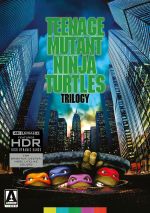
Note: this Turtles 4K UHD currently appears only as part of a “Trilogy” set that also includes 1991’s Teenage Mutant Ninja Turtles II: The Secret of the Ooze and 1993’s Teenage Mutant Ninja Turtles III.