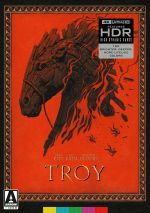
Troy appears in an aspect ratio of approximately 2.35:1 on this 4K UHD Disc. Though largely positive, the Dolby Vision image showed some warts from the source.
Sharpness generally worked well but came with those warts. While most of the flick brought good delineation, wider shots and 22-year-old CG effects tended to seem a bit soft.
I saw no issues with jagged edges or moiré effects, and edge haloes remained absent. No print flaws materialized and grain seemed appropriate.
Colors went with an arid mix of orange and amber much of the time, and we found a fair amount of teal as well. The hues lacked imagination and the disc made them look decent but not great, without as much kick from HDR as I might expect.
Blacks felt dark and deep, while low-light shots offered appealing clarity. HDR added punch to whites and contrast. While much of the film looked solid, the 4K UHD didn't quite dazzle.
As for the DTS-HD MA 5.1 soundtrack of Troy, it seemed good but oddly "detached". This meant an active soundfield but one without terrific integration.
With a lot of action, the soundscape managed to use the speakers as a constant companion. However, the elements failed to blen together as well as I might anticipate and felt somewhat isolated within the specific channels.
Audio quality also brought some inconsistencies. Dialogue always came across as natural and suffered from no edginess or problems with intelligibility.
While music and effects seemed acceptably well-delivered, those elements tended to feel more subdued and without the power I'd anticipated. This all led to a generally positive soundtrack but not one that impressed.
How did the 4K UHD compare to the simultaneously released Arrow Blu-ray? Logically I'd expect both to offer identical audio since they both brought DTS-HD MA 5.1 tracks.
However, the sound on the Blu-ray came across as noticeably better integrated andmore dynamic. I can't explain why the two appeared different but they did.
As for the UHD's Dolby Vision image, it also felt like a downgrade from the Blu-ray. Some of that occurred because the UHD's superior resolution made the aforementioned softness from the source more obvious.
However, it made less sense that the UHD's colors looked less dynamic, as even with HDR, the UHD's hues lacked the same punch. While the UHD seemed perfectly acceptable, it became a rare case where the Blu-ray offered the superior option in terms of both picture and audio.
When compared with the movie's original 2007 Blu-ray, comparisons became more mixed. That one's LPCM 5.1 audio came across as stronger than the UHD's DTS-HD MA 5.1.
However, the UHD's visuals became a clear upgrade over the dated image found on that nearly 20-year-old BD. While the 2026 BD became the best of the bunch, I'd take the 4K UHD over the 2007 Blu-ray because the latter's picture quality seemed so iffy.
This Arrow set includes both the film’s theatrical version (2:42:49) and a Director’s Cut (3:16:04) on separate discs. How do the two differ?
My movie discussion earlier examined the theatrical version of Troy. Given I didn’t care for that one, the fact the Director’s Cut almost 34 minutes to the original’s already-long running time sounds like a dangerous decision, as making an already slow movie longer should be a disaster.
Not always, as sometimes extensions make a movie richer and more dynamic. Does that happen with Troy?
Not in my opinion. That said, I will admit some surprise that the extra running time doesn’t slow down the film to a substantial degree, and I could argue that the footage helps flesh out some of the secondary characters.
However, this additional breadth doesn’t fix the flick’s problems, as we still find too much talk and not a lot of meat to make the enterprise interesting. While I don’t think the Director’s Cut comes across as worse than the theatrical edition, I also don’t feel it improves upon the shorter version.
No extras appear on the theatrical platter and only one shows up on the DC disc: a two-minute, 31-second Introduction with director Wolfgang Petersen where he tells us a little about why he decided to create the extended edition and offers a preview of what to expect. It’s a decent but inessential opening to the longer version of the film.
Everything else appears on Disc Three, where we mainly get video programs. Troy In Focus delivers a 23-minute, eight-second piece that includes remarks from Petersen as he gives us thoughts about his interest in the story and some changes made for the Director’s Cut, working with Pitt, some casting and character notes, and locations and sets.
“Focus” doesn’t substitute for an audio commentary, but it provides a decent showcase for the director’s observations. Its biggest problem comes from its structure, as instead of a single running show, it compiles 11 short clips.
That’s not a major issue, though, and the collection of featurettes gives us a reasonable number of nice insights, especially in the way it illustrates changes for the Director’s Cut.
In the Thick of Battle brings a 17-minute, 14-second program. We hear from Petersen, second unit director/stunt coordinator Simon Crane, weapons designer Simon Atherton, chief prosthetics makeup Daniel Parker, special effects supervisor Joss Williams, sword master Richard Ryan, military technical advisor Richard Smedley, and actors Eric Bana and Brad Pitt.
They discuss the various weapons used in the flick and their construction, the depiction of gory violence, the training of extras to play soldiers, location challenges, and the specifics of some fights.
The program offers a surprisingly rich look at its subjects. It touches on a nice mix of topics and gets into them with just enough detail to become useful. There’s very little fluff on display in this tight and brisk piece.
Next we locate From Ruins to Reality. It goes for 14 minutes, two seconds and features remarks from Petersen, Bana, Pitt, Williams, writer David Benioff, British Columbia Department of Greek/Roman Antiquities Lesley Fitton, producer Diana Rathbun, location manager Peter Novak, supervising art director Les Tomkins, production designer Nigel Phelps, supervising art director Kevin Phipps, and actors Diane Kruger and Peter O’Toole.
They discuss exploration of the historical Troy and research for the film, the choice of locations, the design and construction of the sets, and various details of the shoot.
For the most part, my comments about “Battle” apply to “Ruins”. This show also goes through some intriguing material in a reasonably evocative and distinctive manner.
It isn’t quite as good simply because it engages in more puffy talk than I’d like and it occasionally comes across as self-congratulatory. However, the positives outweigh the minor negatives to make this a good program.
After this comes Troy: An Effects Odyssey. It takes 10 minutes, 54 seconds to give us notes from Petersen, Crane, Benioff, supervising sound editor Wylie Stateman, and visual effects supervisor Nick Davis.
They discuss the creation of a digital armada of boats, camera techniques, building digital soldiers and executing battles, and audio elements. Don’t expect anything to differ from the prior two featurettes. “Effects” presents a tight exploration of the various issues and gives us a short but informative take on the material.
Attacking Troy lasts 15 minutes, 12 seconds and features Petersen, Benioff, Fitton, Kruger, Bana, Crane, horsemaster Jordi Casares, and actor Orlando Bloom.
This piece looks at the story and its influences, changes made from the source material, character and performance issues, fight scenes, horse riding and stunts.
“Attacking” takes a somewhat scattershot approach to the film’s creation and doesn’t settle on the various subjects well. It flits about without much focus, so it doesn’t dig into the areas particularly well. While we get a smattering of decent notes, “Attacking” doesn’t prove very satisfying.
With Gallery of the Gods, we get a compilation that spans a total of 10 minutes, 49 seconds and gives us information about many of the Greek deities referred to in Troy. Though it rushes through the various characters, it nonetheless becomes a decent little overview.
Not found on the prior Blu-ray, In Movie Experience offers a feature found on many Warner releases in the early BD era. The Arrow set refers to it as an archival piece but I can’t find any evidence any other Blu-ray included it.
Anyway, this picture-in-picture program mixes behind the scenes footage, production art, and interview snippets. We hear from Petersen, Benioff, Bana, Pitt, Bloom, Kruger, Atherton, Fitton, Phelps, Williams, Crane, Smedley, Ryan, Casares, O'Toole, Phipps, Parker, costume designer Bob Ringwood, University of Tuebingen's Dr. Manfred Korfmann, and actors Brendan Gleeson, Brian Cox, Tyler Mane, Saffron Burrows, Garrett Hedlund, Rose Byrne, and Sean Bean.
The comments cover the source and its adaptation, story and characters, Petersen's approach to the material, costumes, props and attempts at accuracy, cast and performances, sets and locations, various effects, stunts and action.
A fair amount of good information appears here, even if we get more than a little redundant material after the prior programs. Unfortunately, we get enormous gaps between comments so this becomes a frustrating way to learn about the film.
In addition to the film’s trailer, we end with Image Galleries that cover “Stills” (270 frames), “Behind the Scenes” (63) and “Promotional Material” (14). None stand out as memorable, though "Behind the Scenes" fares best.
Troy turns a remarkable series of battles into bland melodrama. The interpersonal elements don’t coalesce and the fight scenes fail to take flight. The 4K UHD brings good but not great visuals, an oddly tame soundtrack and a fine array of supplements. Fans of the movie should opt for the Arrow Blu-ray version, as to my surprise, it provides better picture and audio than this 4K UHD.