Reviewed by Colin Jacobson (August 16, 2026)
"Timely" doesn't quite describe the amazing coincidences that surrounded the release of 1997’s Wag the Dog, a film in which the White House uses a phony war to distract from a burgeoning presidential sex scandal. At virtually the same time, the Monica Lewinsky absurdity and Clinton's excursions into Iraq took place.
Real life, or Memorex? Spooky!
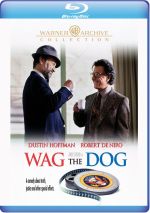
As the election rapidly approaches, an underaged girl accuses the US president of sexual indiscretions in the Oval Office. Aide Winifred Ames (Anne Heche) brings in spin doctor Conrad Brean (Robert De Niro) to fix this problem.
Conrad comes up with a seemingly outrageous concept: he will stage a non-existent war with Albania to distract voters. Conrad brings in Hollywood producer Stanley Motss (Dustin Hoffman) to give him the needed visuals to sell this fictional conflict, a choice that comes with inevitable consequences.
At the very least, Wag the Dog offers a fairly entertaining 96 minutes of political satire. However, it fails to muster any true insight or substantial wit.
For satire to succeed, it needs either some level of affection or true incisiveness, and subtlety is preferred. Wag the Dog achieves none of these goals.
Look at a classic like 1984’s This Is Spinal Tap. It worked because it was clever and it took a gently satirical look at metal bands, an extremely easy target.
The media also makes for an easy target, but Wag the Dog in no way can be viewed as either an affectionate or subtle parody. Throughout his many crass and heavy-handed films, director Barry Levinson has made it clear that he sees TV and the media as elements in the downfall of the United States.
Okay, "downfall" may be too strong a term, but 1990's Avalon brought such a blatant attack on the media that it should have been subtitled How TV Ruined the American Family. For a Hollywood liberal-type, Levinson seems about as reactionary as they come, and he possesses little subtlety.
Wag the Dog runs along similar lines as Avalon in that the film makes it clear what an evil force media and technology can be. Yes, the film posits some interesting ideas: in this age of easily manipulated images, where we no longer can trust what we see, how do we know what to believe?
That was accurate in 1997 when they shot Dog. It seems exponentially more true in 2026.
Although the movie's theme that we should be wary and not blindly accept what we see on TV makes sense, I take issue with the insulting way in which Levinson makes his case. Basically, it becomes very clear that he feels the American public is completely comprised of idiotic chumps who fall for any scheme thrown their way, and it's up to him to let us know what to do.
Given the US elected Donald Trump president twice, he might be right about that first part. The second works less well.
Levinson clearly feels pretty full of himself. Through his films, he thinks that it's his job to "educate" everyone about the true ways of the world.
A lot of Levinson's pretensions could be more easily ignored if he delivered a consistently funny movie. That doesn't happen here.
Wag the Dog offers occasional laughs, but it simply tries too hard. It tells us over and over again that it's clever and witty, but it rarely delivers.
I find that fault with much "intellectual" humor is that it so badly wants us to appreciate that it's sly and incisive that it hardly ever actually amuses. Comedy needs to lack much pretense to work, and in that vein, Dog fails.
One unfortunate choice Levinson made for this movie was to attempt a faux-documentary style. He seems unsure about this decision, because very little of it comes across rough or awkward, as do actual documentaries.
No, Levinson’s sole apparent method of using this form is to occasionally do a really quick, slightly out of focus zoom on a character. We've definitely seen this in real documentaries, as because they usually are filmed with only one camera, the operator has to quickly shift focus when a different person speaks, and these
kinds of abrupt zooms occur.
Levinson apparently tries to use this method as a shorthand for the documentary style, because he doesn't follow through with any other appearances from that form. Virtually the entire movie looks just like any other Hollywood picture.
Like I said, this isn't new territory for Levinson, and it's at least more entertaining than the unbelievably sappy and manipulative Avalon. In many ways, it does provide an entertaining viewing.
The film boasts a fine cast, most of whom do pretty good work. Hoffman puts in a nice turn as a film producer hired to give the president's staff their phony war, as he comes across as more relaxed and natural than usual as the naive Stanley Motss.
De Niro offers a surprisingly understated performance as "White House spinmaster" Brean. De Niro can chew scenery with the best of them but he backs off in this part.
Wag the Dog supplies a terrific group in the supporting roles, from the sublime Andrea Martin to Denis Leary. Woody Harrelson gives an amusingly over the top performance as a psychotic "war hero," while Heche does some of her best work as an anxious member of the president's staff.
No, it's certainly not the cast who are to blame for the failure of Wag the Dog. Again, it simply comes down to the heavy-handed manner in which Levinson treats the material and his audience.
There's a goldmine of material here, but it receives such an overbearing treatment that the audience is left cold. If Levinson could have resisted his urge to shove his viewpoint down the viewer's throat, this film might have offered a scathing indictment of the media and the political process. As it stands, Wag the Dog insults rather than informs.