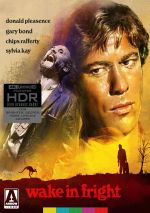
Wake In Fright appears in an aspect ratio of 1.85:1 on this 4K UHD Disc. Though a few anomalies appeared, the Dolby Vision image usually looked solid.
Some softness cropped up sporadically, but not often. This meant most of the flick seemed accurate and well-defined.
Neither jagged edges nor moiré effects materialized, and I saw no edge haloes. Grain appeared natural.
In terms of source issues, I saw a handful of small specks and a little judder early in the production. These elements remained minor and non-intrusive, however.
Given the oppressively hot Outback setting, the movie’s palette emphasized a blistering sense of yellows and reds, with a little teal tossed in at times. These looked appropriately steamy and the hues got a boost in intensity from HDR.
Blacks felt a little crushed at times but usually looked positive, and I thought low-light shots brought appealing clarity. HDR delivered a nice bump to contrast and whites. Even with some dodgy moments, much of the movie looked great.
As for the film’s DTS-HD MA monaural soundtrack, it worked fine for a 55-year-old flick. Despite some iffy on-set recording, speech appeared acceptably natural and lacked edginess or other issues.
Music and effects became reasonably full and accurate. Nothing here impressed but the track appeared more than acceptable given the production’s vintage.
We find a mix of extras here and start with two separate audio commentaries. The first comes from director Ted Kotcheff and editor Anthony Buckley, both of whom sit together for this running, screen-specific look at story/characters, sets and locations, photography, editing, cast and performances, music, and related topics.
Expect an inconsistent chat here, as this one comes with more than a few ups and downs. While we find some good information along the way, Kotcheff and Buckley also sometimes simply narrate the movie, and too much dead air renders this a mixed bag.
For the second commentary, we hear from film historian Peter Galvin. He delivers his own running, screen-specific discussion of the source and its adaptation, story, characters and themes, cast and crew, various production elements, and views of the movie.
Galvin digs into a slew of useful areas in this fast-paced track. He covers a good variety of domains and makes this a highly informative discussion.
Video programs ensue and Return to the 'Yabba goes for 49 minutes, 46 seconds as it takes us on a modern-day tour of movie locations with film/TV historian Andrew Mercado. He chats with some locals along the way to tell us about Broken Hill to make this an engaging view of the places they shot the flick.
A Take in Fright spans 20 minutes, 42 seconds. It brings remarks from director of photography Brian West.
He discusses how he came to the project as well as memories of his work and the shoot. We get some useful remarks but the conversation can seem a bit loosely focused.
With Sounds of the Outback, we find a 14-minute, 52-second reel. This one involves sound editor Keith Palmer and assistant sound editor Eddy Joseph.
As expected, "Outback" examines elements related to the movie's audio. They deliver some worthwhile insights.
The Cinema’s Great Squeak Bald Git lasts 14 minutes, 51 seconds and offers a discussion of actor Donald Pleasence from critic/film historian Kim Newman. We get more of an appreciation than a clear biography but the collection of movie clips acts as a nice overview.
Next comes The Filmmaker and the Film Buff. The 20-minute, seven-second program provides a chat between filmmaker Philippe Mora and film buff Paul Harris.
Here they provide reflections of cast/crew and aspects of the film along with their impressions/interpretation of it. Some of the production notes repeat from elsewhere, but Mora's perspective adds value.
Five components appear under Archive Interviews> “Yer Mad, Ya Bastard!” (12:57) brings a circa 2008 chat with Kotcheff, while we also get a 2008 interview with actor Jack Thompson (6:50).
From 2009, a “Toronto Film Festival Q&A” (45:51) features Kotcheff. We also find audio-only interviews with Kotcheff (2:10:27) and composer John Scott (15:30).
The audio-only piece with Kotcheff covers essentially the same topics heard in the director’s commentary along with more about his life and career but it does so in a more dynamic and complete manner. I’d recommend viewers go with this interview and skip the commentary because they cover so much of the same ground and this one fares better.
Scott's audio interview focuses pretty tightly on his score for the film. He brings useful notes.
"Mad" offers more of Kotcheff's memories. That means a lot of repetition, though he gets into topics like impressions of Australia that he doesn't really touch on elsewhere.
Thompson discusses the Australian film industry in this flick's era plus other movie-related thoughts. He gives us a few good details.
Finally, the Q&A covers Kotcheff's career and the production of Fright. After so many other chats with Kotcheff, this one comes with lots of repetition and not much fresh material.
A “censored” version of Fright titled Outback played in the US and the UK, and Alternate Footage (10:40) displays changes made for those cuts. This gives us a fine view of the alterations.
TV Reports includes three segments. “ABC’s 7:30 Report” (6:35) looks at the movie’s 2009 restoration, while “Who Needs Art?” (5:52) comes from 1971 and examines aspects of the shoot.
Finally, “Chips Rafferty Obituary” (3:27) offers a tribute to the late actor. "Report" seems fairly general, though it gives us minor insights into the work required to bring the print back to life.
"Art" works because of its archival bent and its inclusion of footage from the shoot as well as a take on governmental support of the Australian film industry. "Obituary" also comes from the early 1970s so that "vintage" side of things adds to its appeal.
Within a Trailer Gallery, we get theatrical and TV spots for the movie’s US release titled Outback, as mentioned previously. We also find a “restoration trailer” and “Foreign Visions of Local Stories” provides a 38-minute, 13-second compilation of promos for 14 films set in Australia but made by outsiders.
Lastly, an Image Gallery delivers 60 shots from the film. It seems forgettable.
A dark and foreboding look at a man’s moral collapse, Wake in Fright largely succeeds. Its depiction of real violence against animals becomes an off-putting distraction but the rest of the film connects. The 4K UHD comes with largely solid picture and audio as well as a long roster of bonus materials. Fast-forward through the kangaroo slaughter and this winds up as an impressive tale.