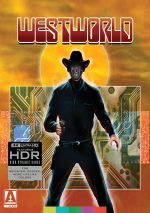
Westworld appears in an aspect ratio of approximately 2.35:1 on this 4K UHD Disc. The Dolby Vision transfer seemed fine, though it showed its age.
Overall sharpness seemed satisfactory, though some shots could look soft without a lot of obvious reason. Still, most of the film exhibited positive delineation.
I saw no issues with jagged edges or shimmering, and the image lacked edge haloes. Print flaws also failed to materialize here, and grain seemed natural.
The film’s palette tended toward a rustic brown feel that suited the largely Western motif. Thanks to the other “worlds”, the colors showed good range, with nice pop from HDR.
Blacks felt deep and tight, while low-light shots offered largely positive clarity. HDR added some punch to whites and contrast. No one will view this as a visual showcase but the UHD seemed to replicate the source well.
As for the film’s DTS-HD MA 5.1 soundtrack, it appeared erratic, but it leaned toward the good side of that equation. The soundscape focused on the front and displayed nice stereo presence for music.
Effects seemed less consistent, as they occasionally broadened to the side and rear speakers in a vivid manner. We also got occasional instances of localized speech.
However, some scenes felt closer to monaural. This meant the soundscape usually offered reasonable breadth but it varied somewhat.
Audio quality seemed dated but acceptable. Despite occasional edginess, speech was fairly natural, and I detected no issues with intelligibility.
Effects appeared similarly restricted, and they could be a bit distorted at times, but they usually appeared reasonably clear. Music fared best, as the score sounded full and rich. Given the movie’s vintage, this felt like a “B” soundtrack.
The 4K UHD also came with three alternate mixes: stereo, mono and DTS-HD MA 4.0 that apparently replicated the movie’s theatrical audio. I opted for this one to compare to the 5.1 track.
Both seemed virtually identical in terms of quality and they also felt pretty similar when I considered their soundfields. Though the 4.0 dropped the surrounds – it went front three channels and subwoofer – this didn’t make much of a difference given that the 5.1 version so heavily focused on the forward channels.
In that domain, I thought the 4.0 came across as a bit more natural and better integrated. Localization and movement appeared a little smoother, though both occasionally showed dialogue that came from farther to the side than it should.
None of this made the 4.0 considerably superior to its 5.1 peer. Nonetheless, it acted as the preferred mix.
How did the 4K UHD compare to the original Blu-ray from 2013? Both came with identical 5.1 audio but the UHD added the original 4.0, and that gave it a modest sonic advantage.
The Dolby Vision UHD also boasted improvements in terms of accuracy, colors and blacks. This wound up as a quality upgrade.
The 4K UHD mixes old and new extras, and we open with a circa 2025 audio commentary from film historian Daniel Kremer. He offers a running, screen-specific look at cast and crew, the project’s development, story, characters and screenplay variations, various production details, and his thoughts on the movie.
Kremer delivers a balanced chat that discusses the topics well. He provides a compelling overview that fares nicely.
The next two extras also appear on the prior Blu-ray. Beyond Westworld, a 1980 TV pilot that runs 49 minutes, 39 seconds.
The show gives us a look at the theme park after the robots malfunctioned. The series only lasted a handful of episodes, and I can see why, as the pilot isn’t very good.
In addition to the film’s trailer, we find a vintage featurette called On Location. It fills nine minutes, eight seconds and offers a few notes from writer/director Michael Crichton and actors Richard Benjamin and Yul Brynner.
Despite a few good behind the scenes shots, this mostly becomes promotional fluff. Don’t expect to learn much.
From there we find four programs new to the Arrow release. Cowboy Dreams spans 11 minutes, 42 seconds and features actor Richard Benjamin and producer/screenwriter Larry Karaszewski.
Given he was 12 when they made Westworld, obviously Karaszewski didn't work on the film. Instead, he acts as interviewer with Benjamin.
The actor tells us how he got onto the film along with aspects of the shoot and the flick's legacy. Benjamin provides a nice collection of memories.
At Home on the Range lasts 17 minutes, four seconds. Here we find notes from actor James Brolin.
He discusses how he got into movies as well as what brought him to Westworld and his recollections of the shoot. Brolin's comments add good reflections of his experiences.
Next comes HollyWorld. This involves 34-minute, 16-second reel involves producer Paul N. Lazarus III.
Here we find Lazarus's comments about how he got backing for Westworld, casting, some production notes, the sequel, subsequent collaborations with Michael Crichton, and the film's legacy. Though the conversation rambles a bit at times, Lazarus nonetheless brings a mix of insights.
Sex, Death and Androids goes for 13 minutes, 13 seconds. We get info from film scholar Alexandra Heller-Nicholas.
Billed as an "appreciation", Heller-Nicholas offers context and interpretation for the movie. Happily, Heller-Nicholas doesn't just make this a collection of plaudits for Westworld, so she provides useful context.
Despite an inspired premise, Westworld sputters too much of the time. The movie fails to develop its themes and characters in a satisfying manner, as it dallies too much and wastes a lot of its limited length. The 4K UHD provides solid visuals and audio as well as a mix of bonus features. The film winds up as an erratic disappointment but the 4K UHD presents it well.