|
WARNER BROS.
|
| |
|
MOVIE INFO
|
Synopsis:
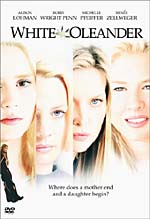
White Oleander chronicles the life of Astrid (Alison Lohman), a young teenager who journeys through a series of foster homes after her mother (Michelle Pfeiffer) goes to prison for committing a crime of passion. Set adrift in the world, Astrid struggles to become her own person while coming to terms with the challenges of living life on her own.
Director:
Peter Kominsky
Cast:
Alison Lohman, Michelle Pfeiffer, Robin Wright Penn, Renee Zellweger, Patrick Fugit
Writing Credits:
Mary Agnes Donoghue, based on the novel by Janet Fitch
Tagline:
Where does a mother end and a daughter begin?
Box Office:
Budget $16 million.
Opening weekend $5.607 million on 1510 screens.
Domestic gross $16.346 million.
MPAA:
Rated PG-13 for mature thematic elements concerning dysfunctional relationships, drug content, language, sexuality and violence.
| |
|
DVD DETAILS
|
Presentation:
Widescreen 1.85:1/16x9
Audio:
English Dolby Digital 5.1
French Dolby Digital 5.1
Subtitles:
English, Spanish, French
Closed-captioned
Runtime: 109 min.
Price: $27.95
Release Date: 3/11/2003
Bonus:
• Feature-Length Commentary By Director Peter Kosminsky, Producer John Wells and Original Novel Author Janet Fitch.
• Enthralling Additional Scenes
• 2 Behind-the-Scenes Visits With the Cast and Creators: "The Journey of White Oleander" and "The Making of White Oleander"
• Theatrical Trailer
• Cast & Crew Highlights
| |
|
EQUIPMENT
|
TV - Mitsubishi CS-32310 32";
Subwoofer - JBL PB12;
DVD Player - Toshiba SD-4700;
Receiver - Sony STR-DE845;
Center - Polk Audio CS175i;
Front Channels - Polk Audio;
Rear Channels - Polk Audio.
| |
[an error occurred while processing this directive]
|
White Oleander (2002)
|
|
Reviewed by David Williams (March 25, 2003)
White Oleander is based on the “Oprah Book Club Selection” and best-selling novel by Janet Fitch and it has all the right pieces in place in order to make it a really good film. It’s got a top-notch cast (Michelle Pfeiffer, Renee Zellweger, Robin Wright Penn, and newcomer Alison Lohman), beautiful cinematography, source material that was given everything but the Good Housekeeping “Seal of Approval”, and surprisingly enough, it manages to capitalize on the toxic and very rocky relationship between self-described artist Ingrid (Michelle Pfeiffer), a resolute and volatile mother and her troubled teenage daughter, Astrid (Alison Lohman).
The relationship between mother and daughter here is very charged and at times, emotionally cruel, as Ingrid is as narcissistic and self-absorbed as they come. Astrid, a loving and obedient daughter, isn’t stupid and she clues in on the volatile tendencies her mother displays. Like an obedient child, Astrid coddles her mom and plays into her hands rather than become a recipient of her wrath. The opposite is also true – there’s never any doubt that Ingrid loves her daughter, but she’s so self-absorbed and egocentric, that she doesn’t see the emotional damage that she’s doing to her daughter in the process.
Early in the film, consumed by passion, Ingrid poisons her unfaithful boyfriend (Billy Connolly) with a ‘White Oleander’ – a flower that’s both beautiful and poisonous - and it also gives the film its name. Anyway, mom is busted and shipped off to prison and Astrid is forced to live out her teenage years going from foster home to foster home to foster home.
In between stays at ghastly state-run institutions, Astrid manages to live in some very “interesting” homes. Her first foster mother is named Star (Robin Wright Penn), a “born again” stripper who seemingly thinks that the Ten Commandments apply to everyone but her; next is Claire (Renee Zellweger), an emotionally fragile and faded actress whose movie-making husband (Noah Wyle) seems to have little interest in her; and last, but not least, she moves in with Rena (Svetlana Efremova), a savvy Russian emigrant with quite a capitalistic streak. Wanting so badly to fit in and to be loved, Astrid tries desperately to fit in at each home she’s ushered in to, although something tragic always seems to happen to cause the new family dynamic to heartbreakingly collapse.
Along with the external forces causing emotional turmoil in Astrid’s life, her mother is still trying to exert her emotionally abusive influence over her as well – even from prison. However, as the film progresses, we see Astrid’s rebellion against her mother and her mother’s wishes for her life, as she works to create her own autonomy and discover her own artistic designs for her life. Using these multiple tragic experiences, we see a battle-hardened child evolve into a self-sufficient, beautiful woman.
Performances are strong in White Oleander from top to bottom, as Michelle Pfeiffer shows up here in more of a supporting role rather than a starring one. Even so, she dominates each and every scene she’s in with her borderline sociopathic/homicidal portrayal of Ingrid Magnussen. Pfeiffer seems to really enjoy herself here and if I have one complaint with her role – and it’s not really Pfeiffer’s fault – it’s the fact that in each and every prison scene, Pfeiffer looks more like she’s spent a wad of dough at a day spa rather than having spent a day in prison. She’s the best damn looking inmate I’ve ever seen.
Alison Lohman makes a strong appearance here as Ingrid’s broken and emotionally drained daughter, Astrid. She holds her own against some Hollywood heavyweights and gives an impressive performance in what was most definitely a very demanding role.
Robin Wright Penn, whose role is a slightly overdone and over-the-top caricature, still manages to evoke strong emotions as what we like to call down here in the South a “WTT” - or more familiar, “white trailer trash”. It’s obvious she has her own demons to deal with and underneath her faux happiness lies a much more disturbed woman than what she lets on. Renee Zellweger is totally compelling as an emotionally needy and very vulnerable actress who’s married to a very aloof and detached husband (Noah Wyle). Later in the film, she has quite an interesting run-in with Ingrid while she and Astrid visit her in prison and much like Wright Penn before her, there’s more to her than meets the eye. Ultimately, both Penn and Zellweger make strong, striking impressions, as does Cole Hauser – Robin Wright Penn’s boyfriend in the film.
Mary Agnes Donoghue has faithfully adapted Janet Fitch’s very popular novel and first-time director, Peter Kosminsky (known more for his made-for-TV films and documentaries), keeps things moving along at a zippy pace that never wears out its welcome - and it ends right about when it should. While I missed White Oleander during its theatrical run and was unfamiliar with Fitch’s novel before preparing for this review, this was quite a nice find on DVD and Warner has definitely done the film justice with their DVD presentation.
|
The DVD Grades: Picture B+ / Audio B / Bonus B-
|
|
White Oleander is presented in a nicely done anamorphic widescreen transfer in the film’s original theatrical aspect ratio of 1.85:1. (Warner also has a fullscreen version of the film available as a separate selection, so make sure that you check the widescreen/fullscreen banner when picking up the disc.) In short, this is simply another in a long line of fine offerings from the studio and Warner does nothing here to sully their fine reputation.
The master print seems to be is excellent condition and overall, the image was very tight, defined, and detailed. The film contained a very bold and vivid color palette with some very intentional and very filter-heavy scenes. White Oleander manages to maintain a somewhat soft appearance by design and it’s evident that grain was not the overriding factor in the vast majority of these scenes. Balance and contrast are right on the money, without any smearing or oversaturation noted and fleshtones were always accurate and very natural looking. Black levels were absolutely solid throughout and allowed for excellent shadow detail and delineation, as well as a very three-dimensional, film-like appearance.
Flaws in the transfer were noted, but none were of the distracting variety or took anything away from the viewer’s enjoyment of the film. Edge enhancement was seen on a few occasions throughout White Oleander, as was a bit of a grain that softened up the image somewhat. (FYI - The opening scroll for the film contained some very noticeable grain and was probably the worst offender of the bunch.) Because the film was so recently released, flakes and flecks on the print were practically non-existent and there were no serious print flaws to be found. Surprisingly, I noted a very quick instance of compression artifacting, but it was of the “blink and you’ll miss it” variety. For the most part, the film looked as it should and fans of White Oleander should be pleased with Warner’s results.
Warner has done another outstanding job handling the DVD technical aspects for one of its films and in the case of White Oleander, everything looks magnificent. The studio rarely missteps when it comes to a video transfer and this one is no different. Very nice job.
Warner presents White Oleander in a surprisingly strong Dolby Digital 5.1 mix in English, as well as French. Given the film’s genre, most of you probably aren’t expecting a whole lot and while White Oleander doesn’t stack up against action blockbusters and the like, it’s somewhat notable considering the genre.
The audio exhibited excellent dynamics and fidelity throughout the entire running time of the film, although most of that was found in the front surrounds. While the rear surrounds were only used for general ambience and for propping up certain aspects of Thomas Newman’s impressive score, the front surrounds got the majority of the workout, as the film was very forward centric. Separation and panning were very discrete, natural, and clean, while dialogue was always front, center, and easily understood at all times. Thankfully, there was never any harshness or edginess detected at any time in the track. Again, Thomas Newman’s score was quite enjoyable and Warner’s transfer really accentuated the pleasing soundtrack.
While there weren’t any impressive or bombastic effects to be found in the film, the mix was notable for the discrete atmospheric effects that were found from time to time. While the rear surrounds could never be considered overly active, there are some very subtle and restrained moments contained within that were quite nice. Not the best I’ve ever heard, but again, very nice for the genre.
If you need ‘em, Warner has also included English, Spanish, and French subtitles.
While White Oleander didn’t do bang-up business at the box office, Warner has still offered up a nice selection of extras in order to supplement the film. While no one would confuse this disc with one of Warner’s other, quite excellent SE’s, it’s still quite a nice selection all things considered.
Starting things off is a Cast & Crew section that lists filmographies for the principals in the film including Alison Lohman (Astrid Magnussen), Robin Wright Penn (Starr), Michelle Pfeiffer (Ingrid Magnussen), Renee Zellweger (Claire Richards), Billy Connolly (Barry Kolker), Patrick Fugit (Paul Trout), Cole Hauser (Ray), and Noah Wyle (Mark Richards). Those listed under the “Crew” section were Janet Fitch (Novel Author), Mary Agnes Donoghue (Screenwriter), John Wells (Producer), Hunt Lowry (Producer), and Peter Kosminsky (Director).
Next is a feature length Commentary with director Peter Kosminsky, author Janet Fitch, and producer John Wells. This was quite a nice selection of participants, but unfortunately, Kosminsky dominates the majority of the commentary. While he offers up some nice insight into many aspects of the film, it would have been nice to hear a few more of Fitch’s thoughts on the film and the adaptation of her book. While screenwriting topics were discussed, I would have simply liked to have heard more and while I think the commentary suffered somewhat because of Fitch’s lack of input, it still offered up a decent dialogue about the film itself. There were admittedly a few slow spots during the commentary, but otherwise, Kosminsky offered up some nice anecdotes from behind-the-scenes, as well as his thoughts on adapting Fitch’s story to the big screen. Fitch discusses being involved with the screenwriting process, while Wells covers general production issues encountered while making the film and while it’s not the best commentary I’ve listened to in a while, it manages to bring out some interesting conversation about the film.
Additional Scenes (5:51) are next and here, we have six deleted scenes that run in succession without any sort of optional commentary from the filmmakers or individual menu selection for the scenes themselves. The scenes were a nice inclusion, as they offered up a bit more insight into Astrid’s relationships with her foster families and while there was nothing earth shattering included, the scenes were all well worth the minimal time investment required to check them out. All of the scenes were presented in non-anamorphic widescreen and it’s obvious no touch-up work was done whatsoever.
I’ll list them together only because they’re so darn similar - The Journey of White Oleander (13:02) and The Making of White Oleander (11:32). Ultimately, both were nothing more than the generic and highly promotional EPK material we’ve all seen time and time again. Clips from the film are interspersed with interview snippets from the principals and clips from behind-the-scenes. Unfortunately, there’s nothing incredibly astounding to be gleaned from these supplements, as they represent nothing more than the standard-fare “First Look” material.
Finishing off the DVD is the film’s Theatrical Trailer and while White Oleander isn’t loaded to the gills, there’s enough here that fans of the book and fans of the film should be pacified. While I would have liked to have seen a bit more about Fitch’s rapid rise to best-seller and “Oprah Book Club Selection”, what’s included was a nice glossing-over of what went on behind-the-scenes of White Oleander. Nice job – as usual – from the folks at Warner Brothers.
I really enjoyed the film although I had never seen it before watching it for review purposes here at DVDMG. While it doesn’t rank up there as a sight-unseen purchase, I’d highly suggest a weekend rental for the curious. If you saw the film in theaters and enjoyed it – or read the book and haven’t seen the film – Warner’s film is faithful to Fitch’s vision and the DVD is quite strong in the areas that matter. White Oleander is quite an easy purchase decision for fans of the story and/or the film itself.
|
|
[an error occurred while processing this directive]
|
|