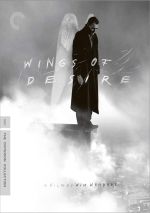
Wings of Desire appears in an aspect ratio of approximately 1.66:1 on this Blu-ray Disc. For the most part, the picture seemed solid.
Sharpness consistently looked fine. No problems with softness cropped up during the film. Instead, it came across as tight and well defined.
I saw no instances of jagged edges or shimmering, and edge enhancement remained absent. The movie used stylized grain and only showed a few source defects. I noticed a handful of barely perceptible streaks and lines, but nothing substantial interfered.
Most of Desire was in black and white, as it went to color only in scenes without angels present and filled little of the film’s running time. The hues were somewhat subdued, which made sense given the restrained nature of the movie, and they looked accurate and smooth.
The black and white imagery was very good. Contrast seemed solid, as those scenes featured a nicely silver presentation.
Blacks appeared deep and dense, and shadows came across as concise and nicely delineated. The minor concerns knocked down my grade to a “B”, but I remained generally pleased with the appearance of Wings of Desire.
Wings of Desire included a DTS-HD MA 5.1 soundtrack, as the soundfield remained generally subdued. The front spectrum featured most of the audio and mainly displayed general ambience.
Scenes with lots of voices enjoyed good localization and melding. Music demonstrated decent stereo delineation, which the surrounds reinforced acceptably.
A few effects featured some nice movement, such as one with a helicopter, but they mostly stayed with light ambience. The surrounds echoed the front and didn’t do much more than contribute to the atmosphere.
The quality of the audio appeared good. Speech came across as natural and distinct, and I noticed no issues related to intelligibility or edginess.
Music seemed restrained but full, with clear highs and acceptably rich lows. Effects seemed clean and accurate and also demonstrated decent dynamics. There wasn’t much to this track, but it appeared fine for this sort of material.
How did the Blu-ray compare with the 2003 DVD? Both discs came with similar soundscapes, but the lossless nature of the BD’s audio gave it greater range and warmth.
As for the visuals, the BD demonstrated the usual step up in terms of delineation and blacks. This became a positive upgrade.
The Criterion Blu-ray mixes old and new extras, and we open with an audio commentary from director Wim Wenders and actor Peter Falk. The track comes from interviews conducted in the mid-1990s, so it’s not a running, screen-specific affair.
Don’t expect much from the actor. Falk occasionally makes a comment about his role, especially in regard to the absence of a script, but appears very infrequently and he doesn’t tell us much.
Happily, Wenders fills the rest of the time fairly nicely. He covers the origins of the film and relates why we made the flick. Wenders also discusses the general looseness of the virtually script-free production, visual elements, and other notes like his thwarted attempt to shoot in East Berlin.
The commentary lags at times and occasionally seemed somewhat somnambulant. Nonetheless, Wenders still helps educate us reasonably well about his movie.
Next we find a 2003 documentary called Angels Among Us. This 43-minute, nine-second piece includes remarks from Wenders, Falk, writer Peter Handke, actors Bruno Ganz and Otto Sander, composer Jurgen Kneiper, and City of Angels director Brad Silberling.
They offer a pretty solid general overview of the production. We get notes about its origins and the loose script as well as the characters, casting, visual look of the film, various anecdotes, the score, the flick’s legacy, and other elements.
“Angels” moves at a good pace and goes over all the appropriate topics in a logical and concise manner. “Angels” provides a very nice examination of Desire
Nine Deleted Scenes occupy a total of 32 minutes, 13 seconds, and they come totally accompanied by commentary from Wenders. In an unusual touch, you can’t watch the scenes without Wenders’ remarks, and there’s almost no background audio other than score..
This makes the clips somewhat less useful, but most of them seem like general impressionistic images anyway, so the absence of audio causes no problems. A few of the clips actually fall more into the “outtake” category anyway.
We find things like some clowning from Sander, shots of a rare female angel, and many other snippets. None of these seem very interesting as they consist of little more than basic imagery without anything more substantial to them.
Wenders contributes some decent anecdotes from the production but since the scenes don’t deal with plot for the most part, he doesn’t tell us a lot about their potential integration into the film.
Heck, even the director seems to get a little tired of the never-ending outtakes after a while, though he does challenge viewers to create their own new cut of the movie with some of them reintegrated.
We also find six minutes, 50 seconds of actual Outtakes. Accompanied solely by music, these feel similar to the deleted scenes, so I can’t quite figure out why they got relegated to “outtakes”.
In any case, the absence of source audio makes them less useful than I’d like, especially because we get no commentary to discuss them.
Two features look at the film’s cinematographer. Shot in November 1985, Alekan ‘85 gives us excerpts from an unfinished documentary about director of photography Henri Alekan.
This piece goes for 10 minutes, 16 seconds and looks at Alekan’s thoughts about filmmaking. A few decent notes emerge but the chat doesn’t become especially engaging.
Also from 1985, an excerpt from Alekan la lumiere fills 27 minutes, 11 seconds and provides a “hands-on” look at Alekan’s work. We see Alekan go through his choices for one specific scene, and we examine other instances of his photographic choices. This turns into an effective segment.
With Remembrance, we get portions of a 1982 film about actor Curt Bois. It goes for 29 minutes, 42 seconds and shows Bois as well as Ganz and Sander.
In a loose format, we get notes about Bois’s life and career. It never becomes the most insightful look at the actor, but it seems moderately interesting.
A February 1987 episode of Cinema Cinemas runs nine minutes, 24 seconds and provides comments from Wenders. He gives us a few notes about the film but doesn’t say a lot of interest.
However, the reel includes nice views from the shoot. These make it worthwhile.
The set includes two trailers. We see the German theatrical promo as well as one call “Wen Wunderts”.
Finally, we find a booklet that mixes photos, credits, an essay by critic Michael Atkinson and writings by Handke and Wenders. It concludes the set well.
Visually terrific but without much else at work, Wings of Desire scores some points because it doesn’t beat the viewer over the head with its themes or ideas. However, it goes a little too far in the opposite direction and fails to produce much more than lovely imagery. The Blu-ray provides good picture quality, low-key but acceptable sound, and a nice package of supplements. This fine Blu-ray will make those who love Desire very happy, although it may not create many new fans.