Reviewed by Colin Jacobson (October 7, 2026)
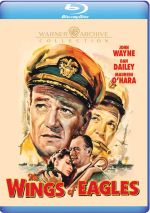
US Navy veteran Frank Wead wrote the screenplay to John Ford’s 1945 flick They Were Expendable. 12 years later, Ford turned the camera on Wead’s life and career via 1957’s The Wings of Eagles.
After the conclusion of World War I, Frank “Spig” Wead develops an interest in military aviation. He actively promotes the usefulness of aerial combat to his Navy superiors.
This helps him advance in his career but it damages his marriage to Min (Maureen O’Hara) as well as other elements of his personal life. Eventually Spig becomes paralyzed but he continues to find other ways to serve his country as he goes through recovery.
Unquestionably, the real Wead led a remarkable life. Unfortunately, Eagles fails to give us a particularly evocative take on the man.
Going into Eagles, I feared Ford would “soft soap” the story because of his connection to Wead. Given their relationship, I thought perhaps Ford would sand down any roughness involved.
To my surprise, Eagles plays up conflict in Wead’s life, mainly as these issue relate to his marriage. We see how his focus on work impacts his connection to Min and his kids.
That said, Eagles doesn’t paint Spig as uncaring or aloof. He comes across as genial but just unable to easily discern the damage his career has on his family.
Which actually makes him seem somewhat like an idiot given how angry and bitter Min appears. Poor O’Hara gets little to do here other than scowl and act exasperated.
Ford doesn’t appear especially interested in Spig’s home life beyond some basic melodrama anyway. Min and the kids come up when the movie wants some overbaked conflict and that’s about it.
For its first act, Eagles cranks at a relentless pace that leaves little room to absorb the characters. This makes it tough to connect to Spig or the rest.
Once his injury leaves Spig paralyzed, Eagles slows down massively. The film then spends more time on Wead’s physical therapy than his home life.
We dig into how Wead adjusts and develops new skills. Again, Ford feels way more interested in this area, perhaps because it involves his own experiences with Spig.
Indeed, Eagles includes a film director called “John Dodge” (Ward Bond). You get no credit if you figure out he exists as a barely-disguised version of Ford himself.
“Dodge” indeed! Well, at least Ford didn’t call him “John Cadillac”.
Not much of this feels especially compelling. I can’t quite figure out how a life as accomplished as Wead’s ends up as such a dull biopic.
Wayne offers his usual manly performance, though he was much too old for the part. 50 at the time of the production, Eagles asks him to play Wead at 23!
This might explain why Ford rushes through Wead’s early career, though given Spig died at 52 in 1947, Wayne doesn’t catch up until the film’s 1945 finale. Of course, Wayne isn’t the first actor to play a much younger character, but the generation gap becomes a bridge too far at times.
Even with a more age-appropriate lead, Eagles would become a surprisingly blah drama. It makes a remarkable man’s life seem strangely uncompelling.
Trivia note: as most know, Wayne wore a hairpiece for much of his career. We get to see him sans rug when he plays a balding Wead.