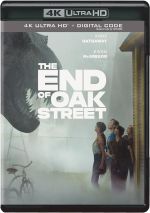
Reviewed by Colin Jacobson (November 1, 2026)
Ever since 1993, the Jurassic Park franchise has dominated movies that involve dinosaurs. Nonetheless, moviegoers find the occasional “competitor”, and 2026’s The End of Oak Street winds up in that category.
In Michigan circa 1982, Greg (Ewan McGregor) and Denise Platt (Anne Hathaway) endure an increasingly unhappy marriage for the sake of their teen kids Audrey (Maisy Stella) and Brian (Christian Convery). However, when solar flares create odd anomalies in the area, they find other issues that take priority.
Before long, the Platts find their suburban neighborhood smack dab in a prehistoric landscape populated with dinosaurs and other threats. They need to struggle through these challenges to figure out how to survive and return to their own timeline.
No one will call End writer/director David Robert Mitchell a prolific filmmaker. He debuted with 2012’s “coming of age” tale The Myth of the American Sleepover and then created 2014’s It Follows and 2018’s Under the Silver Lake.
None of these made much of a dent at the box office, though thanks to its miniscule budget, the $22 million Follows made meant it turned a tidy profit. End’s $122 million worldwide makes it easily Mitchell’s highest-grossing flick, though its roughly $85 million budget means it didn’t go into the black.
As implied earlier, it feels like a challenge for dinosaur movies to separate themselves from the seven Jurassic flicks to date. To its credit, End doesn’t really attempt to compete with those mega-blockbusters.
Even though the Jurassic movies involve characters about whom we care – well, sometimes – they exist more as action spectacle than human drama. End leans more in this latter direction.
Not that it lacks violent chompin’ material, of course. While not as elaborate or dynamic as the Jurassic flicks, End manages some excitement at times.
Perhaps not as much as genre fans might prefer, however, as we get a greater focus on the family dynamics. These elements work fine, though they can make End feel a bit like a tale uncertain of which genre it wants to pursue.
We get too much interpersonal drama for an action flick and too much dino mayhem for a character piece. Mitchell gets his chocolate in our peanut butter but the end result doesn’t taste especially great.
That sounds harsh and a bit snarky, I admit. I don’t want to view End as a bad flick, for it works mostly fine.
Perhaps I entered the movie with expectations for something that I didn’t get. End enjoyed very good reviews and I thought it’d bring a lively twist on the genre.
After all, the Jurassic flicks have come with diminishing returns. While they all still come with enough dino action to keep our attention, they tend to feel a bit uninspired.
The setting of End brought a twist, especially given that the Jurassic movies never brought us the “dinosaurs run rampant in the US” that we always expected. Oh, 1997’s Lost World delivered a segment in Southern California but that existed as a coda and didn’t really explore the theme much.
2022’s Jurassic World: Dominion did show co-existence between humans and dinos in civilization. However, this didn’t become a real plot point, as the concept existed in the background.
All this means we never got a full Jurassic flick that embraced mayhem in a Godzilla vein. End pursues that concept.
Albeit on a limited scale, as End sticks with its little suburban domain. The movie makes it clear that the solar flares only impacted this one neighborhood and didn’t become a global concern.
That gives the movie a small focus that seems satisfying. Not everything needs to follow a massive scale to succeed.
As implied, the issue comes from the inconsistency of tone – or the way Mitchell handles the tone, at least. End clearly chooses 1982 for a reason: to go all Spielberg on us.
Thanks to ET the Extra-Terrestrial and Poltergeist, Steven Spielberg dominated the summer of 1982. The decision to set End in the summer of 1982 feels less than coincidental, especially because the film often plays like a Spielberg flick.
The Spielberg of 1982 would’ve knocked End out of the park. The Mitchell of 2026 struggles to achieve the same success and that results in a somewhat muddled tale.
I do think the first act works well as it sets up the characters and events, but the second act loses a lot of momentum. The flick rebounds to a decent degree in its final third, but even then a few issues arise.
These tend to stem from the contrived ways the film places the Platts in harm’s way. Granted, End makes it clear there’s nowhere in the neighborhood immune from the dino threat, but even so, the characters’ choices often seem illogical and they exist just to create threats.
Arguably my biggest complaint here comes from the filmmakers’ decision to neuter the movie’s biggest emotional scene. To avoid spoilers, I won’t say more, but the ending undoes the flick’s most shocking moment.
This seems like a big mistake to me. I get that they wanted to give End a big happy finale but it feels like a complete cheat.
All of these criticism aside, I do find a fair amount to like here, mainly when Mitchell digs into the action. We get some very tense and effective dino-based set pieces along the way.
And the actors all do well. We get a couple of overqualified lead actors – even if McGregor still can’t do a credible American accent –and they bring depth to the proceedings.
As much I wanted to love End, though, the ups and downs leave it as a mixed bag. While I find enough positive to offer a guarded recommendation, the film doesn’t fully satisfy.