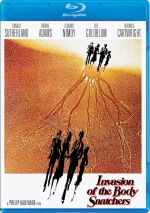
Invasion of the Body Snatchers appears in an aspect ratio of approximately 1.85:1 on this Blu-ray Disc. While dated at times, this was usually a satisfying presentation.
Sharpness showed few concerns. A smidgen of softness crept into a few wider shots, but those examples were minor. Instead, the movie usually looked detailed and well-defined.
No issues with jagged edges or shimmering materialized, and I noticed no edge haloes. In terms of the source print, it showed natural grain and it lacked print flaws.
Colors tended to lean a bit heavy, as we got an amber/teal vibe at times as well as facial complexions that could seem somewhat ruddy. While the hues usually looked fine, these instances made them appear a bit off.
Shadows became concise but blacks could come across as somewhat crushed at time. Though more than watchable, the Blu-ray turned into something of a mixed bag.
Next came the surprisingly ambitious DTS-HD MA 5.1 soundtrack of Invasion, with a mix that emphasized the forward channels. Audio spread fairly well across the front channels, but localization of effects seemed somewhat mushy and ill defined at times.
I thought the soundfield lost a few points due to some flawed placement of elements. Most of the stems came from the appropriate spots, but occasionally some pieces popped up on the wrong side.
Some bits that should have come from the left appeared on the right and vice versa. These tendencies occurred infrequently, but they created enough distractions to rob the audio of some appeal.
The rear speakers offered moderate levels of activity, though the elements remained moderately ill-defined. Still, the overall package was considerably more involving than I’d expect for a film from 1978.
Audio quality was also somewhat flawed but decent for the era. Speech sounded acceptably natural and without notable edginess.
Effects presented fairly accurate and distinct elements, with only some mild distortion at times. The score appeared to show similar qualities, as the music sounded acceptably clear and vivid. The wonky localization knocked some points off of my rating, but I still thought the track held up well after 48 years.
How did this 2022 Kino Blu-ray compare to the prior BD from 2010? Both showed largely similar – if not identical – 5.1 soundtracks.
While the 2022 Blu-ray cleaned up specks from the 2010 disc, it also came with a heavier sense of colors and less concise blacks. I regarded it as a toss-up which one fared better because both came with ups and downs.
The disc comes with two audio commentaries, the first of which comes from director Philip Kaufman. He provides a running, screen-specific look at visual choices and the film’s tone, updating the original flick and storytelling decisions, shooting in San Francisco, various effects, camerawork, cast and performances, and a few other production issues.
Though Kaufman’s chat never threatens to become great, the director does offer a pretty good examination of his flick. Kaufman covers matters to a satisfying degree and provides some nice insights.
This does come with more than a few slow spots, though, especially during the movie’s third act; Kaufman often goes MIA at that time. Otherwise, he fleshes out the material to create an informative chat.
For the second commentary, we hear from film historian Steve Haberman. He provides a running, screen-specific talk about the source story and the 1956 film adaptation as well as cast and crew.
Haberman spends too much time on the 1956 movie, as he actually tells us more about its production than he does the creation of the 1978 version. He also devotes many minutes to basics about the cast and crew that add up to little more than basics we could get from IMDB or Wikipedia.
Prior Haberman commentaries often worked well, but this one turns into a sluggish dud. He just doesn’t dig into the movie in a satisfying manner and his persistent mispronunciations of names become an irritant.
From the prior release, we get a series of featurettes. Re-Visitors from Outer Space, or How I Learned to Stop Worrying and Love the Pod goes for 16 minutes, 15 seconds and involves Kaufman, screenwriter WD Richter, director of photography Michael Chapman, The Writer’s Journey author Christopher Vogler, and actors Donald Sutherland and Veronica Cartwright.
“Pod” looks at the original story and its adaptations, notes about the 1956 version as well as decisions made when the 1978 remake emerged. In addition, “Pod” examines the San Francisco setting and context, themes, cast, characters and performances, and the film’s ending.
“Pod” doesn’t offer the most concise examination of the production, but it gives us plenty of good notes. It covers the requisite issues with charm and brings us many interesting tales about the shoot. Too bad Brooke Adams doesn’t pop up to settle the debate about who won her footrace with Sutherland.
Next comes the four-minute, 39-second Practical Magic: The Special Effects Pod. It features Kaufman and space sequence special effects artist Howard Preston.
We learn about how the filmmakers created the alien landscape, the space sequences, and the early pod shots. We get some decent notes, though it seems odd that we hear nothing about special effects that appear after the movie’s opening.
The Man Behind the Scream: The Sound Effects Pod lasts 12 minutes, 48 seconds and includes special sound effects creator Ben Burtt. He tells us a little about his job description and gets into details of his work on Invasion.
We also get some remarks from Kaufman and supervising sound editor Bonnie Koehler in this excellent little examination of the movie’s audio. It’s a fine synopsis of the various sound elements and goals.
Finally, The Invasion Will Be Televised: The Cinematography Pod fills five minutes, 24 seconds. It brings comments from Vogler, Kaufman, Chapman, and Richter.
They discuss the movie’s camerawork and visual design aspects. More good notes pop up here, as we find a mix of useful details in this short but tight show.
From there we get five featurettes new to the Kino release, and Star-Crossed in the Invasion spans nine minutes, seven seconds. Actor Brooke Adams shows up here.
The actor discusses how she got her role as well as her memories of the shoot. Though this seems like a brief chat, Adams nonetheless offers a good collection of thoughts.
Re-creating the Invasion occupies 15 minutes, 45 seconds. Screenwriter WD Richter appears for this one.
Richter tells us about his adaptation of the source along with his collaboration with Kaufman and his experiences during the production. The screenwriter gives us an appealing view of his work and offers some interesting stories as well
Unsurprisingly, Scoring the Invasion features composer Denny Zeitlin. His chat lasts 15 minutes, 35 seconds.
Also unsurprisingly, Zeitlin what brought him to films plus specifics about his score for Invasion. Zeitlin offers a vivid and enjoyable take on these domains.
Leading the Invasion goes for 25 minutes, four seconds. Actor Art Hindle sits for this interview.
Hindle discusses his character and performance and recollections of the production as well as some of his other films. The actor boasts a nice mix of insights and enjoyable anecdotes.
For the final new featurette, we go to Writing the Pod. It runs 11 minutes, 16 seconds and gives us thoughts from historian Jack Seabrook.
Novelist Jack Finney becomes the focus of “Pod”, as Seabrook tells us about the author and aspects of his original work. Seabrook delivers a quality biography.
In addition to 10 Radio Spots and two TV spots, we get trailers for the 1978 Invasion as well as for The Puppet Masters and The Wanderers.
Film fans can argue whether 1978’s Invasion of the Body Snatchers fares better or worse than its 1956 precursor. All I know is that the remake stands on its own as a creepy, chilling horror story. The Blu-ray demonstrates generally positive picture and audio along with a solid roster of bonus materials. The 1978 Invasion remains an unnerving tale nearly 50 years after its release.