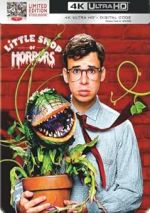
Little Shop of Horrors appears in an aspect ratio of approximately 1.85:1 on this 4K UHD Disc. Given its era, I didn’t expect much from the film’s Dolby Vision presentation but thought the image looked pretty strong.
Sharpness was usually solid. A few soft shots occasionally appeared, but the majority of the flick appeared nicely distinctive and concise.
No issues with shimmering or jaggies occurred, and edge haloes remained absent. Grain seemed appropriate and print flaws failed to materialize.
In terms of colors, Shop tended toward a fairly peppy palette. In particular, the costumes could deliver some dynamic hues, and the 4K UHD reproduced them in a lively manner, with a nice boost from HDR.
Blacks felt dense and dark, and shadows showed positive clarity and fullness. HDR added impact to contrast and whites. This wound up as a satisfying image.
Downconverted to Dolby TrueHD 7.1, I also thought the film’s Dolby Atmos soundtrack worked well. As one might expect, music dominated the mix, as the songs and score spread to the various speakers in a satisfying manner. These showed good localization and integration, as they allowed the track to use all the channels in a lively manner.
The rest of the mix seemed more restricted. Some elements – mostly related to Audrey II – managed to expand to the different areas, and a few additional bits – chattering crowds, vehicles, street noise – added to the experience. However, music remained the most important aspect of the soundscape.
Audio quality was fine overall. Speech usually sounded natural and concise.
Music was the strongest aspect of the track, as the songs and score came across as dynamic and perky. Effects were reasonably accurate, with only a little roughness, and bass response was fine. The audio worked nicely for the movie.
How did the 4K UHD compare to the Blu-ray version? The UHD’s Atmos remix seemed a bit bolder and more involving than the BD’s 5.1.
The UHD’s Dolby Vision image offered improvements in accuracy, colors and blacks, and it also lost the minor print flaws of the BD. This turned into a pleasing upgrade.
When we shift to extras, the main attraction comes from the presence of both the film’s theatrical version (1:33:53) and its Director’s Cut (1:43:11). The difference comes from the DC’s ending.
A darker conclusion that audiences hated, it runs longer due to this alternate conclusion. Note that the two versions remain identical until the plant attacks Audrey.
That’s where the two start to diverge. Both contain some of the same elements, but many changes occur.
Do I prefer one to the other? Not really.
The Director’s Cut is certainly a whole lot more apocalyptic and extreme, which makes it interesting. That said, the happier ending of the theatrical version works perfectly well on its own.
In fact, while the DC’s conclusion stays true to the original stage production, I actually think the 1986 ending probably fits the story better. Yeah, it’s a compromise to commerce, but it feels more “right” to me; Shop just seems like a flick that should come with a happy ending to me. Whichever you prefer, it’s nice to have the choice.
Alongside the theatrical version, we locate an audio commentary from director Frank Oz. Recorded for a 1990s DVD, he provides a running, screen-specific look at story/characters and the adaptation of the stage production, cast and performances, sets and production design, various effects, musical numbers, camerawork, the alternate ending and a few other subjects.
In my experience, Oz’s commentaries tend to be hit or miss, but this one works well. Yeah, Oz can be a little dry at times – and he gets obsessed with describing frames-per-second variations - but he nonetheless covers a wide range of movie-related subjects.
Oz does so in an efficient, informative manner. Oz delivers more than enough solid film facts to make this a good track.
Frank Oz and Little Shop of Horrors: The Director’s Cut runs 10 minutes, 40 seconds and includes notes from Oz and model department visual effects supervisor Richard Conway. They discuss aspects of the original ending and its creation.
Some of this touches on the reasons why the DC’s finale got the boot, but most of it looks at the effects, which is a good choice. We’ll hear more from Oz about controversies later, so I’m glad we get useful nuts and bolts material here.
A program created back in 1986, The Story of Little Shop of Horrors lasts 23 minutes, three seconds. It offers info from Oz, original film producer Roger Corman, 1986 producer David Geffen, Audrey II designer Lyle Conway, and actors Rick Moranis, Ellen Greene, and Tichina Arnold.
The piece looks at the 1960 Shop, the Off-Broadway show, and the project’s move to the big screen. We also hear about sets and locations, cast and performances, the Audrey II puppet, and some general thoughts.
Nothing major pops up here, as “Story” exists for promotional reasons. Nonetheless, it has enough useful material to merit a look.
Two new featurettes crop up on the 4K UHD, and To Feed or Not to Feed spans 14 minutes, 39 seconds. It gives us statements from Oz, Greene,
The reel looks at what brought various participants to the project, Oz’s approach, cast and performances, and various aspects of the shoot. Some of this repeats from prior pieces but it becomes a pretty enjoyable summary nonetheless.
Mean Green Mother lasts eight minutes, 23 seconds. Here we find info from Oz, Greene, special visual effects artist Bran Ferren, model unit supervisor Richard Conway,
We learn about the creation of Audrey II. A bit of this also echoes other chats on the disc but it still delivers enough new info to deserve a look.
Under Outtakes/Deleted Scenes, we get a reel that fills a total of eight minutes, 41 seconds. You can ignore the claim that we get deleted scenes, as this is just a basic blooper reel. It’s more fun than most, however.
We can watch the “Outtakes” with or without commentary from Oz. He offers some rudimentary remarks but little of interest.
If you don’t choose to watch the full version, you can check out the Director’s Cut Ending on its own. It goes for 22 minutes, three seconds and can be viewed with or without commentary from Oz. That’s an improvement over the Blu-ray, as the BD only let you watch with Oz’s notes.
Anyway, I’ve already discussed the Director’s Cut, so I’ll focus on Oz’s commentary. He covers aspect of the sequence’s creation as well as the reasons it got cut.
He went over the latter in the main commentary, but he offers a bit more detail here, and the additional notes about the creation of the alternate ending usually become interesting. Oz gets hung up on frame rates again, but otherwise he delivers an informative chat.
Though two trailers appeared on the BD, they don’t reappear here.
A quirky and generally likable movie musical, Little Shop of Horrors delivers a fun experience. It combines an odd story with good songs and many delightful performances to become a generally strong effort. The 4K UHD brings us positive picture and audio along with a good array of supplements. I’m not much of a musicals guy, but Shop works for me.